
The State of MLS Analytics: 2026
/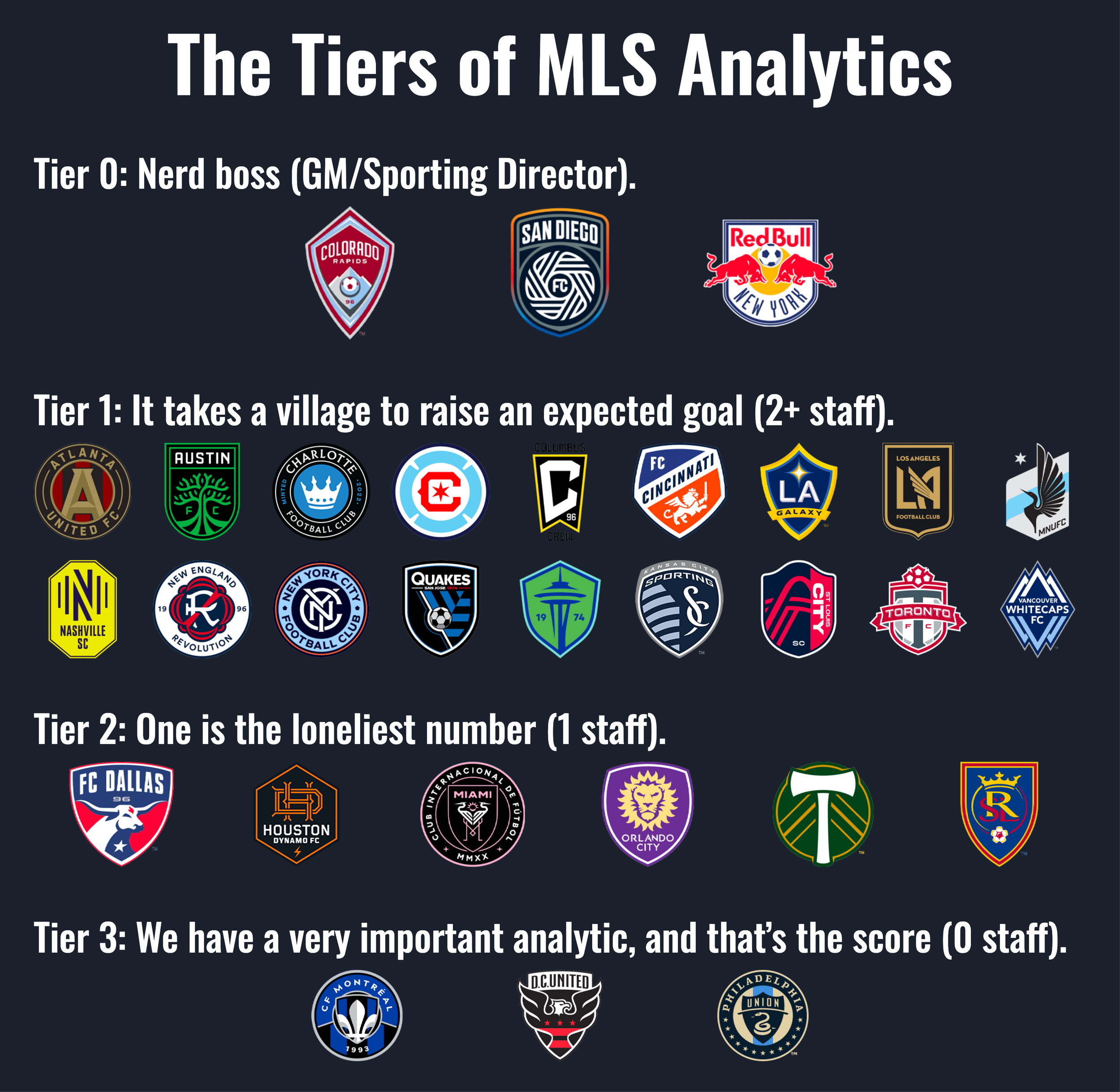
Thirteen years ago when we started ASA, if an MLS club had one person “doing analytics” it was a big deal. Now a majority of clubs have multiple full time employees in actual analytics departments, and a team is seen as backwards if they don’t have at least one staff member primarily focused on game analytics. Every year, we comb team websites, LinkedIn, and ask those who would know about how many people each team employs to determine The Tiers of MLS Analytics.
Former ASA Contributor Kevin Minkus, now Director of Analytics for Chicago Fire, wrote Soccer Analytics 101 over at MLSsoccer.com where he defined analytics as “using data and statistics to better understand something.” For the purposes of deciding what MLS teams have an analytics staff member the “something” is player recruitment and tactical analysis. We’re talking about using numbers and mathematical models (e.g. xG, xA, g+) to help evaluate transfer targets and team and player performance.
The starting point here is math, not video, although video and the eye test will always be an important step in the process. We’re defining this as separate from sports science, where data and statistics are used to mainly evaluate a team’s own players’ physical performance, things like training loads and injury prevention. Furthermore, it is different from business analytics where data and statistics are used to drive more monetary value for a club, but is not focused on the sporting side even though they may contribute there as well.
There is no doubt that MLS staff members wear multiple hats. Just because you have the job title of “data analyst” doesn’t mean you won’t be recruited to film a training session, break down video, or drive new players to Canada to get a visa. Similarly, a sports scientist, video analyst, or performance analyst may spend part of their time looking at statistics or even coding. But there is a difference between using analytics as part of your job and analytics being your job, and for this we will be counting the latter.
As a reminder, we only count full-time employees - not interns or part time employees - for the tiers, but if we know of them they may get a mention.
Based upon public knowledge and some private communications, and knowing full well that anyone outside a club can’t really know what is going on inside (if we missed anyone or got a job title wrong, please reach out), here are the Tiers of MLS Analytics and what we know about each team as of November 2026. The league continues to move in the right direction, nine teams have moved up at least one tier and only one team moved down.
Read More