
The 2026 MLS SuperDraft ASA Big (Dash)Board
/By Paul Harvey
The MLS Superdraft in many ways kicks off the offseason, as most teams have yet to make any real signings. Even though many of the draft picks will never play for their respective first teams, it still marks the beginning of a period of excitement and analysis, as hope springs eternal for every team in MLS.
As part of that, I have continued my project of analyzing the draft for the best available players. Last year, we divided the best players by data into three tiers. Of the 19 tier one players, 15 were drafted and 6 were taken in the top 10. That cohort saw 5 players play more than 1000 minutes in MLS last season, with players like Manu Duah and Tate Johnson being the highlights. Many went on to dominate in MLS Next Pro or USL, like Michael Adedokun, Nick Fernandez, and Emil Jaaskelainen.
Some tier 2 and 3 players were successful, but fewer - San Diego’s Ian Pilcher or Minnesota’s Logan Dorsey both had a good deal of success, even beyond some Tier 1 players. Of the 49 players drafted who were not in any of the three ASA tiers, only a handful saw MLS time, and none played more than 300 minutes. This suggests that the analysis does reflect real differences in quality between the players.
The Teams:
Draft picks are not an ideal way to build an MLS roster; a team with 11 draft picks on the field is not going to win many games. Instead, it’s about filling in the lower part of the roster. There’s a number of ways of doing this, but the draft offers a cheap and reliable way of doing so. Some teams, like Philadelphia, don’t need to do this, because they have a consistent and reliable talent pathway through their academy. San Diego, an expansion team with no academy system in place to provide those players for the opening season, got a lot of run through the draft. If you can’t do either of these, you end up paying a lot of money for the same amount of points. This is in some part why there tends to be virtually no correlation between total salary and points in MLS. It’s not about having the highest paid players, but squeezing every drop from every talent acquisition method. Even Inter Miami, Messi and Friends FC, who did they bring on to see out the MLS Cup Final? 2024 Superdraft 15th overall pick, Yannick Bright.
Here’s a look at how teams are getting production from the bottom half of their rosters - players who are getting paid less than 400K per year in salary, and were under the age of 25 when the season started (if the embed doesn’t work for you, click here):

As you can see, some teams get a lot from these players. Teams like Philadelphia. Columbus, and Vancouver thrive on having a roster of young contributors for cheap. When you can get those contributors, that frees up salary budget to be used elsewhere. Some teams, like Houston, have those young contributors but struggle to make the most of their signings up the roster table. Still, having the foundation means that when those signings do hit they’ll be in good position.
At the same time, these lower-half spots make up the bulk of Montreal’s minutes. That’s a recipe to save money in MLS, but it’s not a recipe for winning. Curiously, none of Montreal’s players in this group came from the college ranks. They drafted Michael Adedokun in 2025, who went on to have a great season with Lexington on loan; unfortunately, Montreal already let him leave to join Lexington permanently.
The Data:
The plethora of per 90 stats that Wyscout provides are broken down into specific subcategories, to help get a picture of what each player does and how they approach the game. Positions were combined into broader positional groups, based on the typical way most drafted players translate. For example, wingers, wingbacks, and fullbacks all tend to be more defensive players at the next level. The Wing Player catch-all group puts them together.
The following are the subcategories of the metrics:
Control: A player’s attempt to control the possession without losing the ball. Factors include offensive duel losses, pass completion percentage, back/lateral pass completion.
Progression: A player’s attempt to advance the ball into more dangerous areas. Factors include progressive passes and carries.
1v1: A player’s attempt to take opponents on and beat them. Offensive duels, dribbles, and fouls received are factors here.
Unlocking: A player’s attempt to break through either behind the defensive lines or inside the penalty area to create a shot. Factors include crosses, through balls, and shot assists (key passes).
Finishing: A player’s attempt to score goals via shots.
Proactive Engagement: Duel numbers are tricky, but this measure attempts to measure physical engagements with opposing players in both frequency and outcome.
Reactive Engagement: This reflects plays on the ball that do not require a physical engagement with an opponent. Factors include clearances and interceptions.
Player Comparison:
One new addition this year was a style comparison between players from NCAA soccer and the top five European leagues, using cosine similarity across a number of key metrics. By comparing players with their more visible counterparts, it can help connect the way the player approaches the game in the eyes of the viewer, allowing for a quicker understanding of the player. Of course, there are limits to this; for example, a player may profile like Kevin De Bruyne at the NCAA level, but at the next level there is little chance they would get the freedom or usage to play the same way. In the end, it’s a lightweight comparison more meant for fun than anything else.
Here’s the data, embedded for convenience. This dashboard can be navigated in numerous ways, and will be updated after the draft with up to date information about who was taken.

Worth mentioning - this contains all players in D1 in Wyscout’s database with more than 400 minutes, so if you are a college coach looking for players in the transfer portal, enjoy.
The “Role Score” is a weighted calculation of the different statistical factors, with the weights determined by a player’s best fit role. Of course, there are players who fit strangely into roles and will likely find a different home in MLS. The role scores still break down into a rough projection of how likely a player is to translate to the next level:
80+: Elite in multiple areas, one of just a handful of top level players - just six in this year’s eligible class
75-80: Exceptional in comparison to peers, with either particular elite strengths or broad base of high level skills. Likely to be MLS contributors or high level lower level players. 18 in this year’s class
70-75: Strong candidates for MLS roster. 27 in this year’s class
65-70: Outside candidates for an MLS roster, but may have individual skills that could translate. 33 players in this year’s class.
Below 65: Not predicted to have an extensive pro career, but with the right fit and skill development could still do so.
ASA Stamp of Approval:
Because the dropoff in quality in the draft can be steep, rather than place draft-eligible players in tiers this year there will simply be one tier with fewer players total. These represent the best players as identified by the data; this doesn’t necessarily mean they are the best players overall, especially in positions like center back where the data doesn’t provide a complete picture. At the same time - if there is a player that is missing from this list despite broader accolades, the role score and subcategories can provide a complete picture as to why that might be.
Center Forward:
This isn’t as strong of a center forward class as prior years, but there’s excellent top end talent. Generally, the best players in this group are younger, and might have a longer path to the first team.

Junior Diouf, Grand Canyon, Freshman
Diouf is very young and would need to sign a Generation Adidas contract to make the jump. His numbers are absurd, with elite 1v1 ability, progression, and shooting relative to the field. He’s by far the biggest prospect in the draft. He may be a little raw, but as a 2007 birthday, he’s got plenty of runway for a potential sale to Europe before age 21.
Daniel Burko, Hofstra, Senior
Burko is the most pro ready striker, even if his ceiling is a little lower than Diouf’s. The Norwegian forward is physically ready in all aspects for the pro game as he has breakaway speed as well as the height and physicality to dominate in the box.
Blake D’Agostino, Cal Baptist, Sophomore
D’Agostino doesn’t have as much shot volume as some of the other forwards, and is not nearly as involved in possession. At the same time, he’s a great downhill transition forward who can take players on, create his shots, or improve the chances he’s getting.
Honorable Mentions
Mitchell Baker, Georgetown, Sophomore
Wide Forward:
Wide Forwards are more frequently called upon to do more in transition than the classic center forward, with a higher emphasis on winning 1v1 battles outside and creating more chances. NCAA wide forwards are players who are less likely to make the jump to fullback, and more likely to continue on as major goal scoring threats.

Richie Aman, University of Washington, Senior
Aman frequently drifted all over the field for Washington, and was their main chance creator; at the same time, he profiles as a wider attacker at the next level due to his prodigious 1v1 ability. His closest matches are Adama Traore, Estevao, and Yan Diomande; he loves to take on opponents and he attacks the cutback zones before turning the ball back to create chances.
Stefan Dobrijevic, Akron, Senior
Dobrijevic is a well rounded forward with an unusual slant towards creating. He’s got a classic forward’s frame at 6’2”, and is a domestic signing. His ability to create chances as well as get shots for himself could prove useful in MLS.
Honorable Mentions
David Raphael, San Francisco Dons, Sophomore
Osei Gyamfi, UNC Wilmington, Sophomore
Enzo Dovlo, UNC Greensboro
Attacking Midfielder/Deep Forward:
Although the traditional 10 and a deeper lying forward are very different positions, in actuality it’s hard for them to be separated just by using Wyscout data. This position group tends to have players who played centrally, but will likely be forced wider into half spaces or deeper into traditional holding midfield positions.

Edouard Nys, UIC, Junior
For a good portion of the charts on the discovery page, Edouard Nys pulls a “Top Right Messi”. He’s an extremely balanced attacking player with super high marks in progression, chance creation, and scoring. He balanced super high usage in the final third with efficient risk taking in his first season in Division I. If a player was putting up similar numbers in any professional league near MLS, they’d be a clear cut DP candidate; for Nys, it’s about convincing a team to invest in him. As an international and high usage attacker, he may be forced to change his game to find his fit.
Ransford Gyan, Clemson, Sophomore
Gyan has been one of the most exciting non-MLS prospects in America since high school. He was a two time Gatorade national player of the year and absolutely hit the ground running. His sophomore year, Clemson as a whole took a step back, losing in both the ACC and NCAA tournament in the first round. Gyan still played well, but the fact is that he’s an international, a very high usage attacker, and doesn’t seem likely to grow past his listed 5’3” frame. I think he’s a special talent and a unique player, but he’s got to find the right landing spot and an MLS team is going to have to put the kind of trust in him that is usually not reserved for SuperDraft picks. Don’t be surprised if he spanks MLS Next Pro next year.
Clarence Awoudor, UCF, Senior
Awoudor is another play in the creator mold. The French attacker is closest matched to Cole Palmer, and has the ability to drift throughout the attack and create chances for teammates while keeping the ball moving. Of all the forwards in this group, he’s the most likely to find a home as a central attacker; at the same time, the required international spot may make that sort of investment a tough sell.
Marius Stenner, Delaware, Sophomore
Stenner is a player who is more of a scorer than the other players in this group. At the same time, he still is a competent contributor in the attack as he managed 0.2 xA per 90 minutes over the course of the season. The Danish forward is a left footed player who likes to cut inside on the right wing in order to find his shot.
Honorable Mentions
Keegan Walker, Green Bay, Senior
Stephane Njike, Maryland
Holding Midfielder:
This bucket captures both more defensive “6” types of midfielders as well as more progressive and aggressive 8s. The role score actually has two different outputs, and the greater of the two is selected. This way regardless of style each midfielder can be judged fairly.

Zack Lillington, UC Davis, Senior (8)
Lillington might be the most interesting player in the draft. He actually profiles as an attacking midfielder based on his Wyscout data, but he’s in this group as that is his most likely projection in MLS. Lillington came from high school soccer to UC Davis, and started out first as a utility player, then a center forward, then a center back, and has settled in to a “wherever they need him” role in 2025. In the draft showcase list, he was listed as a center back.
Whatever MLS team drafts him needs to realize, beyond anything else, that Lillington is an 8. You cannot cage this bird, you have to let him fly. He’s an elite ball progressor, but likes to take risks that would make the average CB faint. He is a volume shooter and let UC Davis in shots on the year. He can attack on the dribble, and wins challenges all over the field. A big contributor to that is his massive 6’4” frame combined with above average athleticism for a player that size. There’s a lot of Keaton Parks to his game, and to play him in the back line would be a mistake.
Sam Vigilante, Princeton, Senior (6)
Vigilante is the best defensive midfielder on the board. The Virginia raised midfielder put up elite defensive numbers while still being an impressive contributor on the ball. He wasn’t as involved in possession as other similar players, but when called upon to do so he was more than effective. He has a great deal of experience and could walk into a spot where a team needs a confident and assured defensive midfielder.
Gilberto Rivera, San Jose State, Junior (8)
Gilberto Rivera is a dream as a possession 8, able to handle a great deal of the ball while still being a relentless ball progressor. The San Jose academy product profiles as a very aggressive passer, going forward or long much more frequently than the average, but completes enough that the risk profile lands in his favor.
Honorable Mentions
Tyler Caton, NC State, Junior (6)
Tomas Bedouret, Pittsburgh, Grad (8)
Morgan Worsfold-Gregg, Drexel, Sophomore (6)
Wing Player:
These players either played as aggressive fullbacks, wing backs, or wingers. This archetype most commonly makes the move from college wide attacker to attacking fullback or wingback at the MLS level.

Luka Nikolai, North Carolina, Sophomore (RB)
Nikolai is an aggressive right back that has the size to play as a more interior fullback or even outside center back in a back three. He is confident getting forward and putting in crosses from the right flank. Although the German was not the most involved defender for North Carolina, he had extremely high duel winning rates showing an ability to make a difference immediately at the next level.
Dren Dobruna, Dayton, Sophomore (LB)
The former NYCFC Academy defender went from being a fringe MLS Next Pro player to thriving in college. He’s a left back who is fairly well rounded, and very technically strong. Although not the greatest athlete he is able to contribute as a defender and has a very high duel win rate on the defensive end. He may be a player that needs another year in college to reach his full potential.
Honorable Mentions
Ernest Mensah Jr., Syracuse, Senior (Both)
Jesus de Vicente, UVA, Grad (LB)
Luc Lavielle, Campbell, Sophomore (LB)
Central Defender:
Central defenders, like their striker counterparts, are the players that most directly translate to MLS without significant adjustments to their roles. The draft has reliably produced MLS quality center backs for years and is likely to continue to do so. They’re harder to evaluate with data, but still some outliers can be identified as major prospects.

Joe McDaid, Columbia, Junior
Joe McDaid is one of the top prospects in the draft. He’s a true left footer, with ideal size and athleticism for an MLS center back. He is very comfortable in possession and combines high volume pass completion with a real progressive streak and willingness to break lines. He also has an artfully constructed highlight tape:
Lasse Kelp, Maryland, Senior
Another lefty center back, the German is a big, physical player who was key to Maryland’s deep NCAA Tournament run. Does not create as many chances passing out of the back as some of the other CBs in the class.
Elbow Defender:
Elbow Defenders are a little bit CB, a little bit FB. They can defend in a back 4 or back three, and split off and be a stay at home FB if the situation requires. Their primary role is defense but a creative coach can find ways to get them into the attack. These players are more rare due to being tweeners.
Owen Walz, San Diego
Niklas Sørensen, Pittsburgh
Goalkeeper:
NCAA soccer is a reliable source of cheap goalkeeping talent for MLS, though relatively few players actually make the jump due to the limited number of spots on first teams for net minders, and it often takes some time for them to make the spot their own. It’s hard to judge GK’s from numbers alone, so this is the first year they are included on the board.
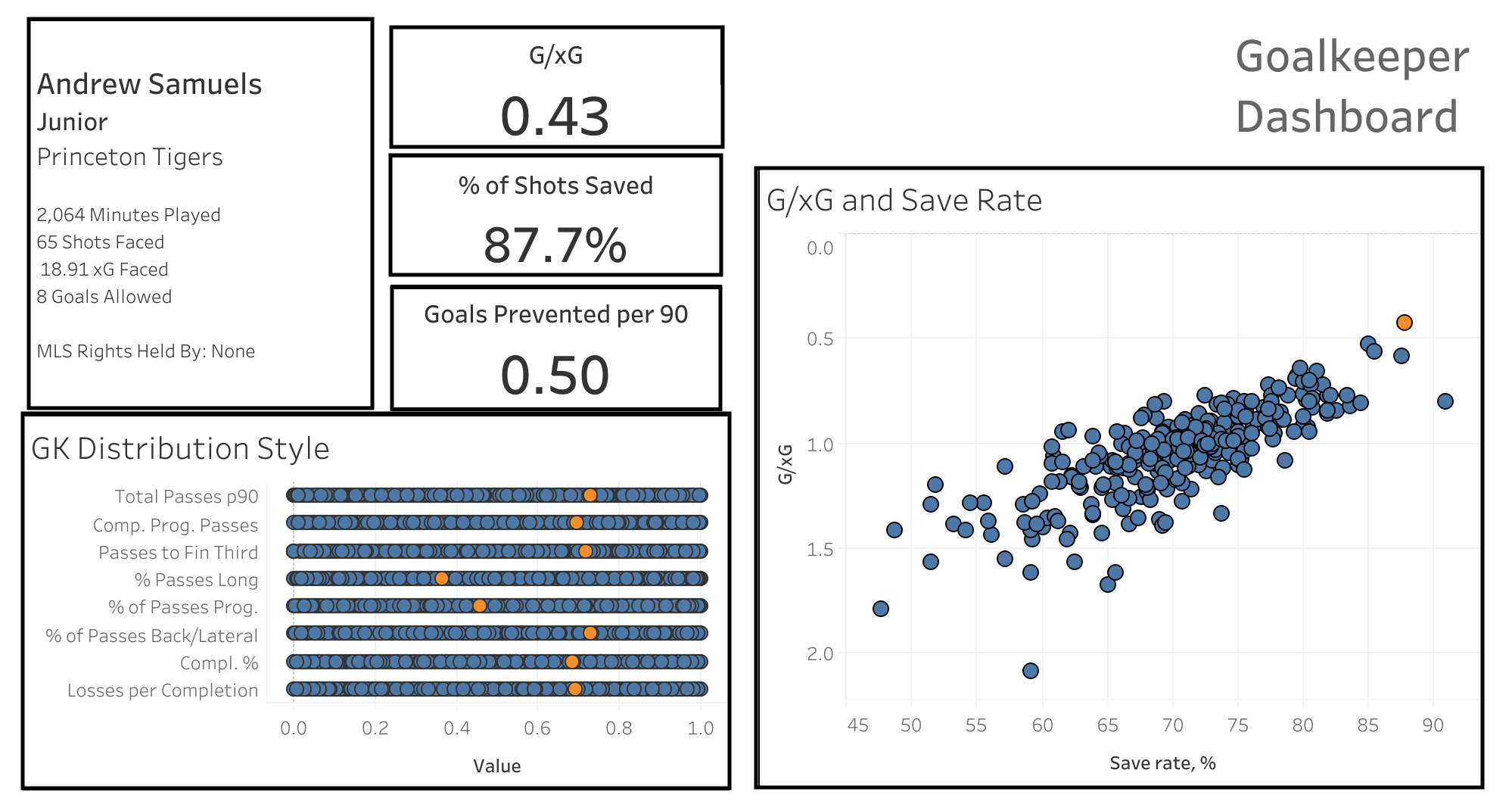
Andrew Samuels, Princeton, Senior
Samuels is the lone recommended player in the draft eligible group. He has a better G/xG (0.42) than Roman Celentano’s senior year numbers, and is comfortable if not outstanding on the ball. The former San Jose academy player is a full 6’5” and his excellence as a shot stopper will likely make him the first goalkeeper selected.
The draft will be held on December 18th, 2025. Although MLS has yet again chosen not to televise it (boooooo), the picks will be updated in the dashboard at the end of the draft (or during, as I feel like it).
For up to date discussion of draft picks, you can follow me on Bluesky or sign up for the ASA Patreon discord where I post all my draft related thoughts.