
2026 MLS Analytics Survey
/By Eliot McKinley and Ben Bellman
Every year, we update the State of MLS Analytics by putting teams into tiers based upon how many analytics staff they have. However, the number of analytics staff members doesn’t necessarily say anything about the quality of work that a club is producing or if analytics is being incorporated into team decision making. Unfortunately, we can never really know what is going on inside a club’s analytics department. For the fourth straight year, we decided to do the best we could to get behind the scenes and asked club analytics staff for their input.
An 11 question survey was sent to a member of the analytics staff at the 27 MLS clubs (an all time high) that have at least one analytics staff member. Responses were anonymous and teams were allowed to skip any question or comment. In the end, we received responses from 18 clubs which were collated and summarized below - note that not all questions were answered by each team. Thanks to all of the analytics staffers who responded for their time and thoughtful responses.
1/2. What are the 5 most/least analytically advanced MLS teams?
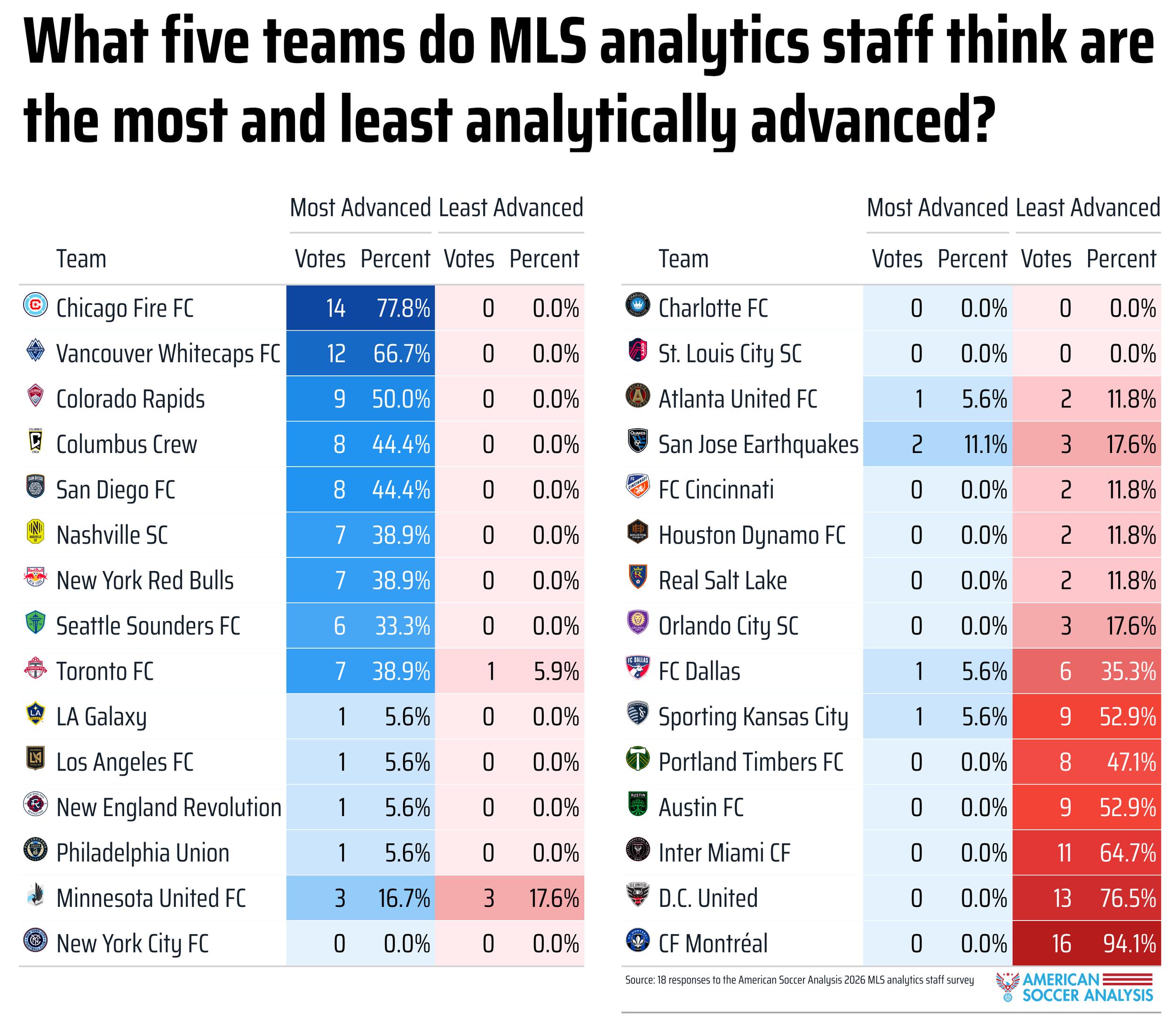
Chicago Fire, whose analytics department is led by ASA alumnus Kevin Minkus, have taken the top spot as the most analytically advanced team as voted by MLS analytics professionals. Both Chicago and #2 ranked club, Vancouver Whitecaps, both made a major jump in the rankings after having real cred in the 2025 survey (5 and 6 votes respectively). Colorado have maintained their good reputation among other analysts, dropping to #3 from #1, but retaining 9 votes of confidence from a previous 11.
A major overall shift from 2025 has been the collapse of “bubble” clubs with a handful of votes. Instead of a gradient of votes down the list, there is now a continental shelf of 6 votes to 1 vote when you get to the 10th spot on the list. Columbus, Nashville, San Diego, NYRB, Seattle, and Toronto round out a group of nine that are generally recognized as the MLS leaders in analytics.
“Each year, this gets harder and harder. Some are very advanced clubs, so it hurts to only pick 5.”
“Staff count, buy-in for infrastructure, application”
“Quality of staff, backing from multi-club model, number of staff”
“These teams have a combination of dedicated technical talent, strong infrastructure, sophisticated in-house processes, and actual integration into sporting decisions. They go beyond reporting and consistently influence recruitment, roster construction, performance evaluation, and long-term strategy while investing in being innovative."
Beyond these leaders, there is a mixed middle from spot #10 through #23 where teams have between 0- votes for or against. Some teams flew under the radar completely with no votes either way, while both Minnesota United and San Jose Earthquakes earned some contentious opinions with 2 to 3 votes for both most and least advanced clubs. Many of these 14 clubs have been in our Tier 1 (2 or more staff) for multiple years, so it is interesting that such a large perception gap has developed across MLS in 2026.
Finally, the bottom 7 spots all earned at least 6 votes as one of the least advanced clubs. The comments are direct about why:
“They don't invest in the staff”
“These clubs either have no analytics teams or appear to be rebuilding their capabilities, so there is considerable uncertainty without knowing their internal operations.”
“The clubs at the bottom here still either don't have a department or only recently made their first hire. A couple of them are farming out analytical work to interns with little direction, guidance, or resources.”
“Lack of infrastructure, staff, no presence on MLS analytic calls”
Both Sporting Kansas City and Austin FC have made significant investments in analytics staff this year to make Tier 1, so in their case, they need time to develop their infrastructure and reputation. The survey is often a lagging indicator. St. Louis City and D.C. United essentially swapped places across perception groups from 2025 after St. Louis replaced their entire analytics staff with D.C. United’s, and progressed from 10 votes as least advanced to zero. Meanwhile, D.C. replaced their staff with no one. Portland, Dallas, and Miami all have one analytics staffer and so fall in Tier 2. While Miami has really fallen into disrepute since Sam Gregory’s departure for U.S. Soccer, Portland and Dallas have been in this bottom group in every single survey since 2023. This has also been Kansas City’s story, so we’ll be watching to see what heads they turn with their four new full time staffers in 2027.
3. What team most incorporates analytics into its decision making?
While having advanced analytics is great, more importantly is if a club incorporates analytical insights into their decision making. You could have the best data scientists in the world, but if your club president makes transfer decisions based on a crowd sourced player valuation website, then it really doesn’t matter.
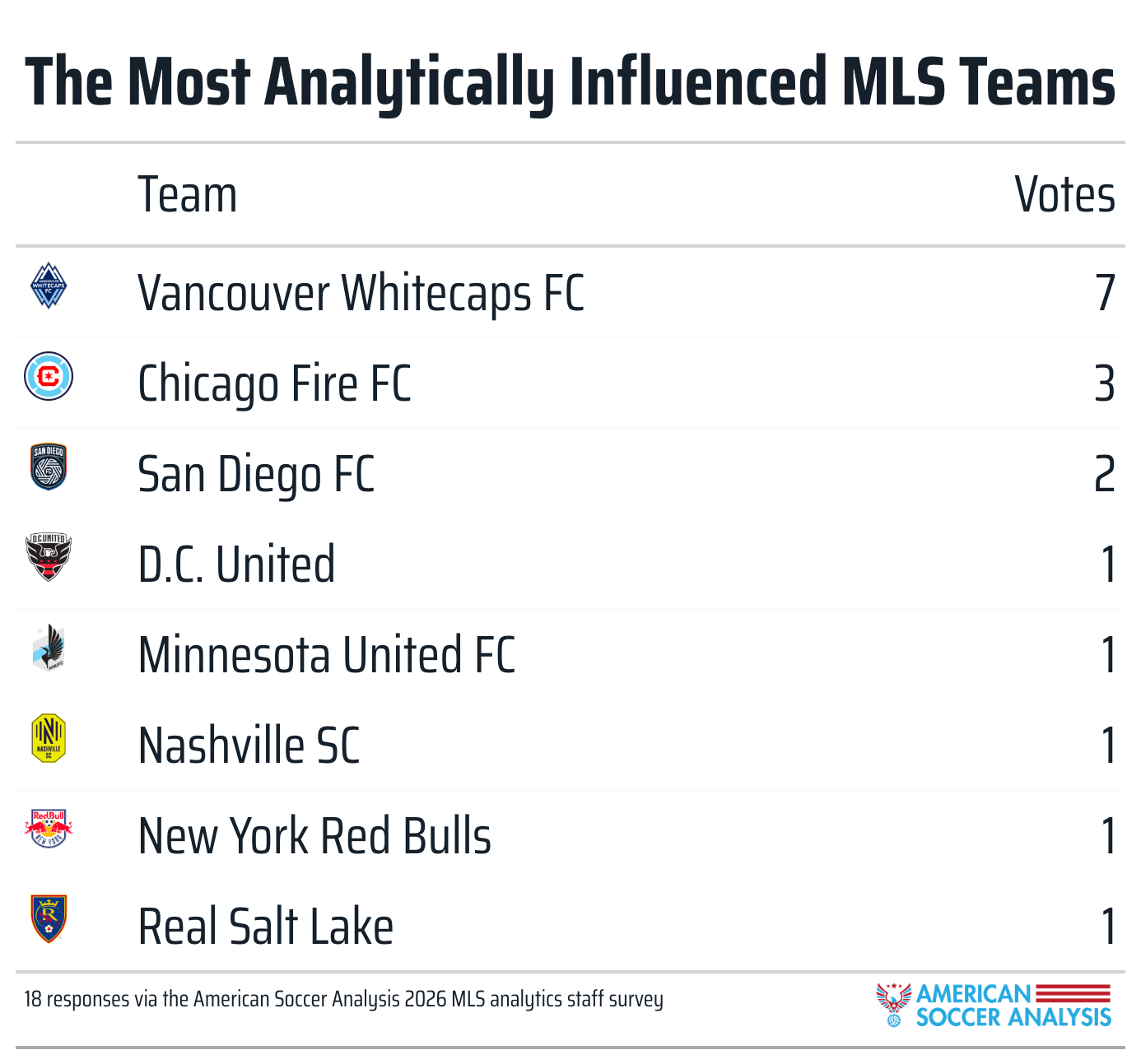
These may be some of the most surprising survey results compared to 2025. In the past three surveys, the most votes a team received for this question was 4 (Colorado in 2024). Last year, only three teams earned more than one vote: Colorado (3), Columbus (3), and Nashville (3). Vancouver have 7 (!!) votes after getting just one last year. Chicago picked up 3 votes after winning the Reputation Shield, so while they are ranked highly, it is a relative influence drop off, especially compared to Vancouver’s votes. Having a giant of the game like Gregg Berhalter wielding lots of power and independence as both coach and GM could play into this perception gap. Despite these surprises, there’s usually fluctuation and disagreement in the answers to this question, and it is a difficult question to answer even from other teams in the league. Colorado has notably fallen out of this group completely despite maintaining their department’s good reputation.
“It's always hard to tell from the outside, but a handful of teams tend to operate in ways where the decision-making process at least makes logical sense from our perspective.”
“Every time we look at players in scouting, we consistently feel like Vancouver has also made contact.”
Despite D.C. getting zero votes for most advanced club and 12 votes for least advanced club, they received a vote for most analytically influenced club. We suspect this is a measurement error, and the response was intended for Columbus, but can’t know for sure, so the data is presented as is. We apologize for the faulty butterfly ballot design, and will use a different provider going forward.
We also asked analysts about how much their recommendations are considered at their own clubs, with a trend towards stronger front office influence:
“Quite often. Whether it is opposition scouting, self-scouting, or making decisions in scouting and recruitment, analytics inform decisions across the board. Normally, analytics matches other strategies that we use to make decisions, but it has sometimes brought up topics that these groups didn't realize were issues.”
“Analytics is involved in recruitment, roster planning, player evaluation, opposition preparation, and performance on a daily basis. Recommendations are generally considered heavily. We are involved in daily conversations with the technical director, head coach, video analysts, and head scout.”
“Data is constantly a conversation around most decisions, however, it may not always be the primary driver behind a decision.”
“Coaching Staff: Only when it agrees with them. Front Office: Not as much as we'd like but the buy-in is slowing (sic) improving.”
“It is a vital process of every signing we make. No signing is made without a full scale analytics breakdown.”
“A good amount, everything is taken into consideration before making a decision.”
“Massive importance on recruitment, somewhat relevant for coaching staff”
“It's considered the most crucial component”
“Front office more than coaching staff”
“FO 100% coaching staff 50%”
“Not much”
“A lot!”
4/5. What player do you believe is generally overrated/underrated, based on your quantitatively informed opinion?
As solving soccer is notoriously hard and there are a lot of players, it is not a surprise that there was not a lot of consensus among the analysts surveyed on who are the overrated and underrated players in MLS.
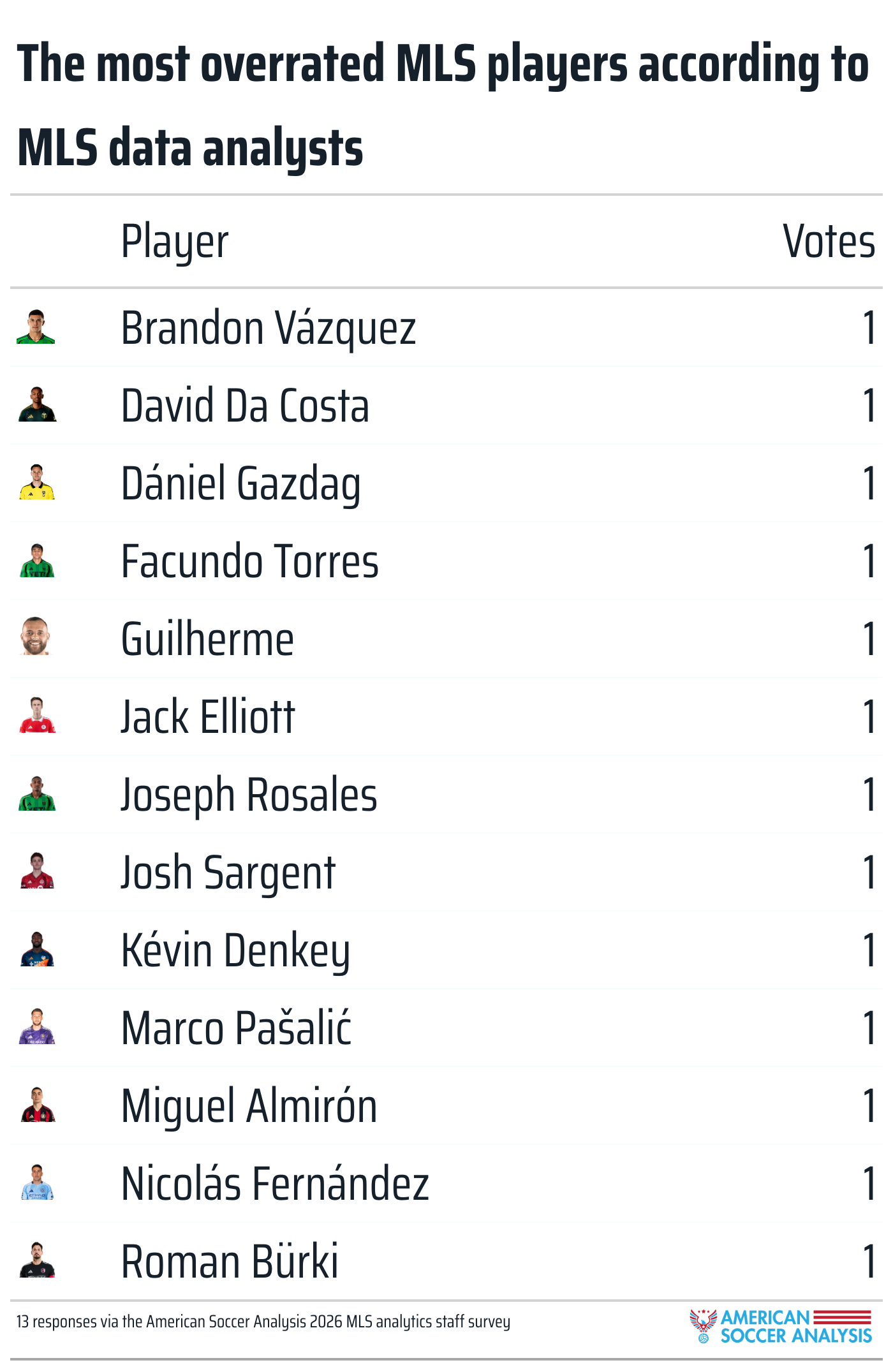
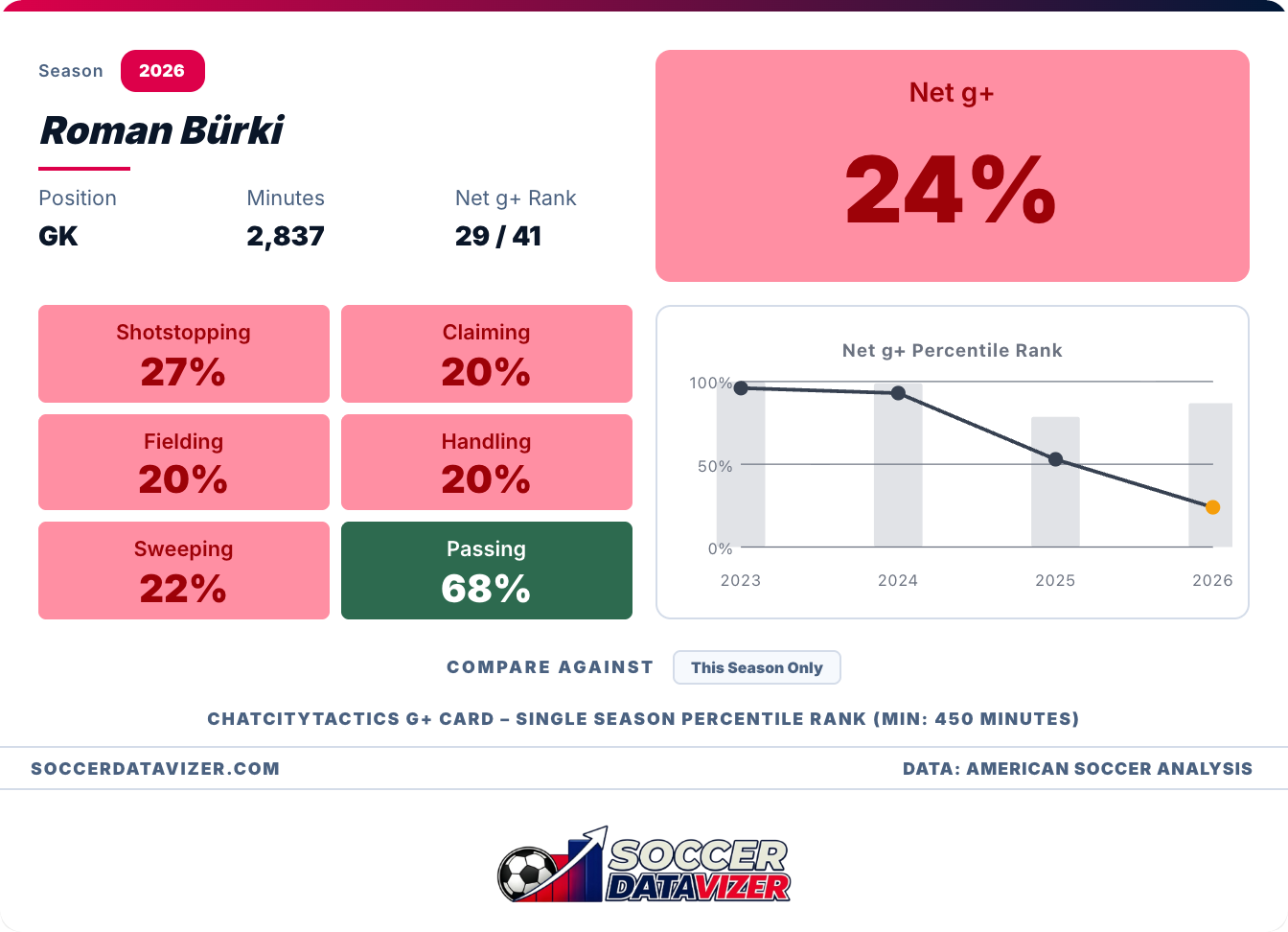
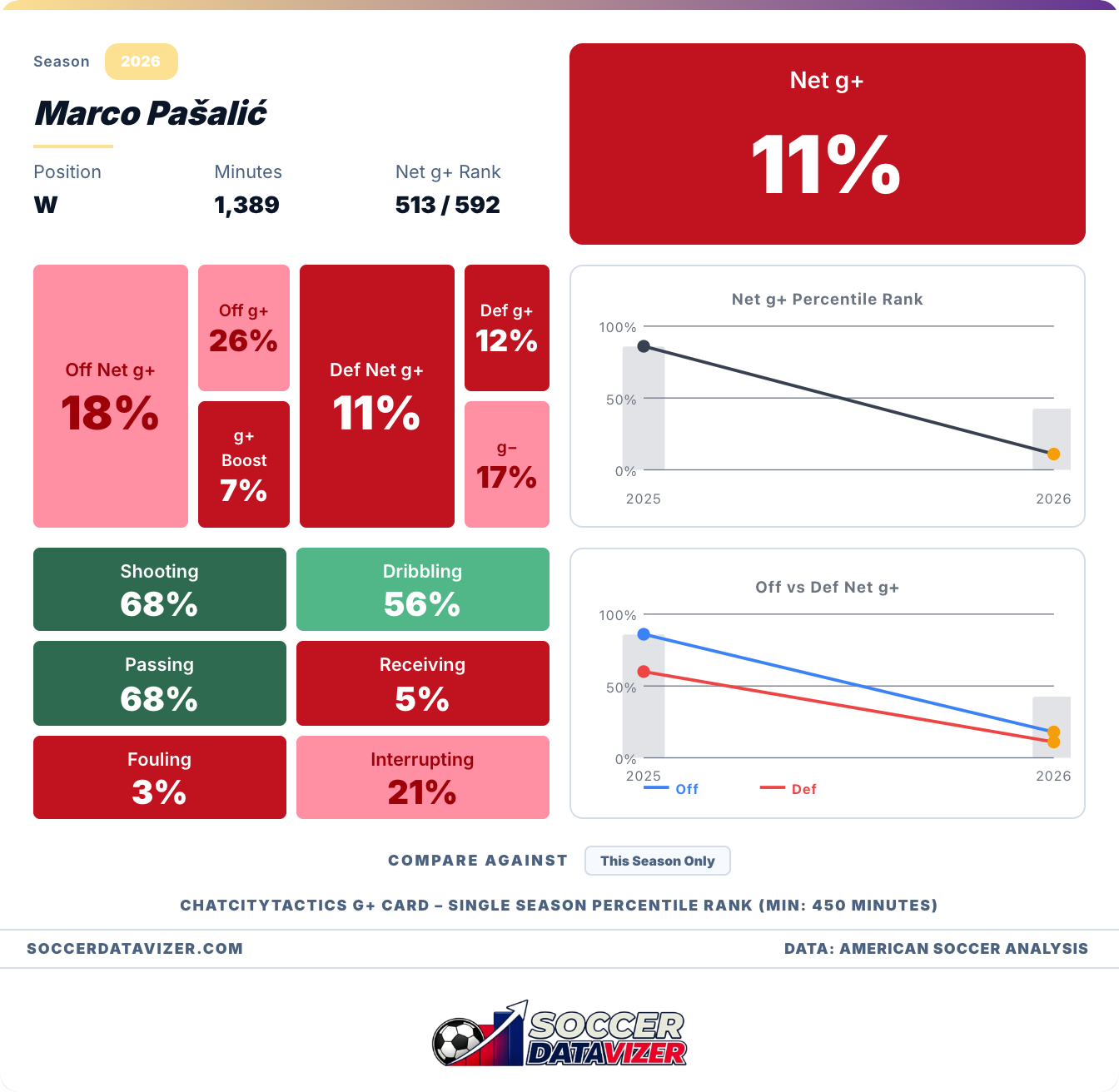
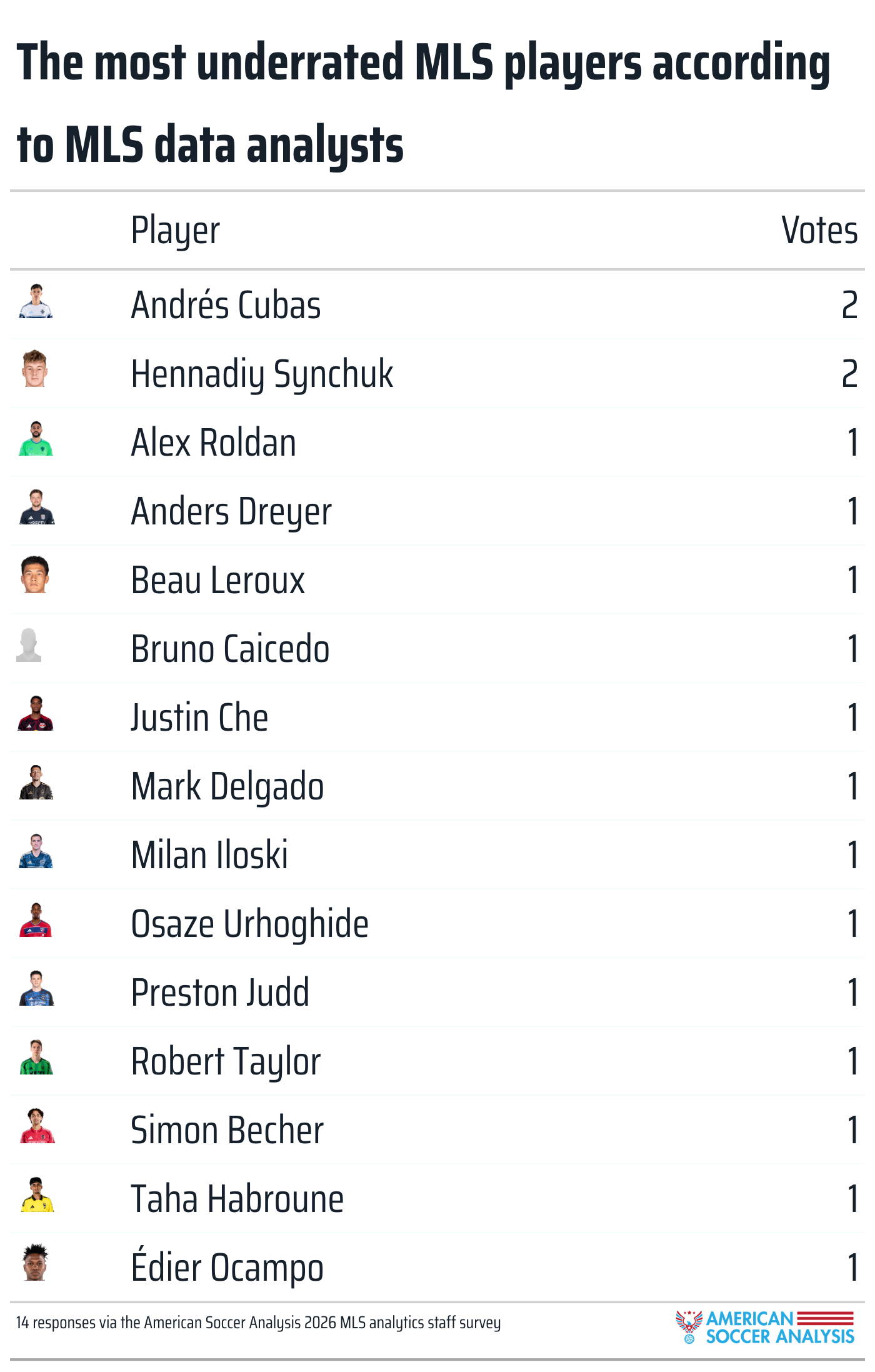
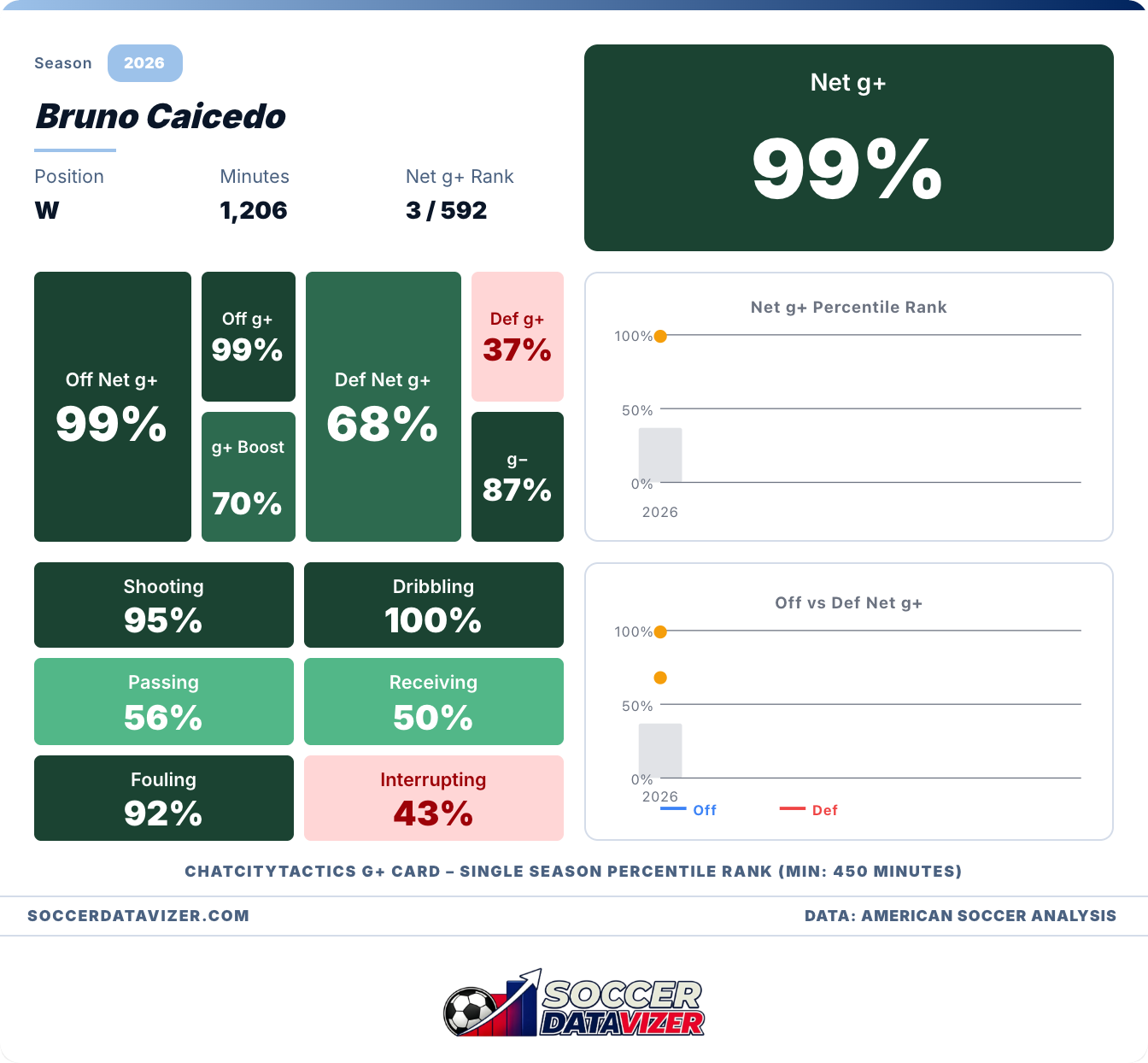
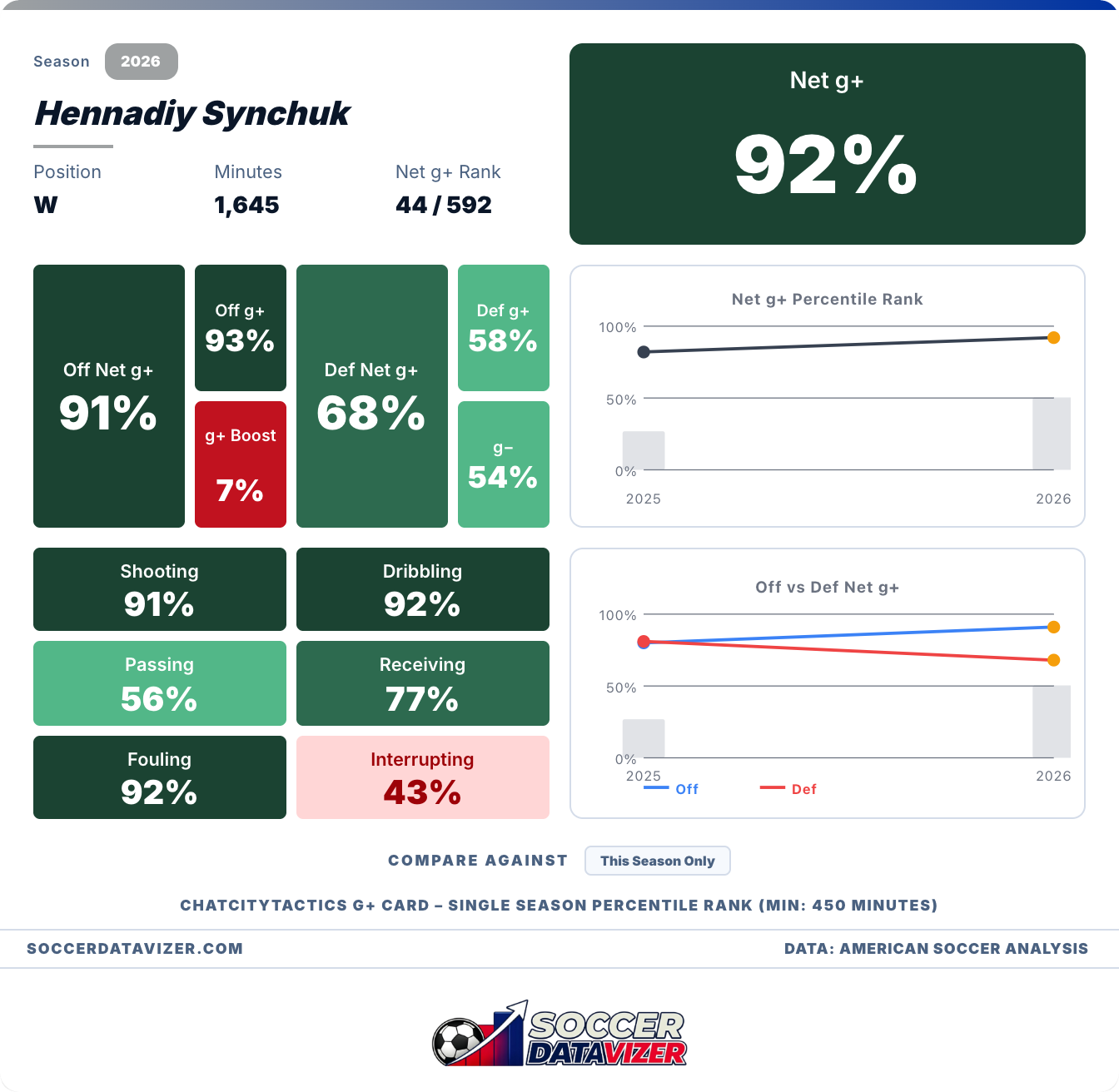
Ali Ahmed was finally sold to Norwich City after ruling this question with an iron fist for two years, so it’s only fair that his teammate Andrés Cubas top the chart. He is joined by Ukrainian starlet Hennadiy Synchuk at the 2 vote mark, with a range of familiar and rising names that you may have seen on a goals added wheel here and there. Two more Vancouver players in Ocampo and Caicedo make the list, and their goals added numbers definitely stand out, so it is clear that the data nerds approve of the work the Whitecaps have done.
6. Does your organization have more or less analytics buy-in than this time last year?
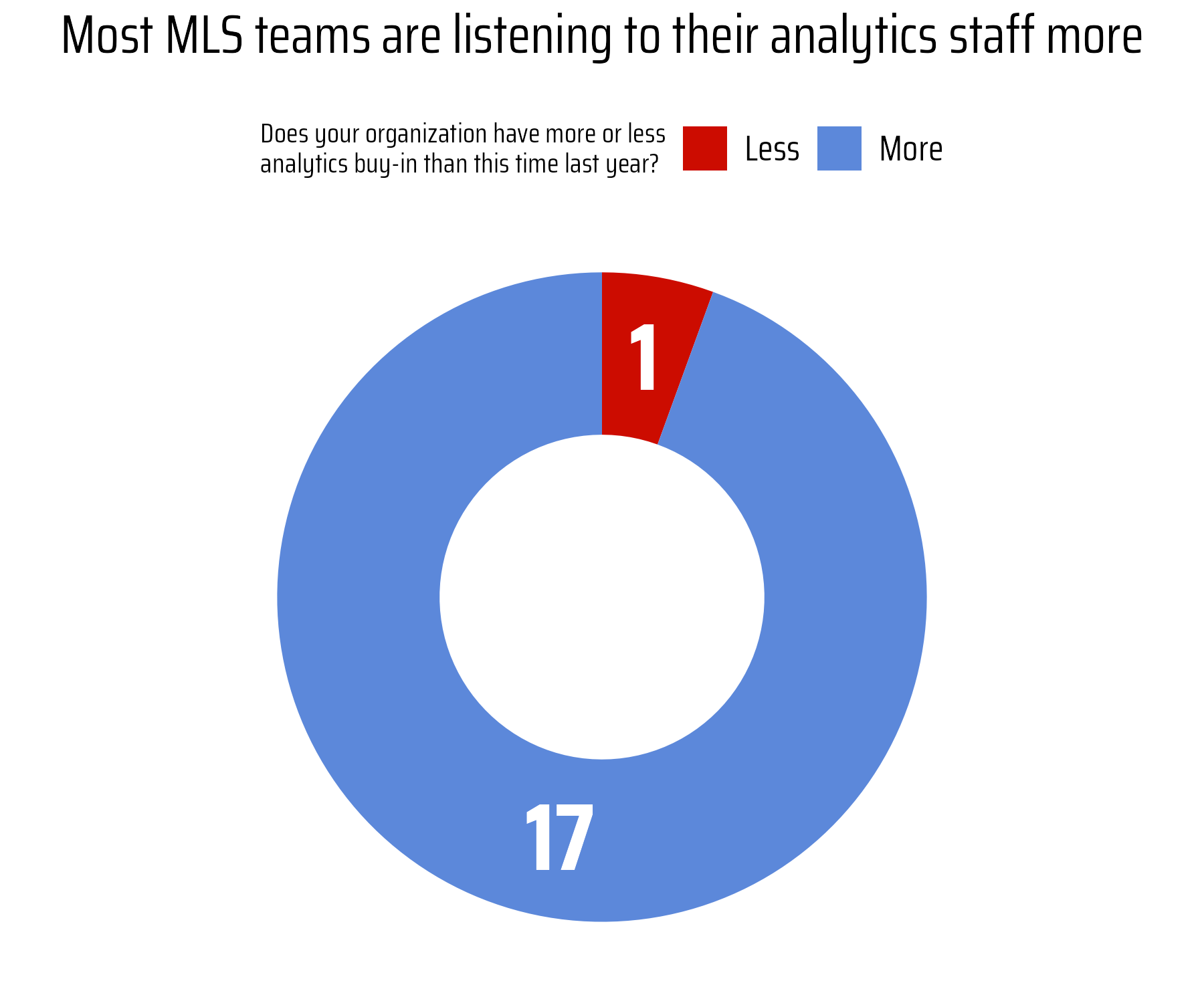
All 18 respondents answered this question, and only one said that they were getting less buy-in than last year. This is an increase over last year’s numbers, where 12 clubs answered more buy-in and 4 answered less. The comments are a little more uneven with some clubs going all-in on data, while others report competing visions.
“Analytics has become increasingly integrated across sporting departments, particularly in recruitment, roster planning, and performance evaluation. Both our head coach and technical director are highly data-savvy and actively engage with our work. The club has improved its underlying performance metrics for eight consecutive seasons, with that progress increasingly translating into success in the standings. This sustained improvement has helped build trust in analytics and strengthen organizational buy-in.”
“There's still a disconnect between our traditional scouts and data-driven recruitment but have increased resources put towards data.”
7. What functions are your analytics team involved in?
We know that with limited headcount, MLS teams utilize their analytics staffers for multiple functions.
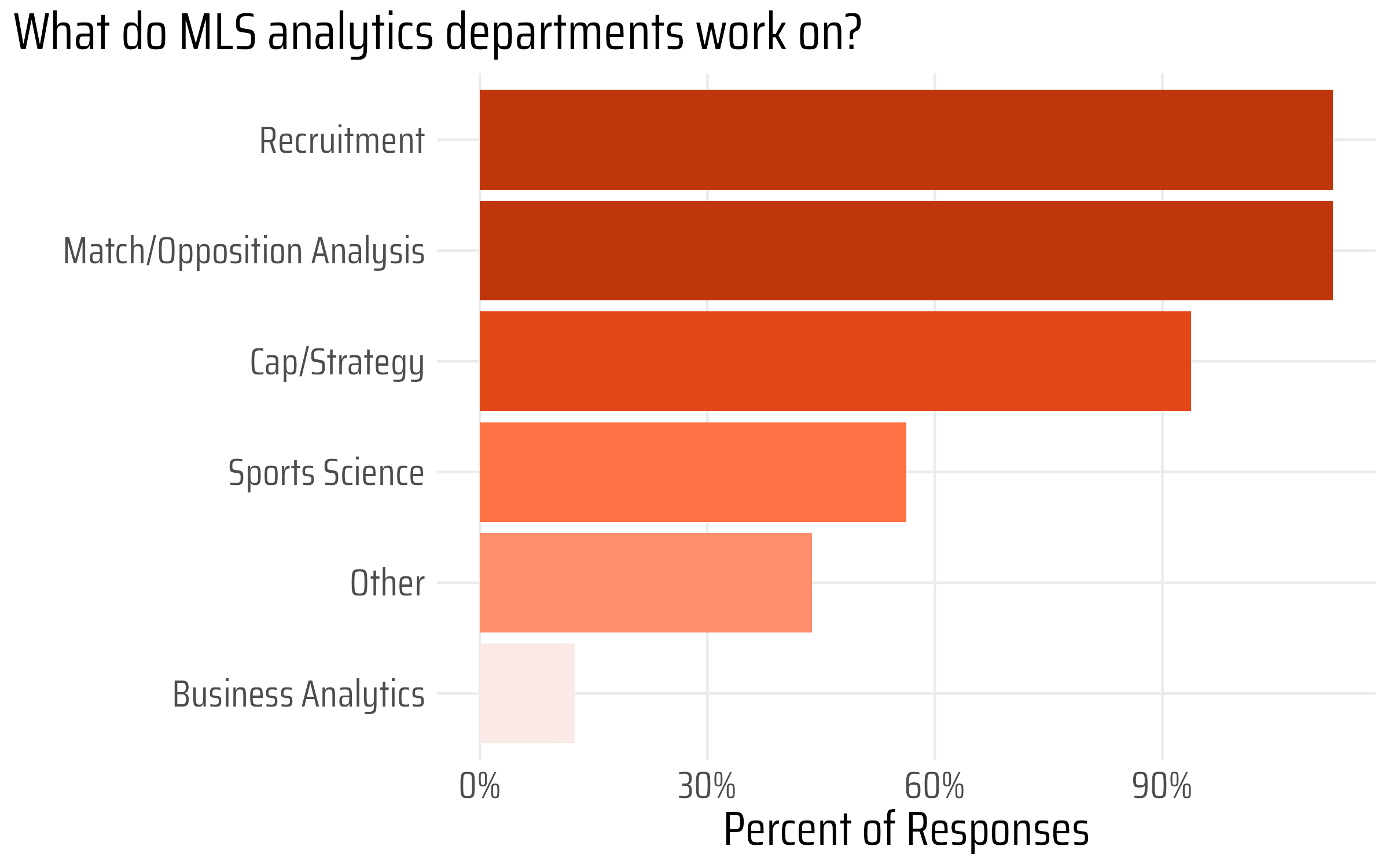
All 18 of the clubs that responded to this question work on the two main pillars of soccer analytics, player recruitment and opposition analysis. Most departments also participate in cap management and roster strategy within their clubs. While sports science can often be a whole different department within a club, the majority of analytics staff at MLS clubs still work with sports science data, and sporting and business data teams are nearly completely isolated now. Some of the “Other” responses directly referenced player development pathways, which we asked specifically about in the next question.
“Our work spans most sporting functions, from recruitment and roster construction through match performance, physical analysis, and player development. We aim to create consistent evaluation frameworks and decision-support processes across different levels of the club.”
8. How integrated are your club's academy and MLSNP team with your analytics workflows and insights?
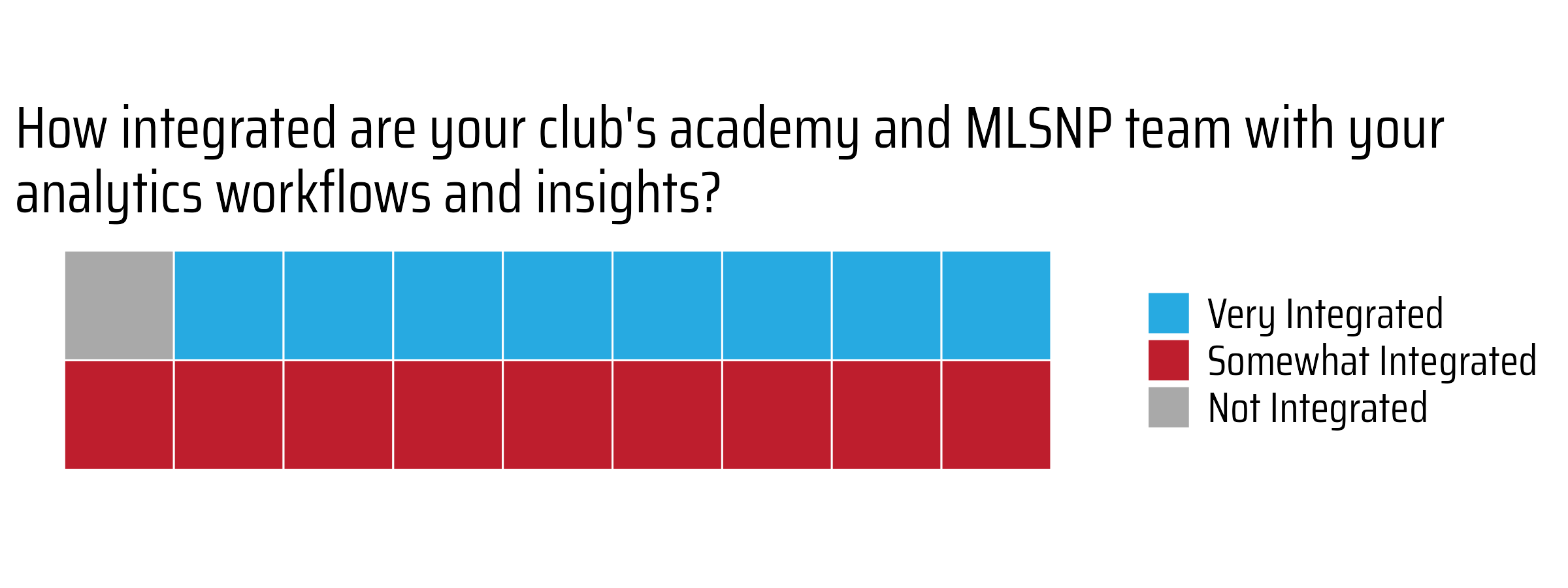
We have never asked these last few questions before, and we are thrilled at the richness of their comments. At least eight clubs report high integration with either their academy or MLS Next Pro team (“We consistently provide data support…during their seasons”). Compare that to the nine clubs that have sterling analytics reputations, and you might see some triangulation across the questions. Another eight clubs report at least some integration with either the club or academy (Survey: “We have done projects…but do not work together consistently”).
“We certainly work with them and try to pull them in. We are much more involved with NP, but work with the academy too.”
“This has ebbed and flowed depending on the interest of our academy and 2nd team staffs in our team's work, and in our access to data to support them.”
“We provide recurring analytical support across the academy and MLS NEXT Pro, including player evaluation, physical and technical benchmarks, development tracking, and progression assessments. We are continuing to improve alignment and consistency between these levels and the first team. We have regular meetings with the NEXT Pro coaching staff and send the usual reports.”
“With MLSNP, complete involvement. We used to have Statsbomb process academy games but have stopped this season.”
“They are getting closer and closer but not consistently enough.”
“MLSNP have access to the same report but less custom work.”
In 2026, more than half of MLS is doing analytics work with their development pipeline. In 2020, a third of teams didn’t have a single analyst on staff.
9. How often do agents use analytics when negotiating for their clients?
This question only asked for freeform text responses. Several responded that they are not involved in direct conversations or negotiations, but it’s clear that analytics concepts are shaping that dialogue. At least for now, it seems that clubs are far more advanced than agencies when analyzing data.
“We aren't too involved in those discussions. So we get pitch decks and some feedback, but not a ton of involvement to know what's all making its way to the scouting team.”
“Not much beyond basic stats like goals and assists.”
“It doesn't happen often in negotiations. It does happen a lot when agents are pitching us their clients, though I'd put "analytics" in quotes. Given the ease with which an LLM can put together a polished slide with numbers on it, we're seeing a lot more numbers and decks come across with player recommendations, but the numbers we see are frequently misleading, uninformative, or worthless.”
“Increasingly they use physical data, especially related to speed or to demonstrate health in training or matches. More rigorous contextual analysis, and objective player valuation appear less common.”
“Great question. They often provide fairly crappy infographics which the data doesn't correspond to what our numbers say half the time. I think it's becoming more common and I do know a few agencies who do have at least one data literate person on staff.”
“I’d say basic metrics frequently are involved in negotiations, however, in my experience any data or analytics presented by an agent is typically skewed toward their client.”
“Look at salaries, top end stats to compare and justify.”
“Regularly.”
“Very rarely.”
“Not as often as they should.”
10. How do you think MLS compares in its use of analytics to other soccer leagues around the world?
Another freeform response. Based on the responses, American Soccer Analysis is readying the Mission Accomplished aircraft carrier. Besides the literal money pit in England, most respondents consider MLS to be a global leader in soccer analytics, especially in its weight class. However this is not a universal opinion, and the size of department staff is a big reason why. This question got a comment from every single respondent:
“I think it is still very behind, especially with the size of the staff.”
“On the whole, better than all but the Premier League.”
“Top 10 in the world.”
“I think MLS is still at the forefront. Behind the Premier League and Bundesliga, most MLS teams have analytics support which is more to say that a lot of other leagues. So we are still up there, but more investment would be very useful in staying ahead of the curve.”
“Pretty high if not the best”
“I think, on average, we're probably ahead or even with most European leagues, besides the EPL and probably the Championship.”
“Clubs probably invest in and use analytics more in MLS than comparable international leagues”
“MLS is relatively advanced compared with many leagues globally, particularly in recruitment analytics, roster optimization, and the use of data. The salary cap and roster mechanisms create additional incentives for quantitative decision-making. However, the gap between individual MLS clubs remains significant, and the most rich European organizations are still generally ahead in data infrastructure, research depth, and integration across sporting departments. MLS has some very capable departments, especially per dollar spent, but the amount of money in the Premier League surpasses it.”
“I believe MLS is still ahead of the curve compared to the typical top flight club around the world, but the distance feels to be closing as more clubs invest in data and can utilize AI to compensate for fewer staff/resources.”
“Probably the widest spread of adoption in the world.”
“I've learned that the gap is growing further than I initially thought. I work in both analytics and recruitment so I do engage with front offices of European/South American clubs more than the typical analytic staff member. It's quite surprising how little infrastructure most non-5 big league clubs have. Even in clubs who are within European comps, they often have only one staff member and heavily rely on consumer products (i.e., Transfer Lab, Dynamic Soccer, etc.) and some don't even use Wyscout. The sporting director can be more analytically involved than anyone.”
“Speaking from limited experience, but I think some MLS clubs have an infrastructure that could rival the top teams in Europe’s top divisions.”
“Near the top as a league. Obviously, a lot of the major clubs in world football dominate these spaces, but overall as a league, you can definitely tell teams are utilizing analytics well.”
“I think it is relatively ahead of the world, but still behind the top analytics driven clubs like Liverpool.”
“I think it's in the top 5 for in-house departments/staffers.”
“Probably 3 or 4th best in the world as far as utilization and buy in is concerned.”
“Probably about where you would expect relative to strength. Top 10.”
11. How do you think MLS compares in its use of analytics to other North American major sports leagues?
Another freeform response. This question also showed a lot of consensus that MLS trails the other four major men's sports leagues in analytics. There’s a lot of nuance to this opinion though, especially the points that more money is at stake in those sports’ decisions, and that working in a smaller organization means you may have more influence at times than in those massive MLB data departments.
“Behind the major 4 sports and not closing the gap.”
“It is still behind the other major leagues. Most other leagues have a full staff of people including Data Engineers and Analysts. While we have people, we are lacking the full investment of other leagues.”
“MLS generally trails the NFL, NBA, and MLB in analytical maturity, investment, and integration into organizational decisions. Those leagues have a longer history of quantitative approaches, but some MLS clubs are catching up in terms of pure integration with key decisions. Being a smaller organization can help in that sense.”
“Still behind but I think it varies organization to organization. I think the sports industry unanimously agrees that analytics has value but the prioritization to apply it when it comes to decision making seems very different. Several organizations have fantastic infrastructure but don't use analytics in decision-making and on the opposite end, you can have a relatively naive infrastructure but utilize what you have for every decision.”
“I think its behind most major sports leagues, but that is most likely due to overall spending and where soccer is in this country. Really this is just because the size of the analytics staff of the major sports leagues are significantly larger. It's not that the data isn't used. But to be truly advanced, more infrastructure is needed.”
“Miles behind in ability to quantify the game, probably about the same in ability to gain edge over competitors. Main difference being other NA sports leagues are closed markets.”
Wrapping Up
The findings from this year’s survey show the continued growth trend in the investment in and influence of data analytics in MLS. It appears that there are solidly three groups of clubs. First, there are the early investors that are now established leaders that have shaped their decision structures around data and evidence. There are clubs that are building or rebuilding their departments, flying under the radar but likely doing solid work. And there are the clubs that were left behind or are caught in organizational transition. This lowest group will only keep shrinking, and the bleeding edge is likely to pick up steam.
MLS is one of the strongest leagues in the world when it comes to data-driven decisions, and may be best in the world relative to financial investment. That investment is likely the next edge that clubs will find as the overall standard continues to rise.