
2026 NWSL Previews: Utah Royals, Angel City
/Our 2026 NWSL Season Previews have started and today we hit Utah and Angel City. If you want to support this coverage of the league, you can head to our Patreon. For $5 a month you can get access to a lot of the data visualization tools we use to make these previews.
If you’re more of an audio person, our friends at Expected Own Goals spoke to our own Catalina Bush on Utah Royals, and Trebor Tracy of Angels on Parade on Angel City. If you want to support them, you can head to their Patreon.
It's got the grooviest kids
Utah’s second sophomore season was a whirlwind, the question is not what didn’t happen, but what actually did happen? Utah struggled early on; head coach Jimmy Coenraets was going on 12 mile runs to cope with their early losses. They traded away the young talent upon which the franchise hopes rested, Ally Sentnor, to Kansas City for $600,000 in guaranteed intra-league transfer funds in August. The team later, as per Utah tradition, went on an eight game unbeaten streak. A little too late of course.
Jimmy Coenraets survived his first full season as head coach and will return for another season. Utah fans should hope the momentum of the later half of the season carries over to this season, despite the changeover.
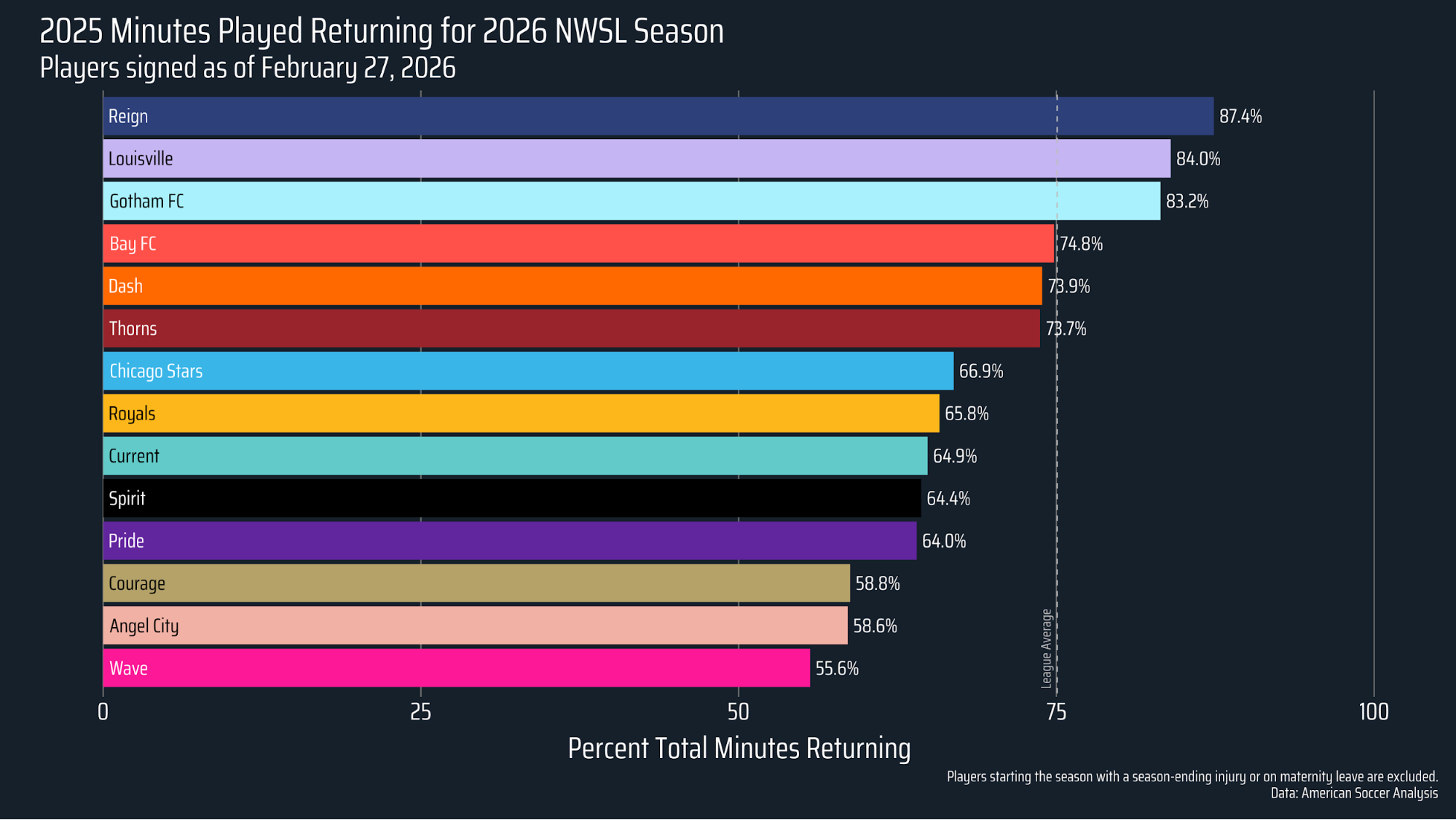
The 2026 season comes with 17 players returning from 2025, including stalwarts Mandy McGlynn, Kate Del Fava, Alex Loera, and Cloe Lacasse. Utah is on the lower end of percentage of minutes returning to the team, at 65.8%, which ranks eighth among the 14 returning teams this season.
New Additions
Utah made a couple more under the radar moves this summer. From college, they signed FSU forward/defender Kameron Simmonds as a defender. Simmonds started the national championship game for FSU, which FSU won, and made the roster for Jamaica at the 2023 Women’s World Cup. Simmonds was the only player they signed from college.
Internationally, the Royals signed Haitian international Dayana Pierre-Louis from RC Lens for an undisclosed transfer fee and Club America legend and Mexican international Kiana Palacios. Pierre Louis helped RC Lens gain promotion for the 2025-2026 season, and started in RC Lens’ 9 out of 11 matches in midfield before the transfer to the Royals. Palacios is Club America’s top goal scorer in all competitions, and is also their appearances leader. Expect the former Club America leader to bring a goal scoring and veteran presence to this “middle aged” Utah squad. Palacios scored 14 times in 34 games for Club America, averaging a goal every 165 minutes in league play, and 0.78 xG+A per match. Palacios ranked in the top 10 percent amongst all Liga MX Feminil players in average goals, assists, and contributions per 90 minutes.
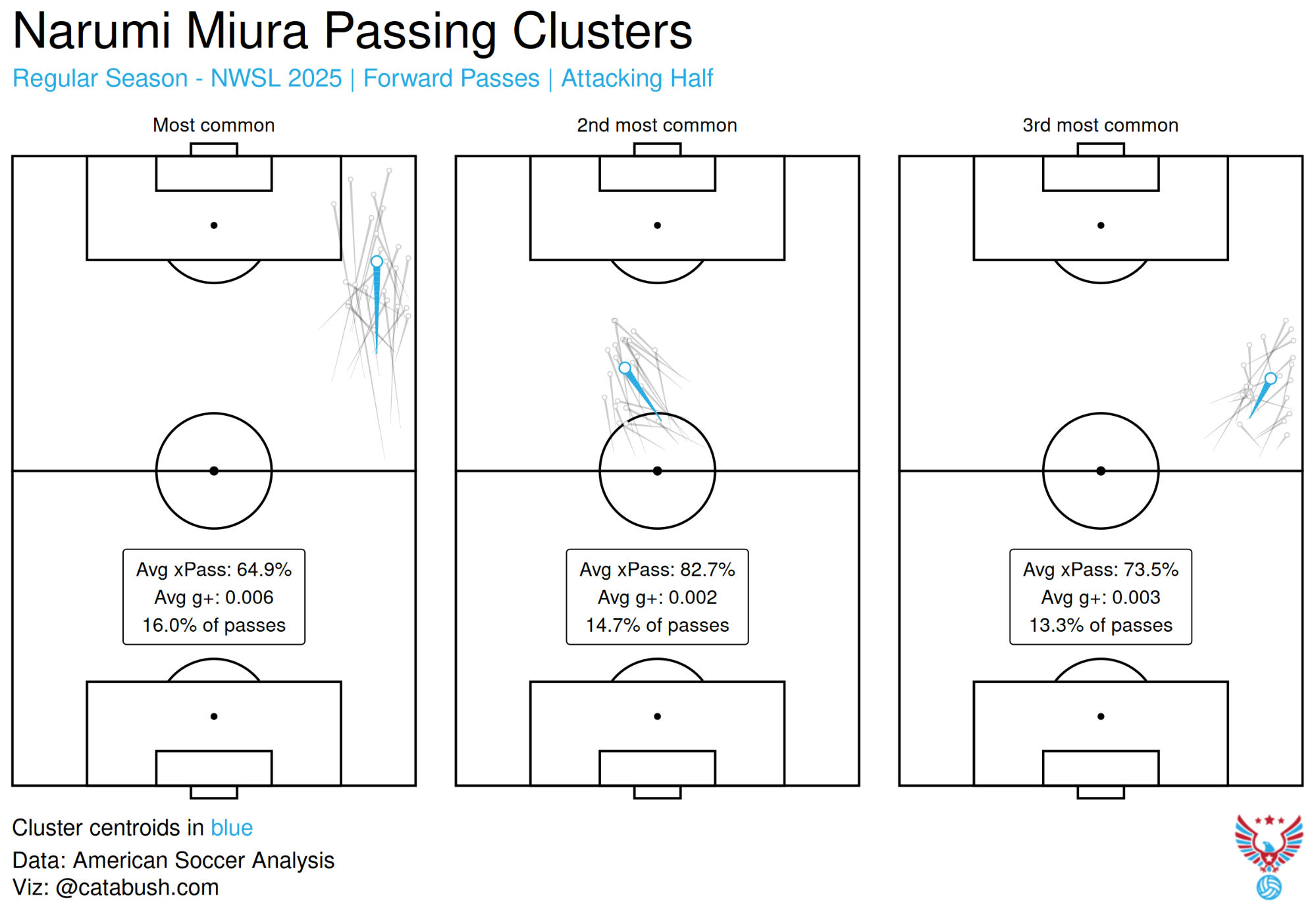
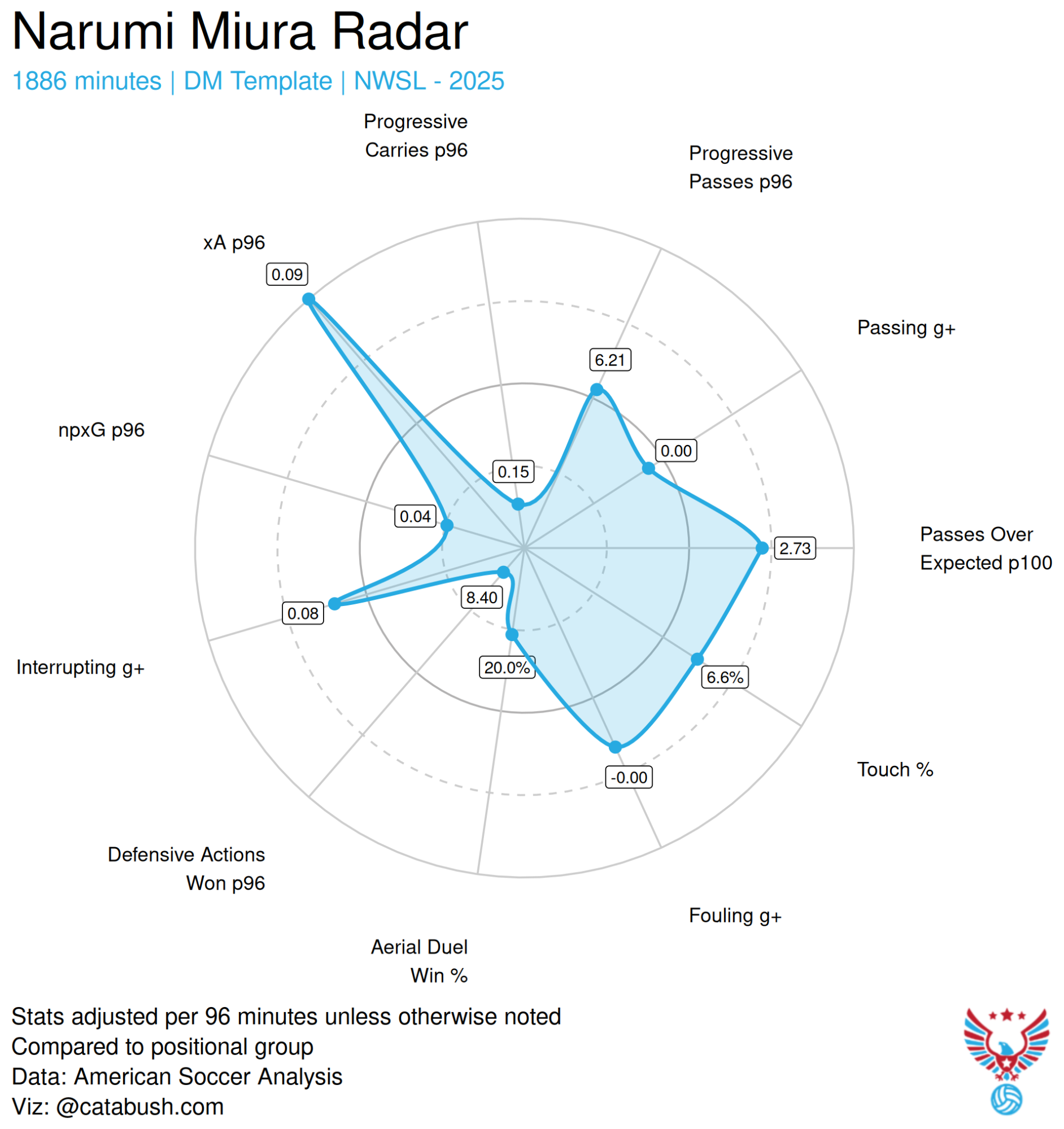
On the intra league transfer side, they made a couple more exciting moves. Utah acquired midfielder Narumi Miura from the Washington Spirit for $180,000 in allocation money. They also signed Miura’s former Spirit teammate and Utah native Courtney Brown, and added defenders Madison Hammond, and Miyabi Moriya from Angel City.
Utah really struggled to use the right side of the attack last season; Miura should look to be a key contributor on the right, when you consider her most used passing clusters last season. There is a lot of moving it wide from central areas, and playing an overlap or wide player in behind. The addition of a Palacios and Miura linkup is exciting, but it feels like Utah did not do enough overall to improve upon a fairly lacklustre 2025 performance.
What to look for
The question for the 2026 season is how will Utah start the NWSL season? In preseason, the Royals fulfilled their annual draw vs Bay FC 1-1, lost 2-0 to expansion team Denver Summit, before finishing with a 2-2 draw with USLS team Spokane Zephyr, with a mystery result against Angel City mixed in.
On their eight game unbeaten streak last season, Utah had a higher non-penalty expected goals than their opponents. For Utah fans perhaps infrequently exposed to this concept, this is a good thing. It means you are more likely to score more goals than the other team. This is the goal of soccer.


This has historically been hard for the Royals, but the return of USWNT Mandy McGlynn should support this objective. McGlynn’s 86 saves last season ranked among the top keepers in the league. Her solid 2025 season earned her a first national team call up. Utah mainstay Kate Del Fava looks to lead the backline coming into 2026, and with center back partner Anna Tejada, and wingbacks Nuria Rabano and Janni Thomsen all returning to the squad; perhaps Utah’s backline will prevent more chances. Also, look for their new addition Madison Hammond from Angel City to add a little offense to the defense with a decent passing game. College signee Kameron Simmonds can also potentially add something to the offense from fullback with a lot of collegiate and some international experience. One of her most similar statistical comparisons is 2025 NWSL Rookie of the Year and now frequent USWNT squadmember Lily Reale. Utah will certainly hope that is the case.
Cloe Lacasse looks to start the season for the first time, having come back from an ACL injury late in 2025. Lacasse, a 32 year old late bloomer who formerly played for Arsenal, has a knack for only scoring bangers. She never really got to shine at Arsenal, but really inspired during her time at Benfica before that. Hopefully she’ll bring some creativity to the Royals offense; they certainly need it. Defender Tatumn Milazzo, who made the NWSL’s Second Best XI whilst playing for Chicago in 2022, looks to return to form after an ACL injury that took away her 2025 season.
The midfield at this point feels like a complete unknown. The additions of Miura and Pierre Louis should change things for the Royals, but again, we don’t really know how Coenraets will look to utilize them.
A “safe” expected outlook
The expected outlook for Utah? Utah will play a brand of soccer that will likely concede a few too many goals and score a few too few. Maybe they’ll go on another fake comeback in the back of the season again, but it already feels a little too late.
Mister mojo risin', gotta keep on risin'
“It took the top four anywhere between two to three years to get to where they are right now,” said Angel City sporting director Mark Parsons at a recent press conference, “We’re trying to do it in less time.” ACFC starts year two of Parsons’ self-prescribed two-year rebuild looking up at the top four from 11th place.
They also weathered a whirlwind of mid-season turnover. Alyssa Thompson’s high-profile departure to Chelsea headlined an exodus of six key squad players before the end of the season.Six more left in the offseason, notably defensive role players Miyabi Moriya, Macey Hodge, and Sara Doorsoun. This leaves ACFC with 60 percent of their 2025 player-minutes to start the new season, one of the lowest in the league.
In wake of ground-shaking departures, Angel City is rebuilding around structural integrity. Emily Sams joins key late-season midfield additions Hina Sugita and Nealy Martin to offer stability in defense and possession. On the other side of the ball, new signing Ary Borges brings box-to-box charm to connect with ACFC’s young attack, further bolstered by NCAA standouts.
“Can 2026 Angel City compete for trophies?” seems the wrong question. What does this system even look like? But let’s use Parsons’ top-four benchmark, however misguided, to show where this new-look Los Angeles side needs to improve.
Defense seeks stability in Sams

Angel City had an average defense in 2026, conceding 38 goals on 36.6 xG and 349 shots faced. This is a far cry from the top four defenses in the league, who conceded an average of 21.6 goals off 26 xG and 277 shots faced. Coach Alex Straus has his work cut out for him.
Compared to the top four, the majority of Angel City’s goals-allowed deficit came from defensive errors and lost loose ball duels (five more goals from unassisted shots than the average top-four side) and poor set piece marking (four more goals from 30 more corners and set pieces). Furthermore, ACFC’s commitment to dribbling and short passes in attack left them open to line-breaking progressive passes in transition (five more goals from progressive passes).
Emily Sams is a desperately-needed addition to this defense. Sams was a starting centerback in Orlando Pride’s top-four defense last season and was second in net g+ among center backs. Her stellar performance was headlined by her ability to minimize space for the opponent attack: Sams accumulated 1.6 goals subtracted (g-) by making her zone impenetrable compared to the average centerback. Sams’ off-ball defensive prowess is welcome in a team that struggled to do this in 2025. Her proactive emphasis should sniff out many more progressive pass chances than Angel City did last year without her.

Defense is not a plug-and-play exercise, though. Sams will need help in organizing how her ACFC defense minimizes space. Her likely partners, Sarah Gorden and Savannah King, struggled to be productive ball winners or space minimizers last year. To this end, Nealy Martin and Evelyn Shores, who will cover the departed M.A. Vignola, will prove useful defenders. Martin led all holding and center midfielders in g- last year. That is to say, she allowed fewer value through her zones of responsibility than any other player in her position.
But who steps up to win loose balls and prevent unassisted goals? With Vignola leaving, this team now lacks a positive contributor for ball-winning (interrupting g+ aside from Gisele Thompson.) Sams’ presence will mean other defenders (perhaps Gorden or King) will have to step up their defensive work rate. Catherine Legeyre is a useful draft pick to this end. NCAA data suggests the former Duke midfielder’s strengths were in both proactive and reactive defending.
This defense will improve in 2026, but Sams can’t allow 16 fewer goals on her own. Angel City fans should look for how her fellow defenders ramp up the marking accuracy and duel-winning intensity that was missing last year.
Can Riley Tiernan Find Space in the All-Dribble Attack?
Angel City’s dreadful attack scored 30 goals from 31.1 xG, a very poor return from a team with the fourth-most shots (349) in the 2025 regular season. Straus’ problem in this case is one of efficiency: ACFC scored eight fewer goals and generated five fewer xG off 14 more chances than the average top-four attack.

The data suggest that Angel City’s attack was too focused on dribbling and short pass combinations last year. ACFC generated 16 more shots from short passes than the average top four attack for a return of one more xG and two fewer goals. The Amazing Dribbling Thompson Sisters created excitement with their marauding runs down the wings, but the thrills weren’t productive. Despite her earned role as the linchpin of the attack, Alyssa Thompson generated a meager six goals and two assists before leaving for Chelsea.
To be clear, being good at dribbling and tight combo play isn’t a bad thing, it’s just a less productive way to play than getting vertical and in behind teams. ACFC created four fewer xG from a similar number of progressive passes as the league’s top four attacks from a roughly equal amount of progressive pass-generated shots. Throughballs are supposed to generate high-value chances, but for ACFC, a progressive attack was simply average. Angel City’s insistence on dribbling attacks marginalized more traditional players who could have made and received line-breaking passes if presented the opportunity.
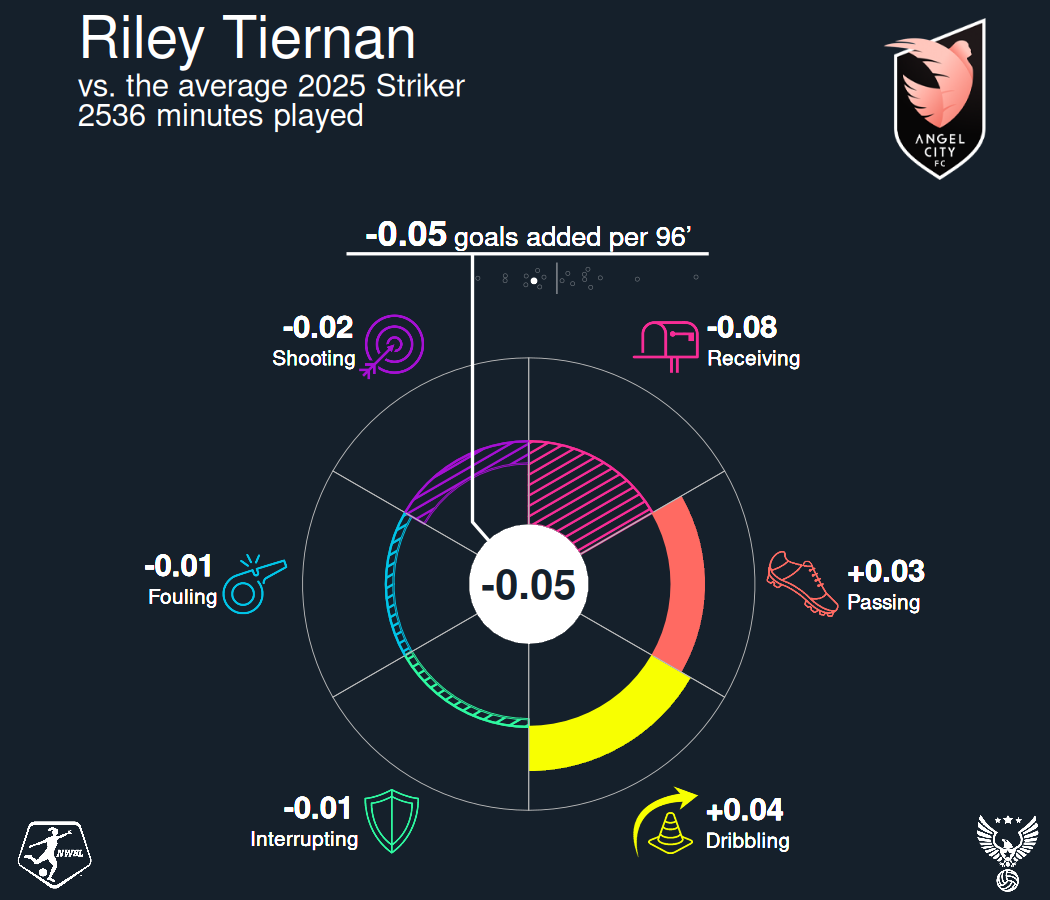
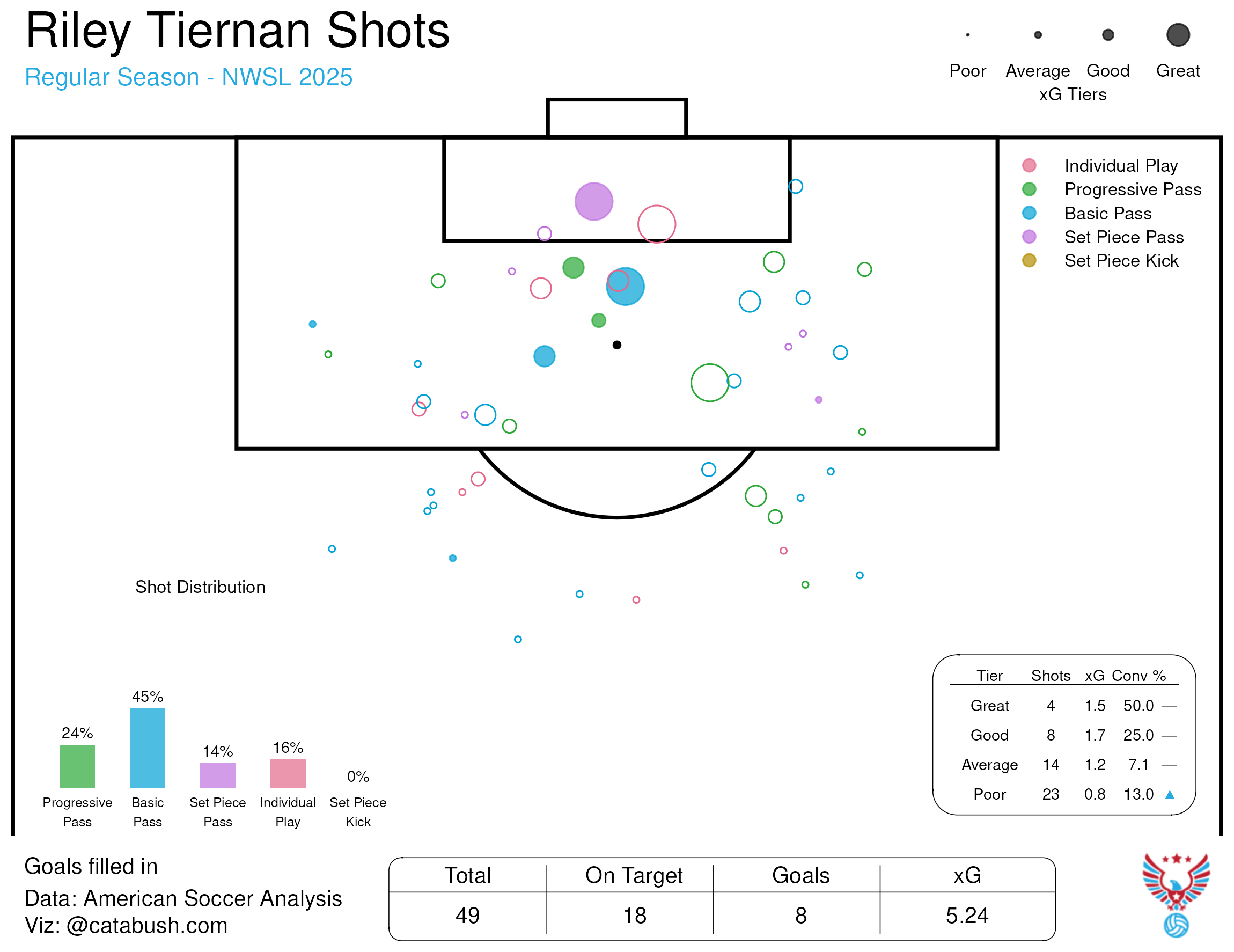
ACFC’s 2026 attack relies on how striker Riley Tiernan meets the moment. The hype around her Rookie of the Year finalist performance claims the 23-year-old could be the next USWNT striker. Data, however, is less kind. Her goals added data suggests that Tiernan was a below-average striker, mostly due to a lower than average receiving score. That is to say, compared to her striker counterparts, Tiernan is on average receiving less in good spots, more in bad spots. A cursory glance at Tiernan’s eight goals suggests otherwise. This is a forward who, if allowed the space, can find the end of crosses and through balls quite ably. You can see that in her shot chart, all of the goals are coming from good spots, there’s just a lot of fat to trim. One could reason that Tiernan’s runs were creating space for Alyssa Thompson to enter dangerous zones. In an Alyssa-less attack, can she create the same space for herself to score?
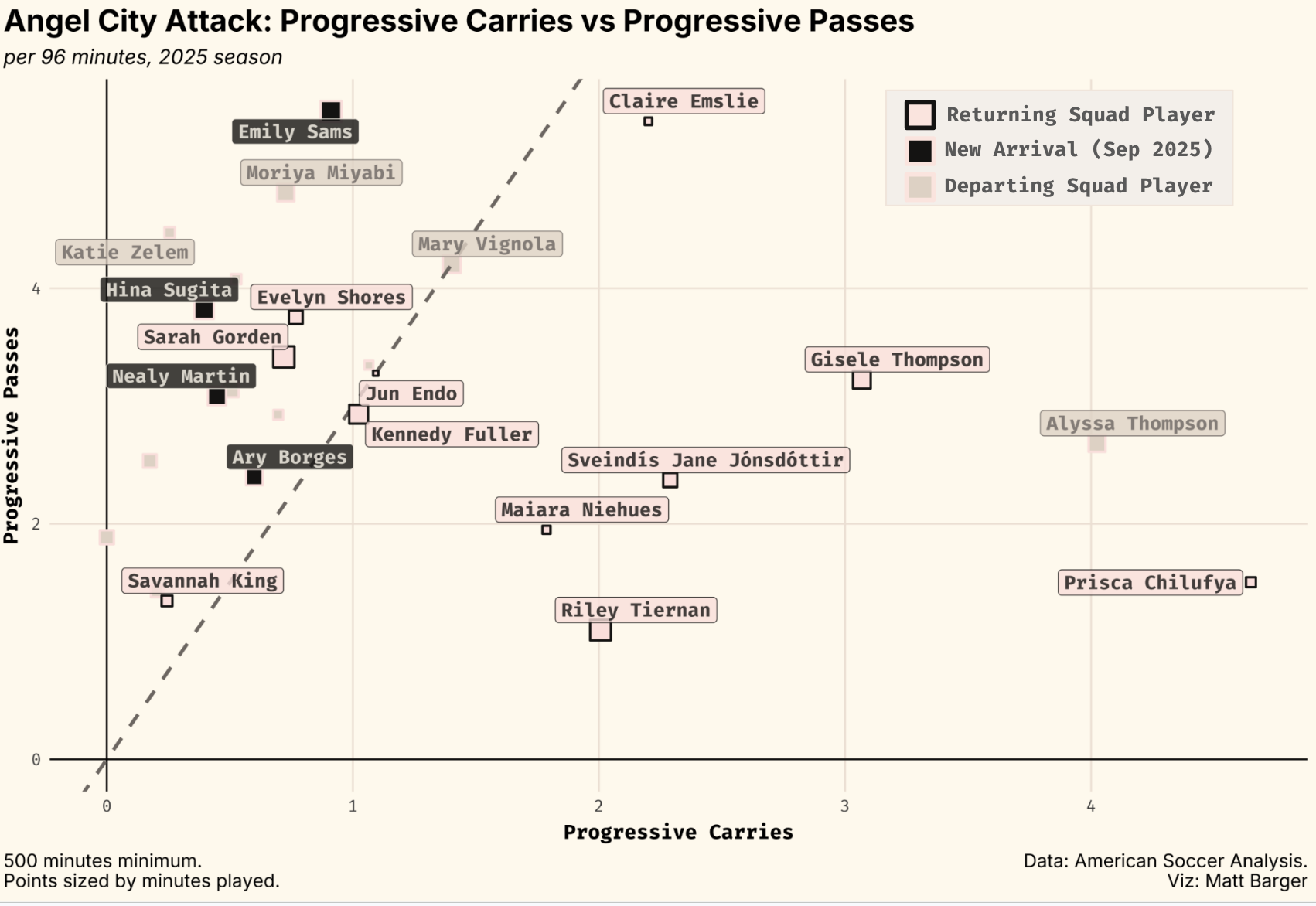
Moreover, who feeds Tiernan the progressive balls she needs? No one jumps off the page. In fact, Angel City’s is losing line-breaking passers instead of gaining them.
Sams is not the first person that comes to mind to feed Tiernan, but the centerback is the most prolific progressive passer in this group; Hina Sugita profiles as an excellent progressor but less of a shot creator. Claire Emslie is still out on maternity leave; her versatility is sorely missed. Returning USWNT legend Sydney Leroux has been more of a finisher than a playmaker historically. Ary Borges isn’t much of a passer either, though her runs from midfield could create a space for Tiernan and Sveindis Jonsdottir to get open.
Thus, the onus falls to Kennedy Fuller and Gisele Thompson to step up the passing attack. Fuller had a prolific second year as a pro, putting up five goals and three assists while deputizing for Emslie. While ACFC are upbeat on Fuller’s potential, the 18-year-old’s statistical readout profiled her more as a progressive receiver than a passer last season. Taylor Suarez, on the other hand, specialized in chance creation at Florida State through her passing. The incoming rookie could fill a key role immediately if Fuller and Thompson fail to spread the ball to Tiernan.
Angel City’s attacking balance remains very much tipped toward dribble dependence with few obvious solutions. Fans should look for the team to open up the space for their young attacking talent to capitalize.
Verdict: Not Top Four, but a Step Forward
Mark Parsons’ timeline may have flown Angel City too close to the sun. To be clear, they should improve. Emily Sams adds defensive leadership to fix the marking issues and a progressive passing acumen to open up the attack. The new-look veteran midfield can be the best version of themselves, the defense could step up its marking and intensity, but there’s still an open question on how the attack doesn’t get in its own way and waste the potential of their young stars.
The gap between Angel City and the top four is too wide to make up with this offseason. Even if all the potential comes good, Angel City has too many open question marks to be rated anywhere near the front office’s lofty ambitions.