
ASA Roundtable: American Soccer Insights Summit
/At the end of January, many members of our ASA Community headed down to Rice University in Houston to talk a whole lot of soccer analytics. ASA Slack was buzzing around so much we figured we’d convene the round table. If you want to hear a podcast version of the conversation around the conference, Ben, Kieran, and Harrison spoke to Arman Kafai about some of the cool stuff going on there.
Kieran Doyle, ASA Show Host: Good morning everyone! Sounds like a lot of ASA faces made their way to the American Soccer Insights Summit at Rice University last weekend. For those of us who couldn't make it, anyone want to share their highlights or pump a specific piece of research that excited them?
Catalina Bush, Owner of the ASA Vizhub: I'm biased in this take because I was involved in the behind-the-scenes process but I think the SkillCorner research presentations continue to be a strong point of the Summit. I thought the quality was really high this year and everyone I talked to agreed that they were really well done.
Matt Barger, ASA Contributor: The level of presentations improved greatly from the previous year. I thought the presentations on pressing and network analysis were great.
Jamon Moore, ASA OG: Lou Zhou, who presented after Devin Pleuler did a great job and gave a fresh perspective on goalkeepers coming out for balls and how to value whether they should or shouldn't. Conceptually, using tracking data, it could improve a bit on the g+ Claiming category by answering whether keepers should or shouldn't come out in various situations.
The one I'll probably ruminate on the most is likely to be the xShot, by Jonathon Pipping-Gamon. It's not the first time xShot as a concept has been considered, but the potential predictive improvement on xG alone is worth looking at more.
Kieran Doyle: The GK Cross claim decision thing is interesting. I remember talking with clubs about using tracking data to make a physics based model of: here are the players, here is the trajectory and the pace of the cross, do you have a realistic claim for this? Like a suped up xClaim.
Jamon Moore: There is also a use case for coming out for throughballs and other balls in front, too. That was something shown in the presentation.
Kieran Doyle: I think from the outside, and something Ben/Harrison and I talked on the pod was, I was pleasantly surprised with the variety of approaches we saw here.
Meredith Shea’s offball run paper gave me the same vibe as the really seminal Borne/Fernandez off ball movement paper at Barcelona, and I'm a sicko for defending so loved some of the passing lane and transition defending stuff.
Harrison Crow, ASA Council of Elders: I also really enjoyed Meredith Shea and "Off-Ball Run Value: Quantifying the Quality of Off-Ball Runs”. Not only was it something unique and added to the conversation but the presentation was so well balanced between the approach, model and impact. I felt it was the most complete presentation.
My runner-up was "A Geometric Framework for Measuring Preventive Defensive Positioning in Women’s Soccer" by Luke Blommesteyn. I had the privilege of running into Luke like in the first ten minutes of the conference and was immediately excited for this presentation and it did not disappoint.
Nate Gilman, ASA Contributor: As an enthusiast attending for the first time, I went into the weekend looking to learn about cool new stuff going on in the soccer world and to hang out and have interesting conversations about it, in really no particular order. The two presentations Harrison mentioned, plus Maddalena Toricelli's one on off ball impact using tracking data and network analysis, were probably the most interesting to me in terms of what's happening on the field as the season kicks off.
More broadly, as a casual user of data in soccer, it was really interesting to hear how from experts about smaller pieces of the whole. So my bigger, and somewhat unexpected takeaway from the weekend, was how everything fits together in the effort to make soccer teams better. I hadn't thought much about how teams structured their data processes and what impacts those foundational decisions might have on the field, but now I am.
Akshay Easwaran, US Soccer Data Engineer: Along that same line - I felt like the theme of day 1 / the industry talks was alignment: on game model, on terms, etc. Clubs can build strong foundations by creating operational definitions for how they want to play / how they see that on video / how they measure and evaluate that via data / how that data is collected and being very very persnickety about how those definitions get disseminated and used for coaching, development, scouting.
Game models mostly aren't unique so the advantages seem to be in how you adjust to micro/macro trends (in games / based on market trends), and how well you communicate and stick to the principles you've defined as an organization.
Kieran Doyle: Harrison and Arman both spoke at length on the pod about how open Carlos Vela from Alajualense was about their game model and the integration of data into that, which was a very cool topic.
Akshay Easwaran: Oliver had a good complement to that too: one of the points I took away from him is that with so much data out there (on Twitter, BSky, Fotmob, etc), you have to make sure you and everyone around you knows exactly what metrics actually matter and why they matter.
Kieran Doyle: Somebody posted a slide maybe in the discord or on bsky showing the game model principle and the attached evaluation metric that I liked. It was a good example of what I think a “data driven organization” actually is. We normally think of that for recruitment involvement, but this I think almost matters as much.
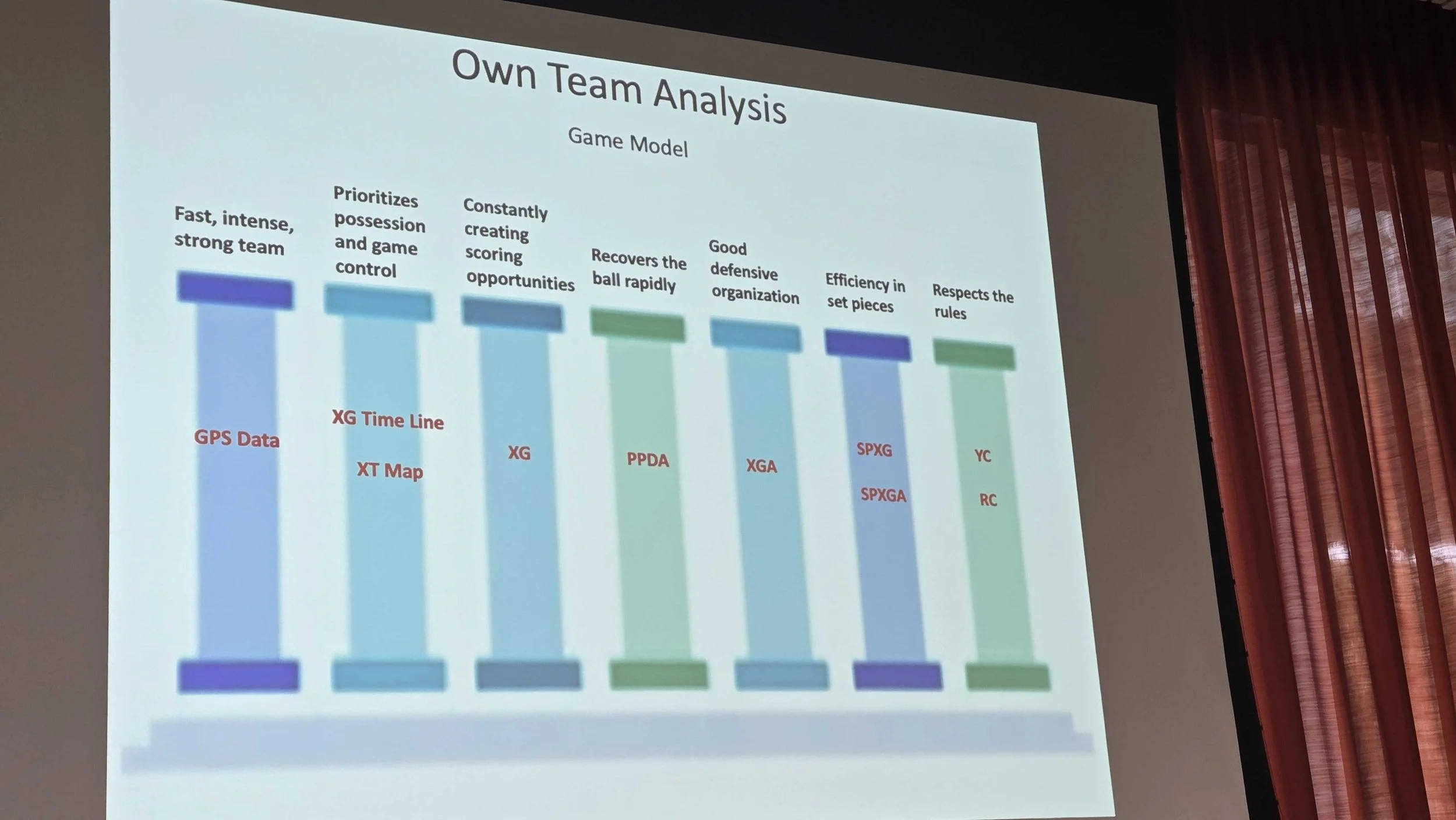
Matt Barger: Define how the data drives decisions. A coach I spoke to at a roundtable made a point of holding their players to a certain number of retention metrics and then having them all celebrate when they hit it.
Akshay Easwaran: I will also plug our USSF panel, which was a great discussion on how data/video/coaching work together. Again: alignment.
Nate Gilman: Need someone to hype up the DuckDB talk.
Akshay Easwaran: I'll stan the DuckDB talk, I'm all for more engineering content at sports conferences. This is the type of stuff that people don't think about at a hobbyist level or at a single club level because they usually don’t have to. Scale and performance at scale end up being important when you're shipping software to multiple clubs like Teamworks.
Brian Greenwood, ASA Backend Whiz: I specifically went up to Adam afterwards and complimented the presentation.
Harrison Crow: Yeah, I want to follow up about how difficult it is to have these types of conversations. It was great that it came from Adam because clubs can't, or usually prefer, not to give this type of insight. I'd be very cool to see more engineering solution driven content like this.
Caleb Barrett, ASA Contributor: I grabbed dinner with Andrew on Thursday and we chatted about using DuckDB for storage and analysis, so it was really cool to see it in visual form during the presentation the next day. I'm using it for my project, so the timing worked out perfectly.
Jamon Moore: I also really liked the roundtables, but I'm all about meeting people I don't know there. I think most of the questions and conversations were interesting, although some kinda left the college students out a bit.
Akshay Easwaran: There was a wider spread of hobbyists and college students this year than last. Timing of non-USLSL preseason makes it hard for club staff but it was great to chat with those that were there. Was also very fun to poke at the Minnesota United folks in the roundtables on set pieces.
Kieran Doyle: The roundtables were a big highlight in my conversations talking with people post conference. Just nerds talking ball with no right answers.
Harrison Crow: It was cool to hear from people at club’s about some of ASA’s work. Somebody told us how close Lucas Morefield’s recent case study on valuing GK’s like Dayne St. Clair was to how they would do it internally.
Jamon Moore: Devin's presentation about MLSE's R&D, particularly the NBA skeletal demo, was fantastic. I wish he had a lot more time.
Matt Barger: As always, the discord chatter was A1; it felt like a relevant twitch stream chat in real time, the Expected Own Goals live podcast was also a highlight again.
Kieran Doyle: I’d be half following a long at work via discord, would go do something and would come back to 200+ messages on somebody’s model decisions. Pretty funny.
Evan Davis, Expected Own Goals: You can find that live podcast with Houston Dash analyst Chloe Dhillon and ASA’s own Catalina Bush on Youtube here:
Kieran Doyle: Anyways - we’ve all gotta get back to work, glad everybody who went had a good time, and hopefully see y’all next year.
If you want to follow some of the research from the event, papers can be found on the conference website here, and presentations were uploaded to this Youtube channel last year.