
2026 MLS Previews: LAFC, Vancouver, San Diego
/Our 2026 MLS Season Previews have started and today we hit LAFC, the Whitecaps, and San Diego. If you want to support this coverage of the league, you can head to our Patreon. For $5 a month you can get access to a lot of the data visualization tools we use to make these previews.
I Left My Wallet in El Segundo
By Kieran Doyle and Ben Bellman
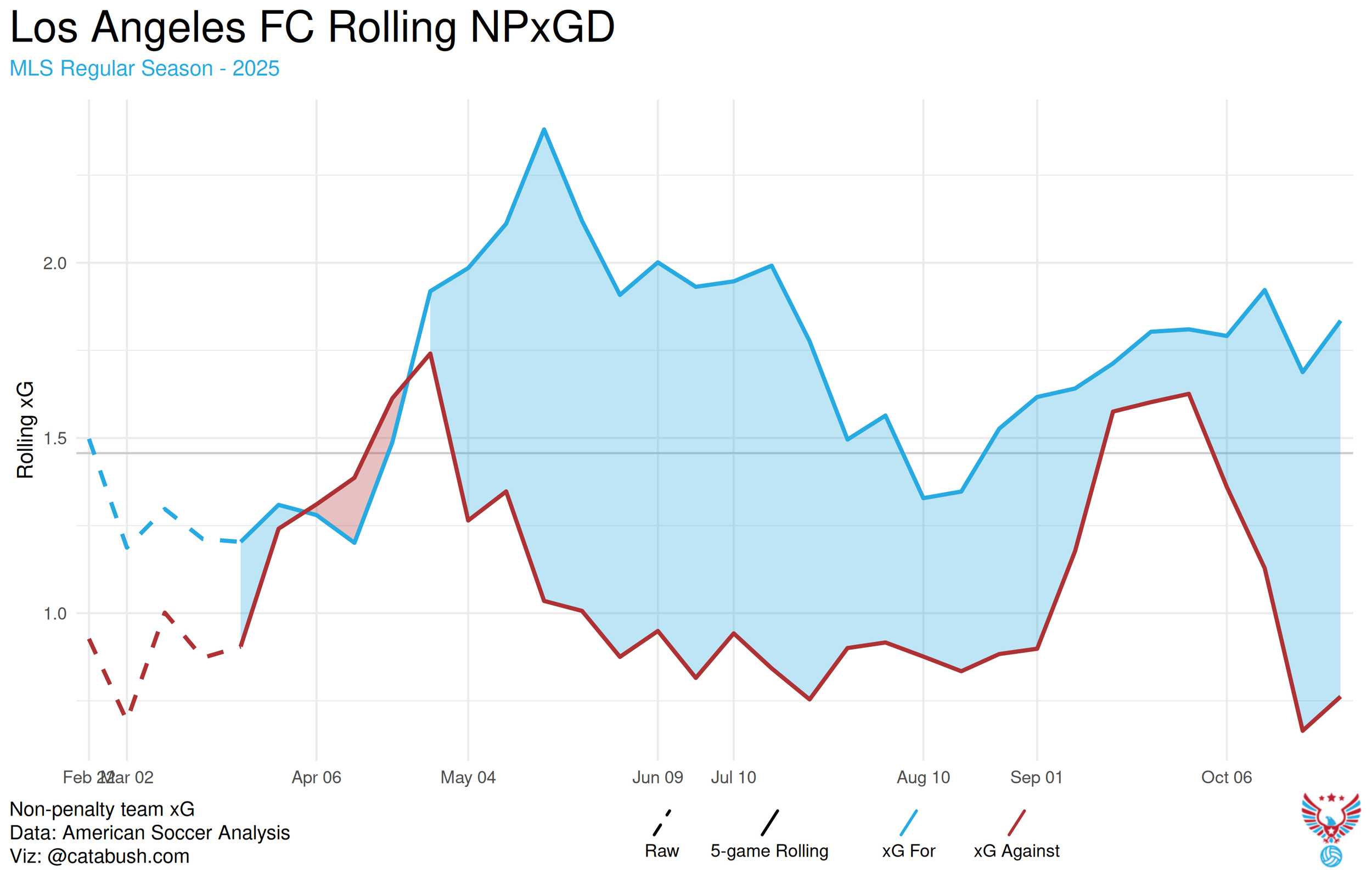
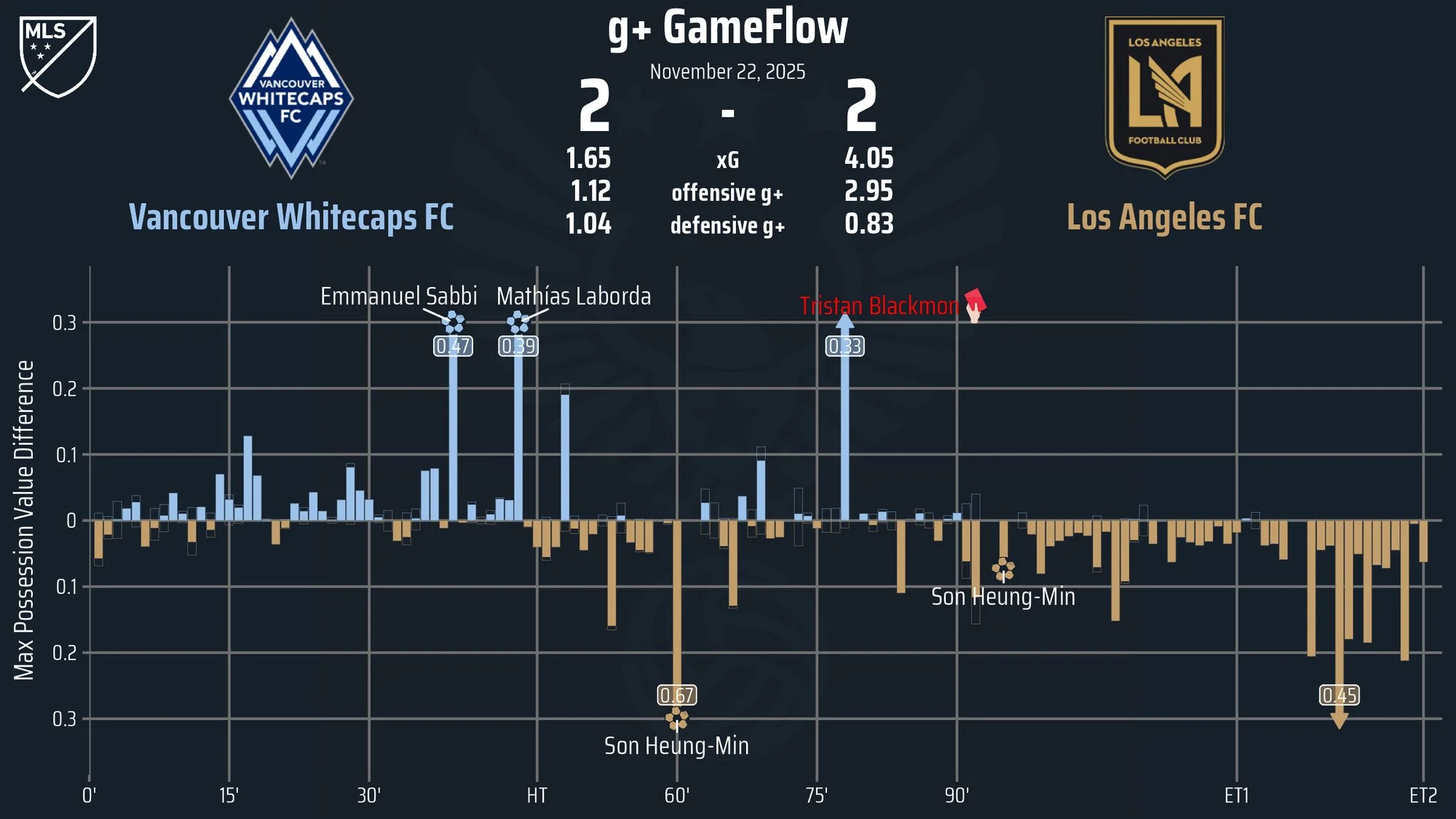
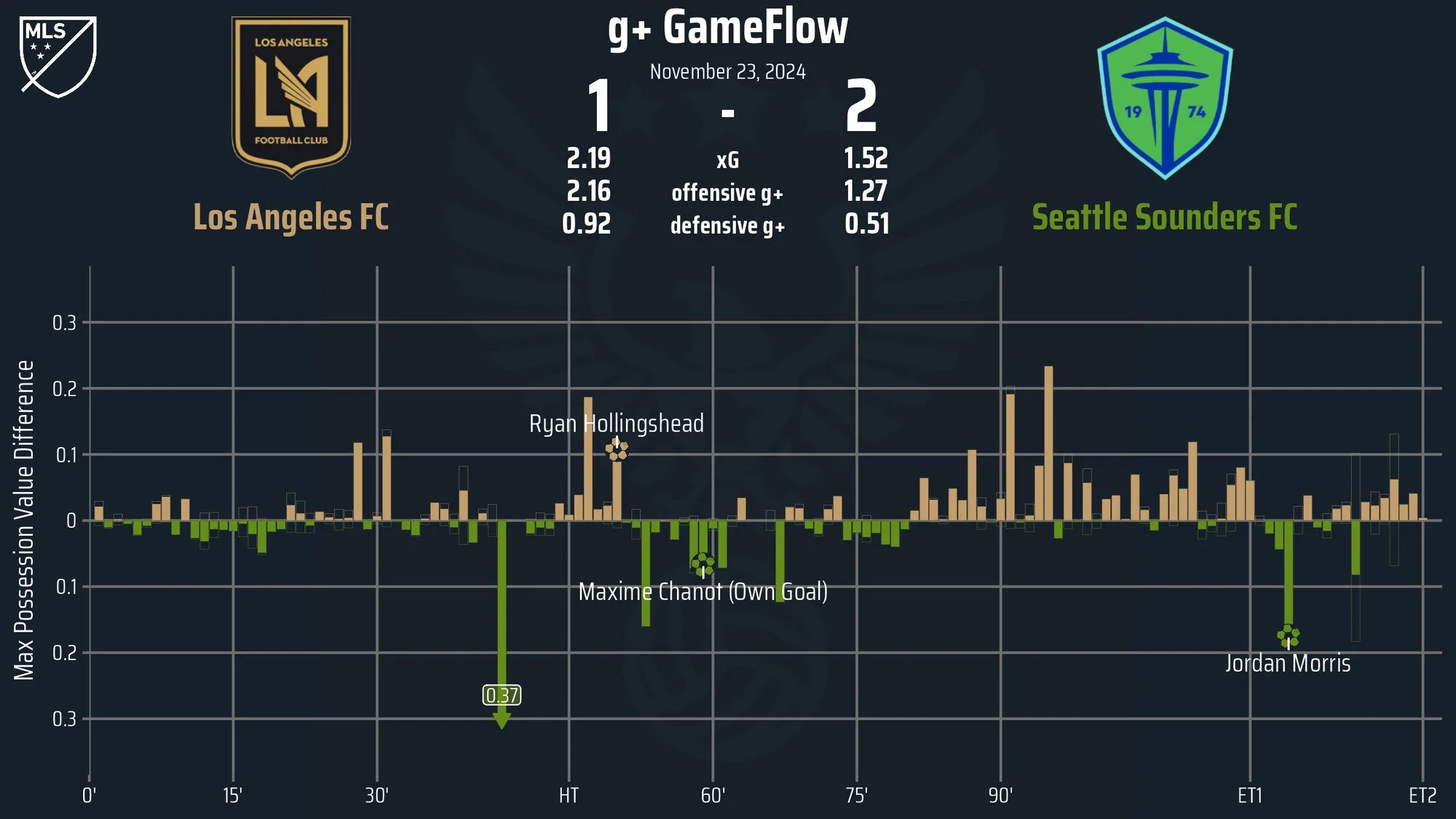
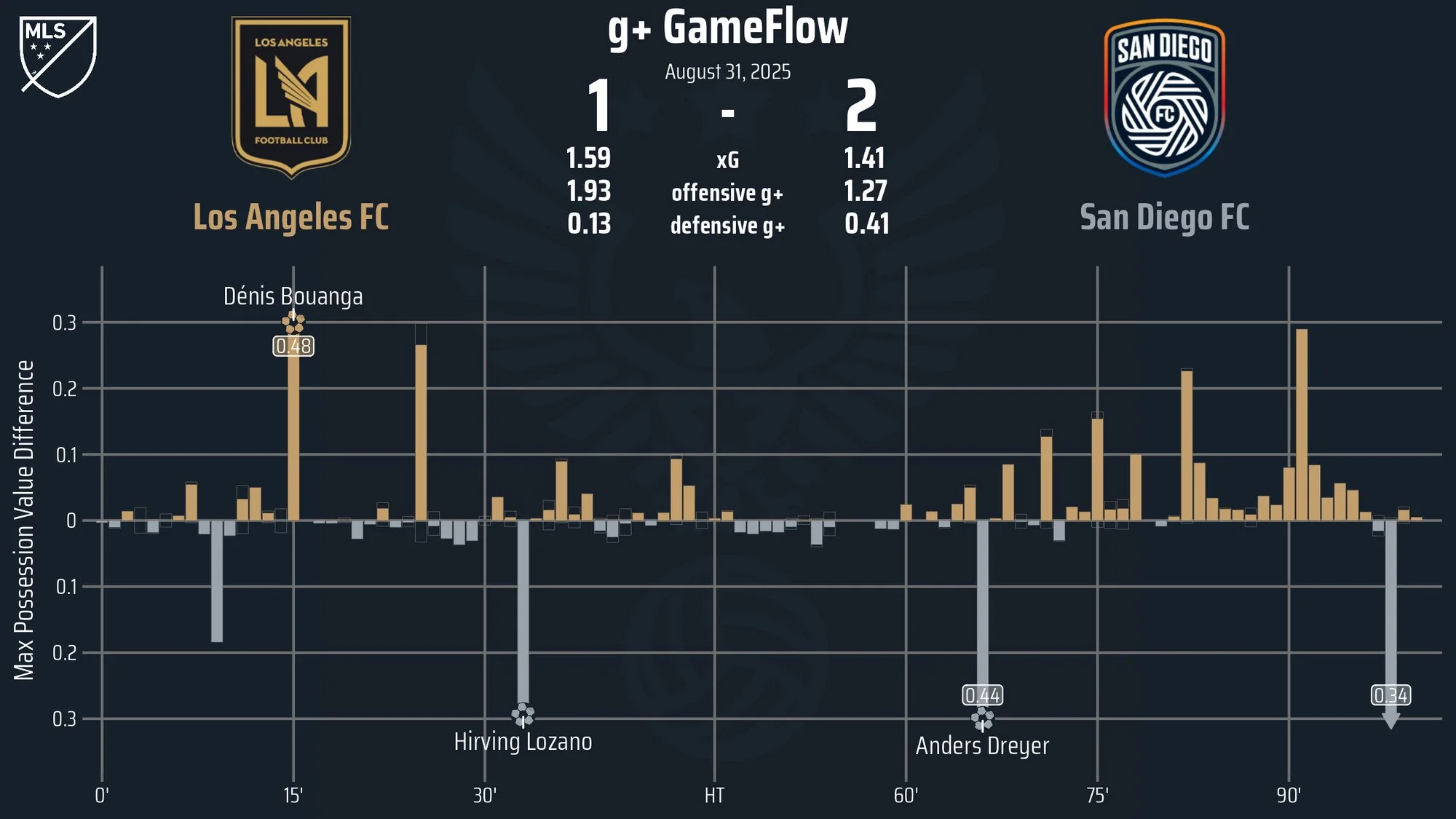
One must imagine LAFC, like Sisyphus, happy. They have rolled their MLS Cup hopes so near the top of the hill for two years now, just to have them roll all the way back down. By xGD, LAFC were the second best team in MLS, and in 2024 they were the best. By goals added difference? Second best in 2025, best in 2024. But in both years, their season ended in a dramatic, gut-wrenching way after regulation in the conference semifinals. But 3252, do not despair! You are sure to roll your hopes almost to the very top yet again! And isn’t it in the striving for excellence that true happiness is found?
Steve Cherundolo is done rolling stones, though, and moved back to Germany with his family at the conclusion of 2025. The perception among fans and analysts alike was that in the biggest moments, Cherundolo probably got too conservative. LAFC would take a bad loss somewhere, in this case a 2-1 home loss to San Diego in August, go back to a back five and play bunker counter for rich guys, and see where they land. I have also felt that way, but it’s somehow difficult to square that with a team who has skewered teams in the regular season for two straight years. It’s difficult to square that with a team who after the aforementioned San Diego loss, rolled off eight wins in their next 10 matches, before going down to Vancouver. Again, in a game, much like their elimination to Seattle the year prior, they probably deserved to win. New head coach Marc Dos Santos, long time LAFC assistant under both Bob Bradley and Steve Cherundolo (sandwiching a disappointing stint in Vancouver), is intimately familiar with the club’s culture and strengths, so one can hope he just keeps that big stone rolling.
It’s often said that data and analysts pay for themselves by pressing a giant “Don’t Do That” button when a suit has a Big Idea to do something. Hopefully, everyone around John Thorrington is slamming that button every day. There’s a new coach, but this is a team that needs to stay the course. Keep doing the things you’ve been doing, because it’s working. One of these weird stupid knockout games you’re going to win.
Transfer Business
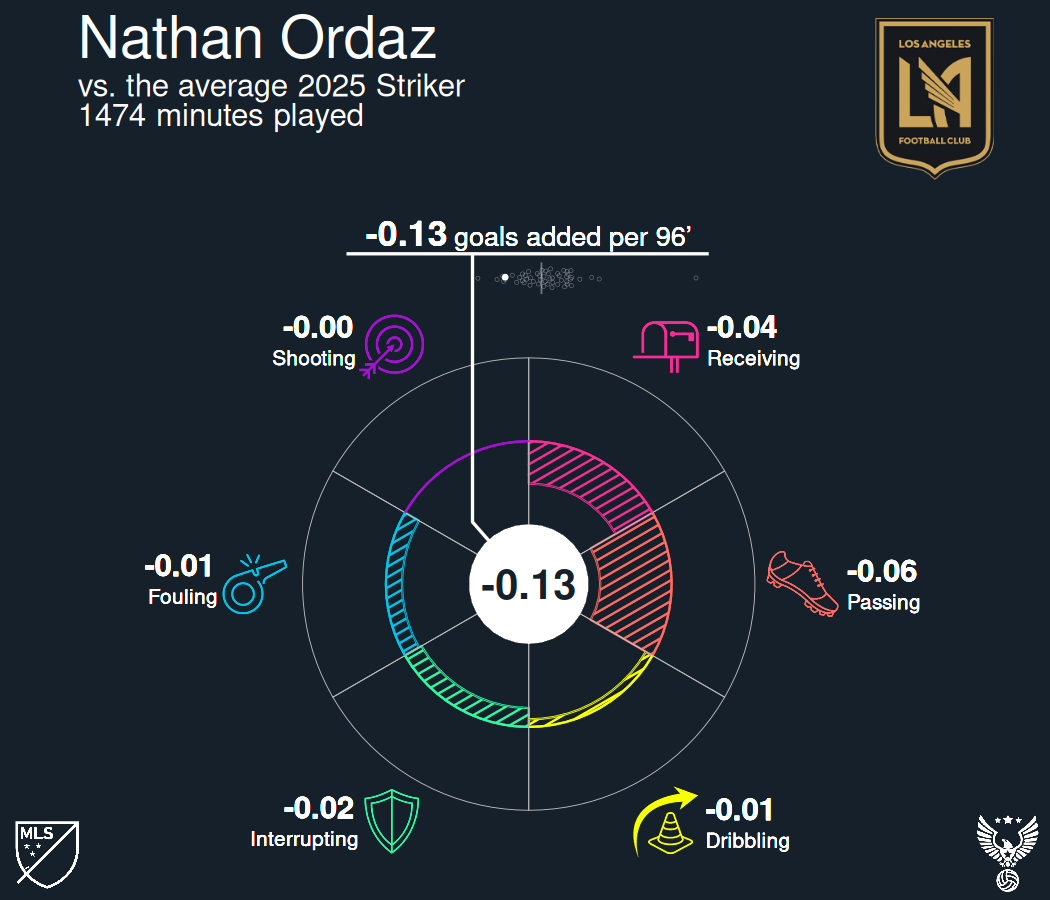
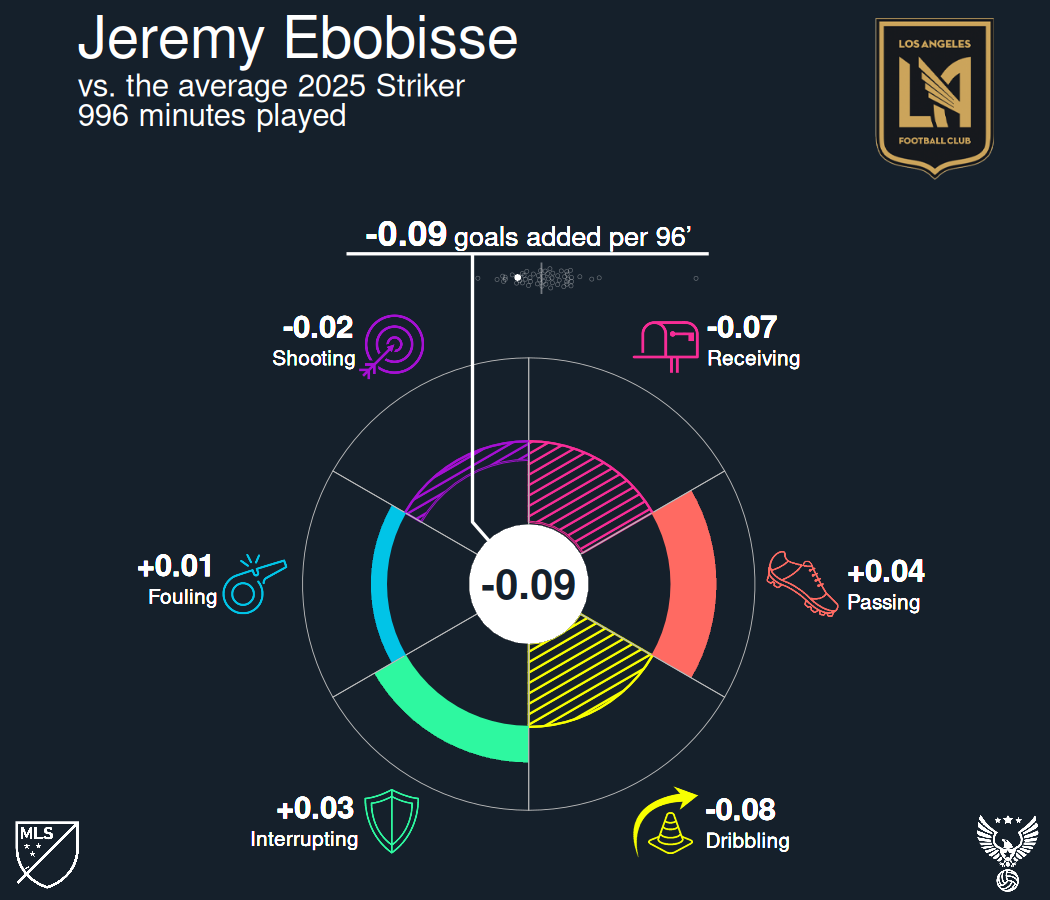
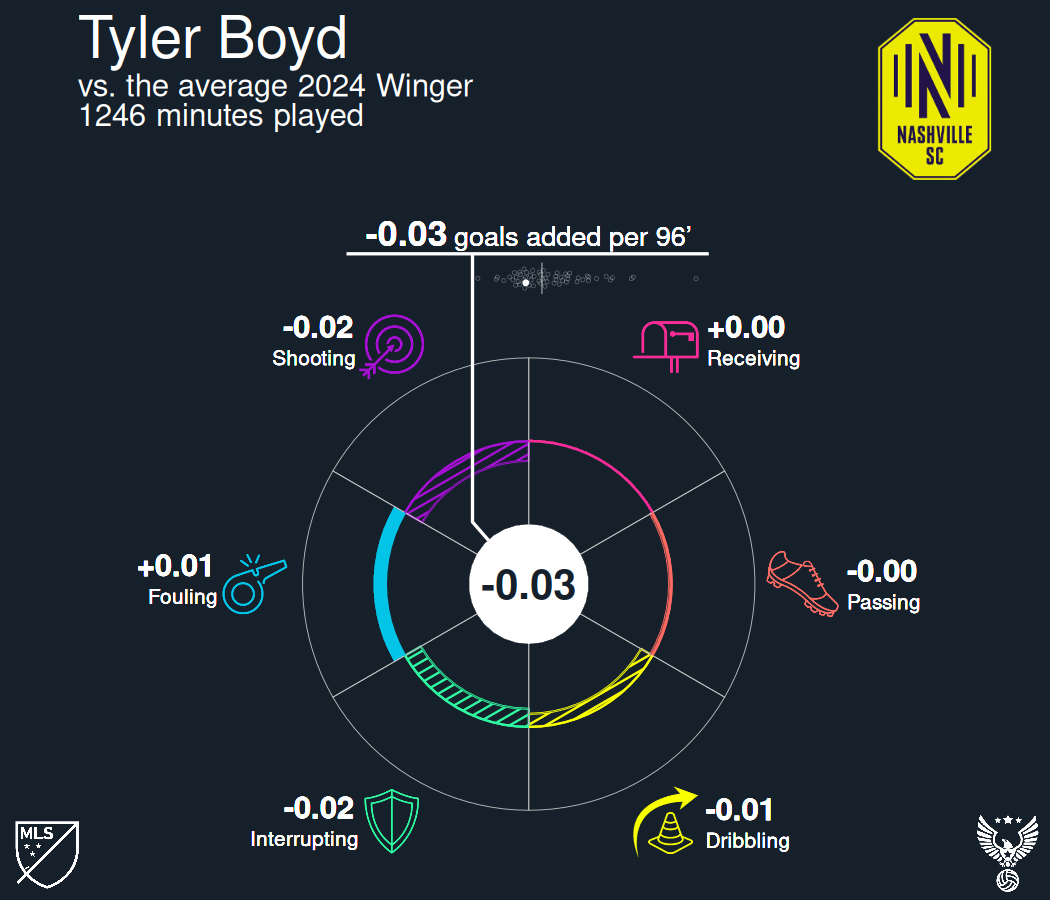
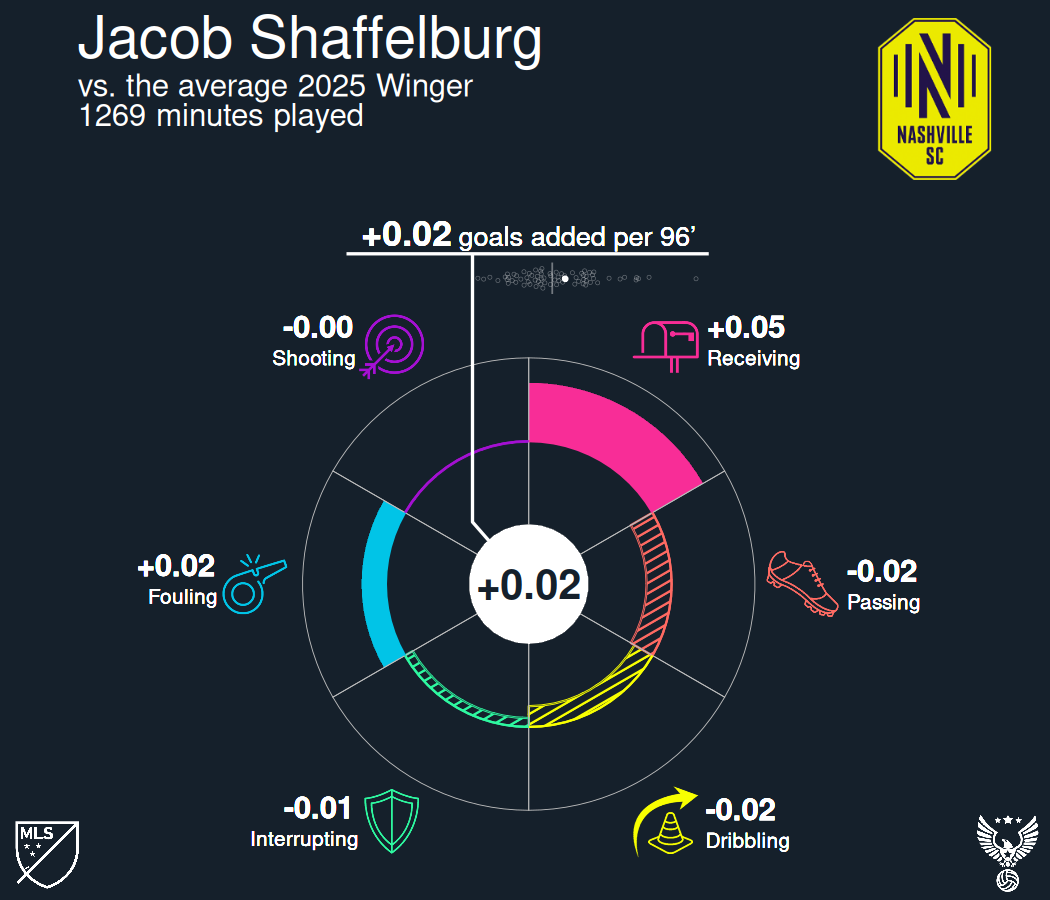
LAFC has moved on from some opportunistic loans (Andrew Moran, Franuel Amaya, Odin Holm, Marlon) and activated the purchase option on Mathieu Choiniere. Yaw Yeboah had his contract terminated after a league suspension, while Adam Saldana, David Ochoa, and Jailson’s contracts expired, Alexandru Baluta left on a free transfer, and Maxime Chanot retired. None of those guys really played, and represent just cap churn.
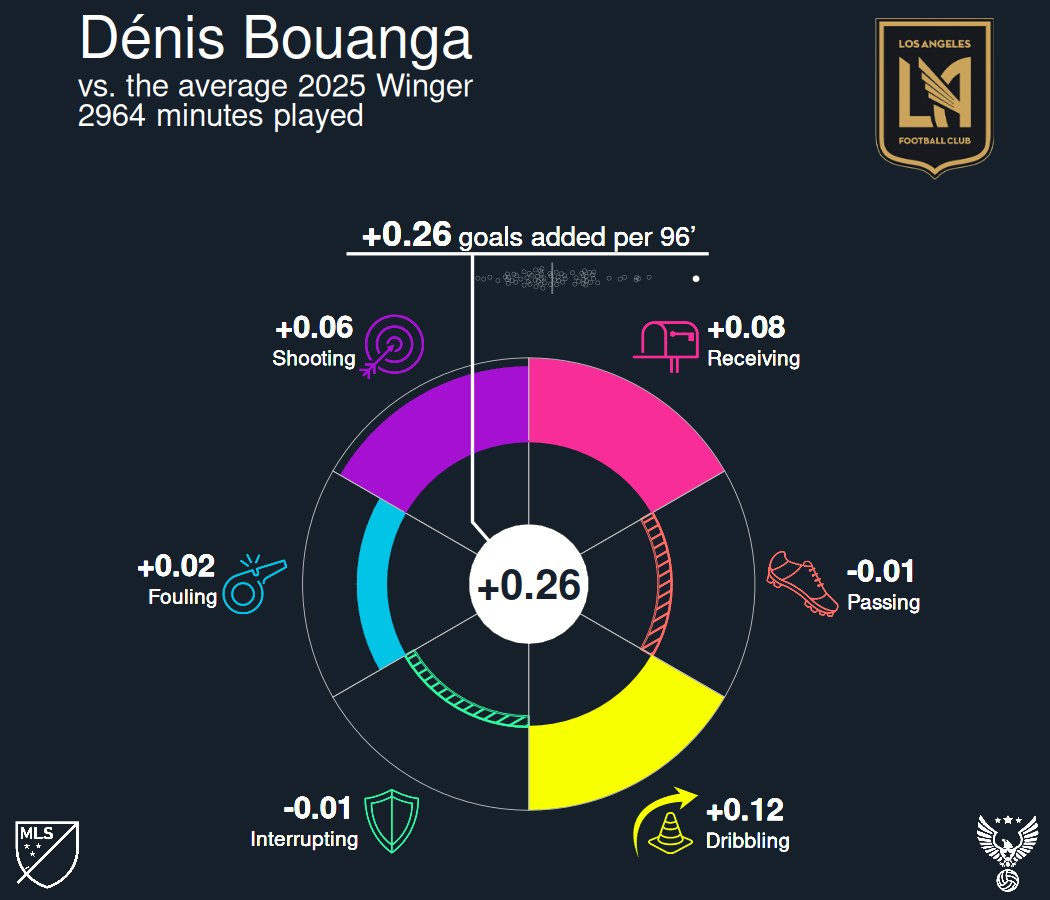
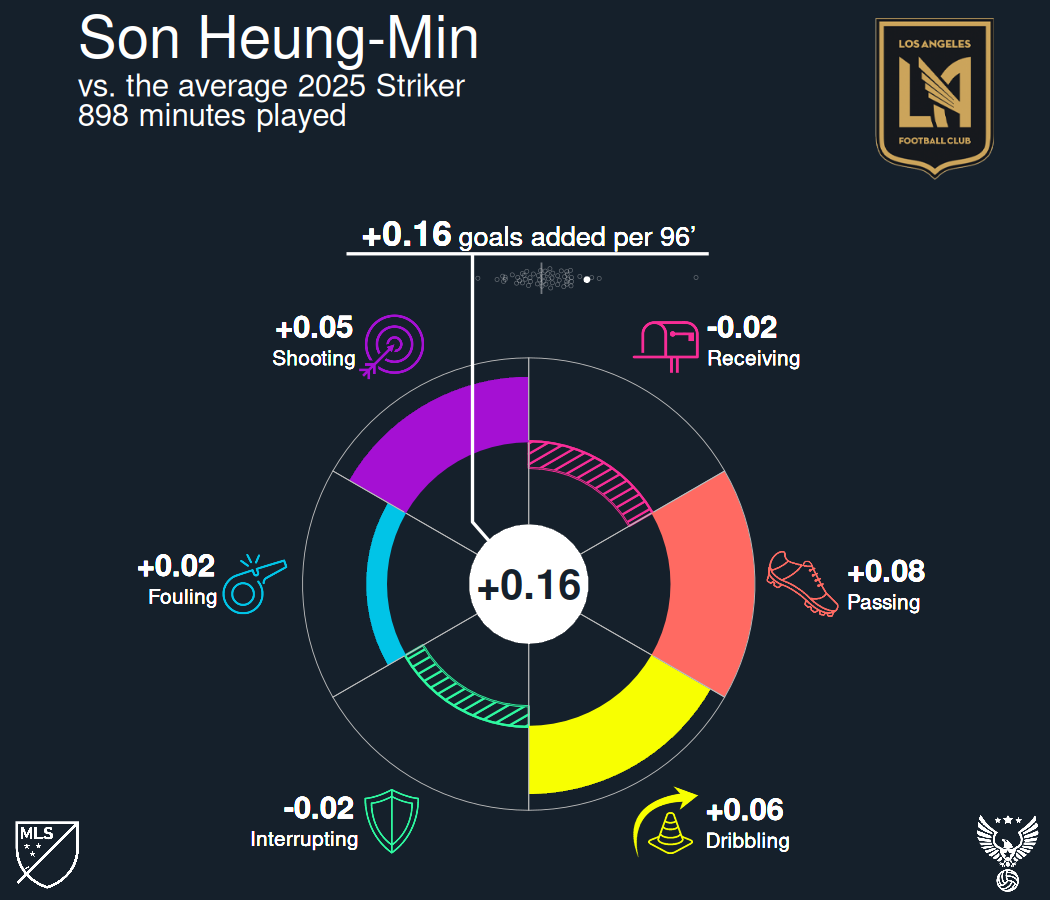
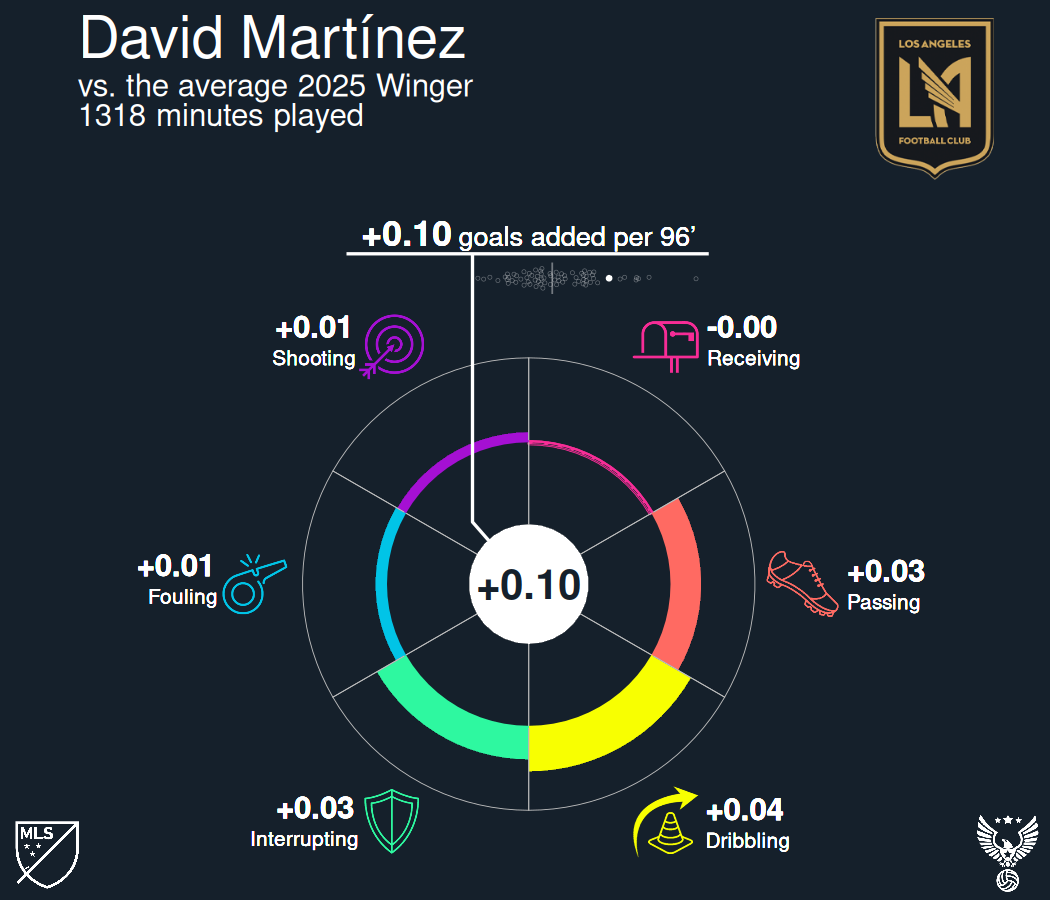
The Black and Gold’s first big offseason move was trading $1M in GAM for Nashville winger Jacob Shaffelburg. Denis Bouanga was the only consistent contributor from wide areas for LAFC in 2025, while seven other players provided over 500 minutes as a winger. That’s a lot of dudes to try and keep in your plans. Shaffelburg and waivers pick Tyler Boyd add to the depth in that spot, perhaps to the point of overcrowding. Heung-Min Son is yet to feature in preseason and will be missing time to focus on South Korea’s World Cup campaign, but keep an eye on LAFC to play three attackers more frequently, or for one of the two young contributors (David Martinez and Nathan Ordaz) to move on. Frankly, I’m not sure about the Boyd move. He has not been productive in MLS for quite some time, and has battled fairly extensive injury troubles. As has Jacob Shaffelburg, who has been very good when available, and is virtually a perfect stylistic fit both at winger and wingback for the bunker counter version of LAFC.
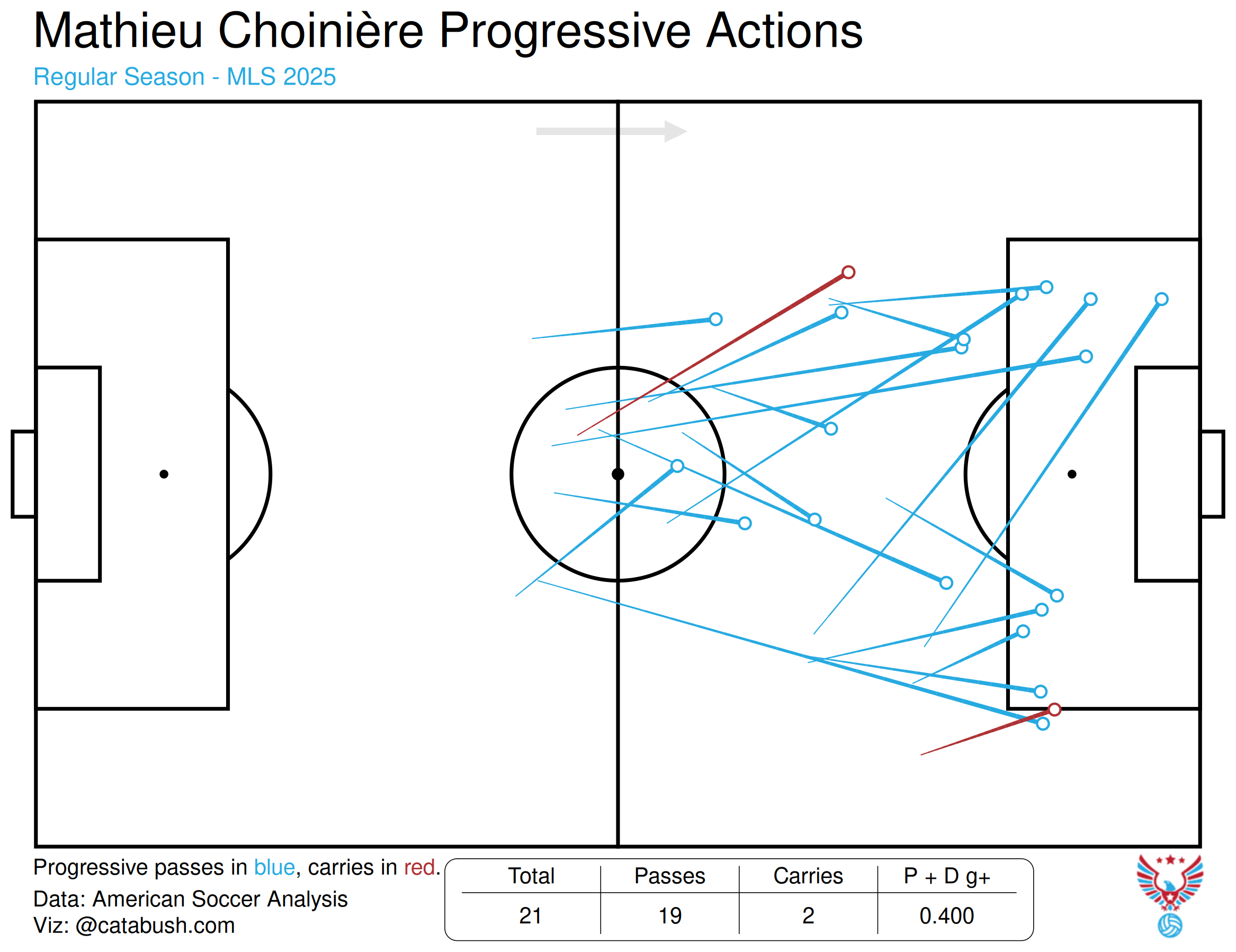
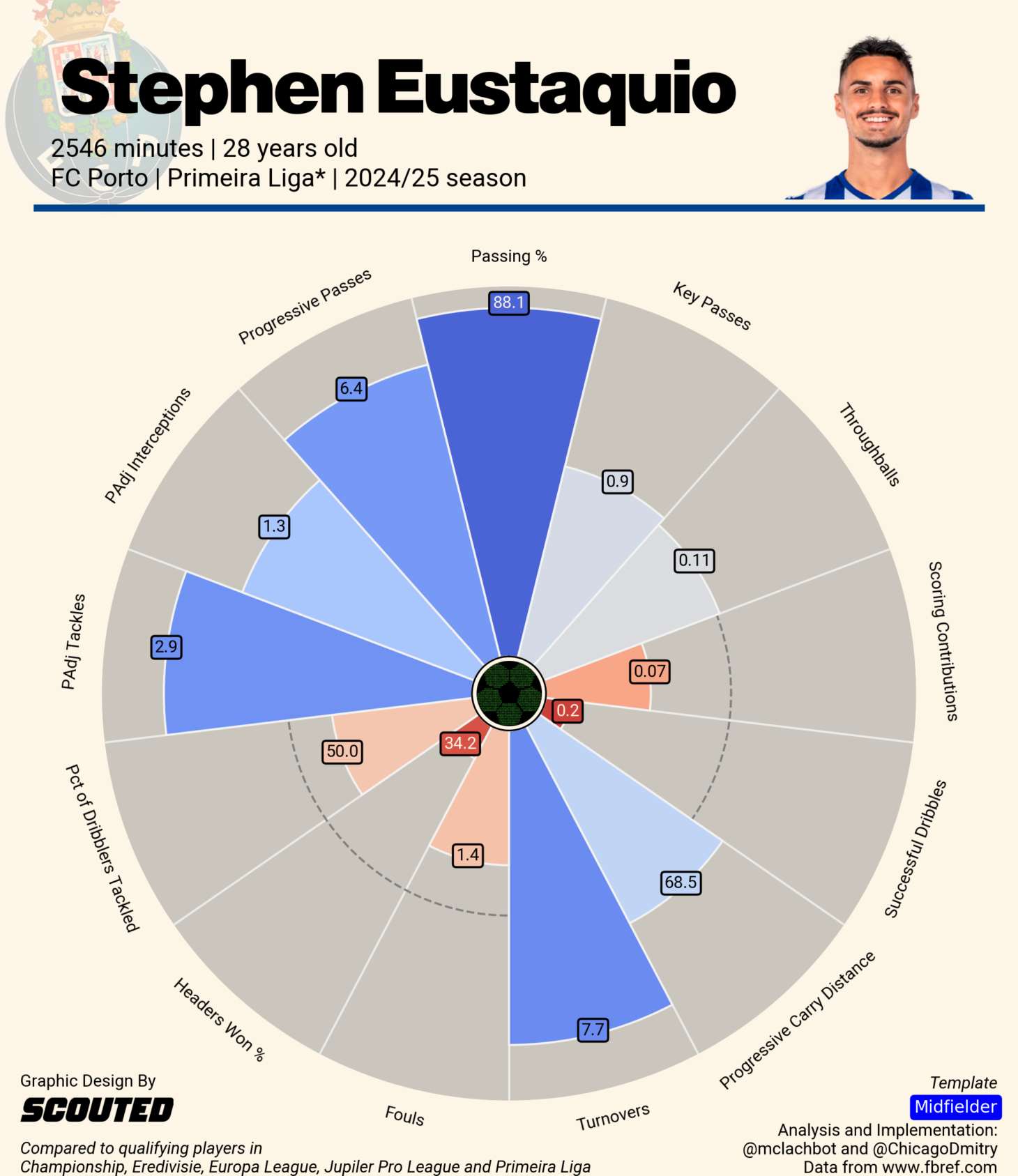
Further back, LAFC strengthened a midfield they already re-tooled last season. Packing on to the addition of Igor Jesus and Mark Delgado in winter 2025, they made permanent the deal for Mathieu Choiniere, and added DP midfielder Stephen Eustaquio on loan from Porto. Choiniere and Eustaquio have linked up frequently for Canada, but it is rare to get midfielders who can pass, dribble, carry, shoot, and ball win at a high level. Eustaquio might be the best passing midfielder in the league. This is all before spending north of $3M on Swedish midfielder Amin Boudri. I am extremely Boudri skeptical. In projecting out college basketball projects to the NBA, there is an analytics idea that “steal rate” extremely predictive of players ability to scale up the big leagues. Players are so able to see the game they just go steal it. I think non attackers scoring goals is the equivalent of this in soccer. Boudri’s career goal assist output from midfield is quite low, particularly in Primavera (Italian U19s) with Venezia.
In the defense, the only real issue is lack of depth. Center backs Aaron Long and Lorenzo Dellavalle both have long term injuries, leaving only Eddie Segura, Nkosi Tafari, and Ryan Porteous active on the roster at that position. All three are perfectly capable of being a solid starter, but that leaves LAFC a month-long injury away from a potential crisis in defense. And while it’s hard to imagine anyone other than Ryan Hollingshead and Sergi Palencia lining up at fullback, their only official backup is Artem Smolyakov. Perhaps Shaffelburg will get some minutes in place of the 34-year-old Hollingshead, but he’s just too good to not play if he can go.
What do they need to change?
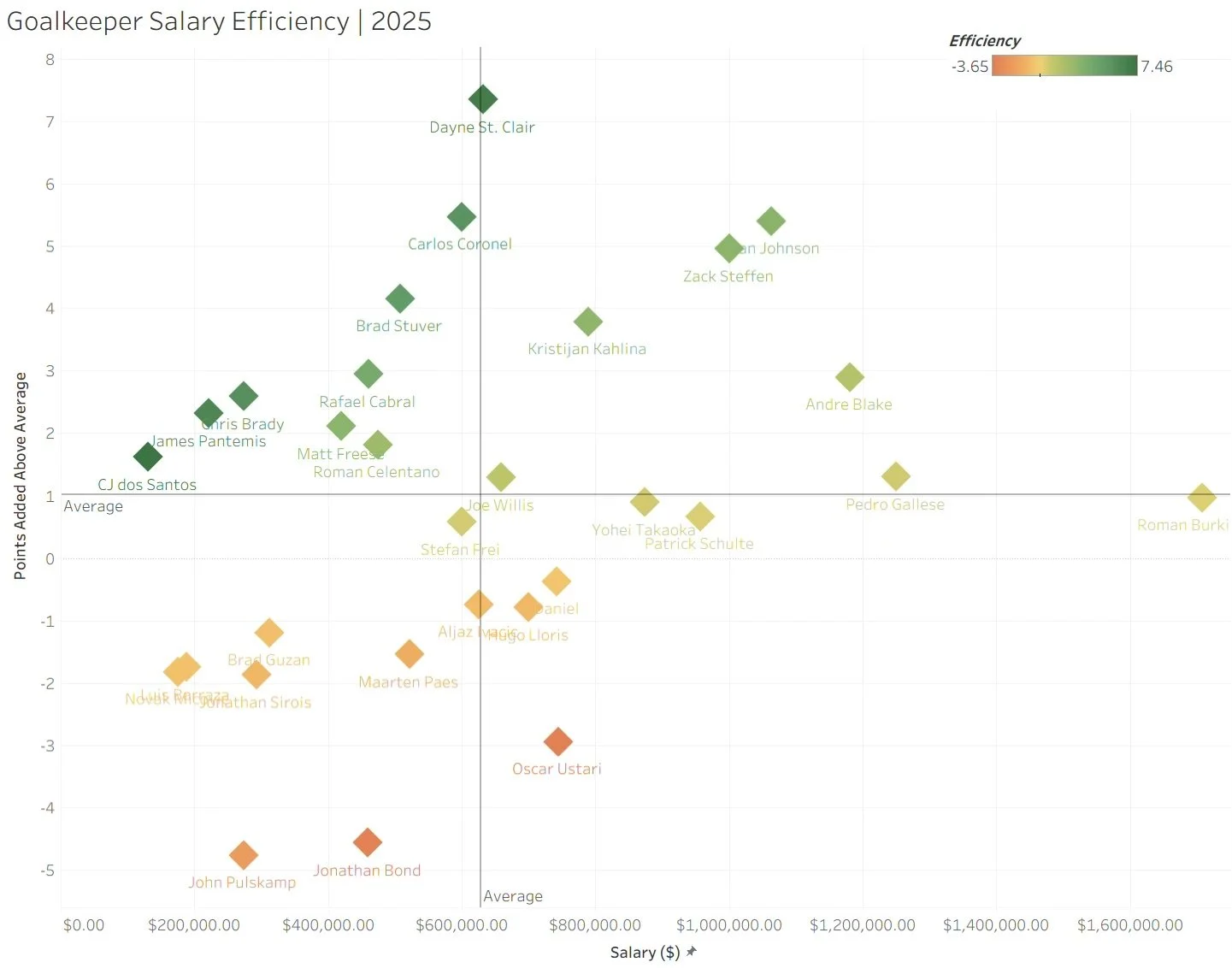
Like I said before, very little. If I was being critical, this is probably a team who needs to answer the goalkeeper question sooner than later. Lloris is expensive, and has largely been not very good in LA. Take this plot from Lucas Morefield’s analysis of goalkeeper value in MLS, Miami dropped Oscar Ustari (near the bottom) for Rocco Rios Novo down the stretch, on the way to winning MLS Cup. If we go back to the Seattle, San Diego, and Vancouver games mentioned at the top. All three feature goals a Scottish commentator would scream “What’s the goalie doin’?” at. While LAFC have sought to reduce variance, reduce the risk of MLS After Dark happening to them, Lloris is a sleeper agent.
This team is legit. If they can hold on to Denis Bouanga, keep Son fit, and the new guys don’t mess it up, they’re even more legit. Press the big red button.
Turns Out The Out of Touch Pundit Underestimating The Whitecaps Was me All Along
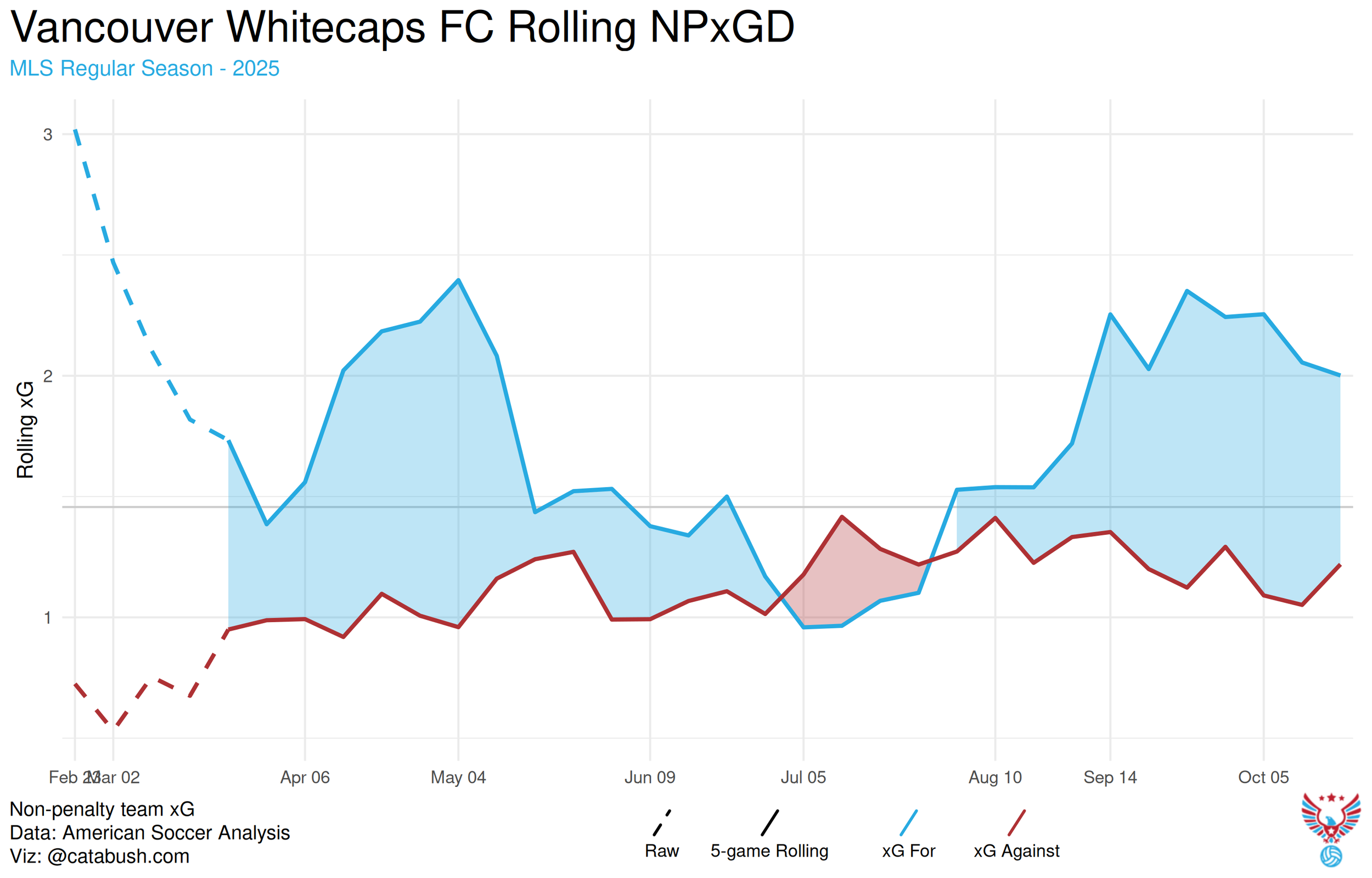
In 2025 the Vancouver Whitecaps blew everyone’s expectations, including mine, out of the water. Even the most optimistic of projections heading into 2025 had them battling for a low playoff spot. But they came 2nd in the West, had a league leading 0.77 xGD/96 (the real prize, obviously), and reached the final of both the CONCACAF Champions Cup and MLS Cup. Reason A1 they were able to defy the critics was player development. It was as if every Whitecap under the age of 25 sat up in bed one day and said to himself “you know what? I’m him.” Ali Ahmed, Jayden Nelson, Pedro Vite, Sebastian Berhalter, Edier Ocampo, Ralph Priso, and rookie Tate Johnson all took significant steps forward and played a big role in the Whitecaps’ success. The result was that the supporting cast of the ‘Caps roster was significantly stronger than anybody in the public sphere had bargained for.
Although the Whitecaps’ squad was a lot stronger than expected, it was also very thin. They began the season with just 17 players on their senior roster. One of these was 3rd string goalkeeper Adrien Zendejas and another was the husk formally known as Damir Kreilach. Season ending injuries to veteran fullback Sam Adekugbe and leading centre-back Ranko Veselinovic meant that the number of usable senior players the Whitecaps had to draw on was very few indeed. This was somewhat mitigated by the excellent performance of supplemental roster players like Ahmed, Johnson, and Priso but by the middle of the season some cracks were starting to show.
You will notice that the Whitecaps started the season absolutely beating the brakes off of everyone, had a big dip in the middle, and then finished the season once again beating the brakes off of everyone. One might correlate the decline with a CCL hangover and the rise with the arrival of Thomas Müller in the secondary transfer window. But I think a better explanation is the ‘Caps simply didn’t have the manpower to deal with fixture congestion, injuries and international call ups that their success brought them.
Squad Changes:
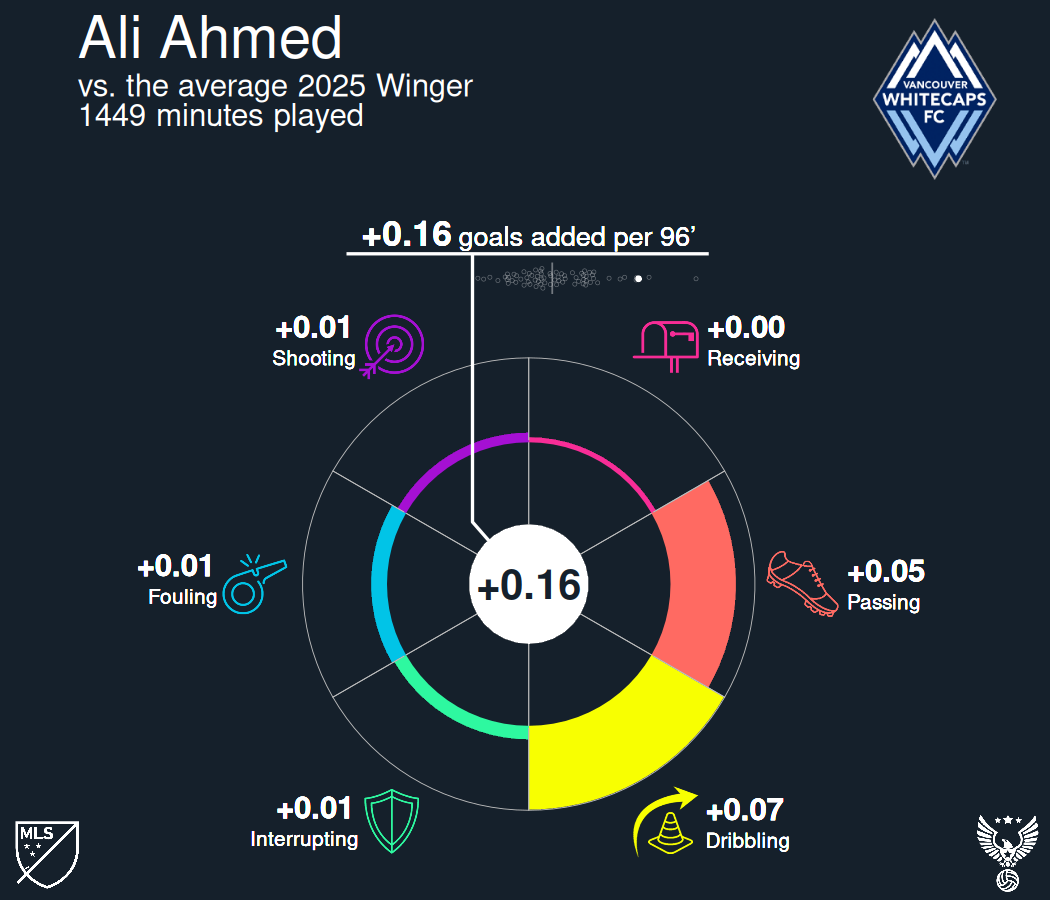
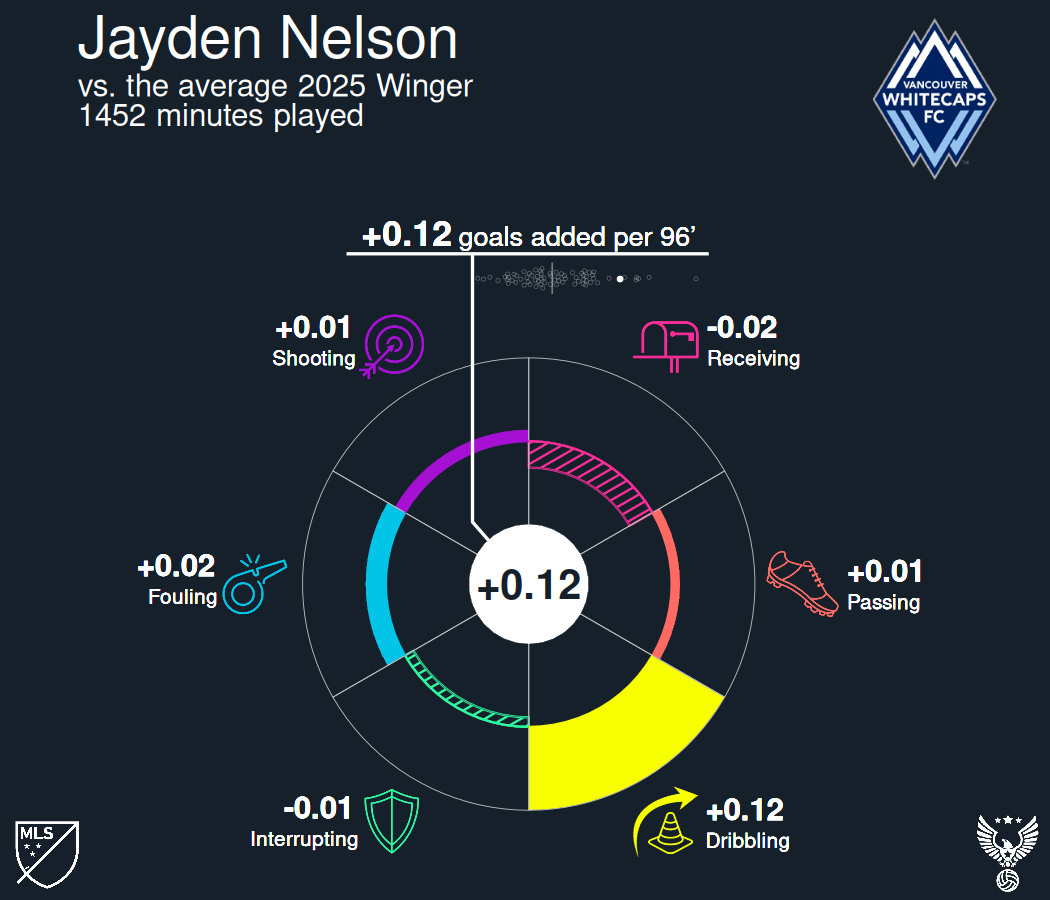
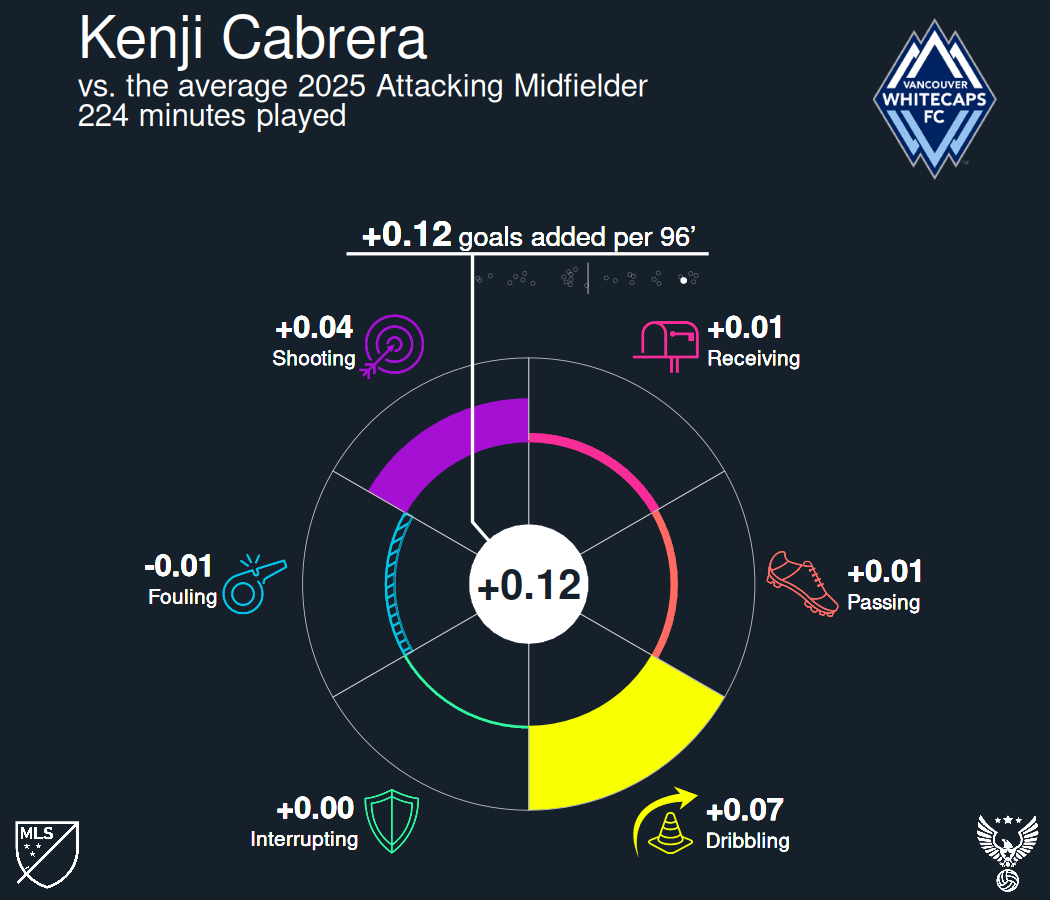
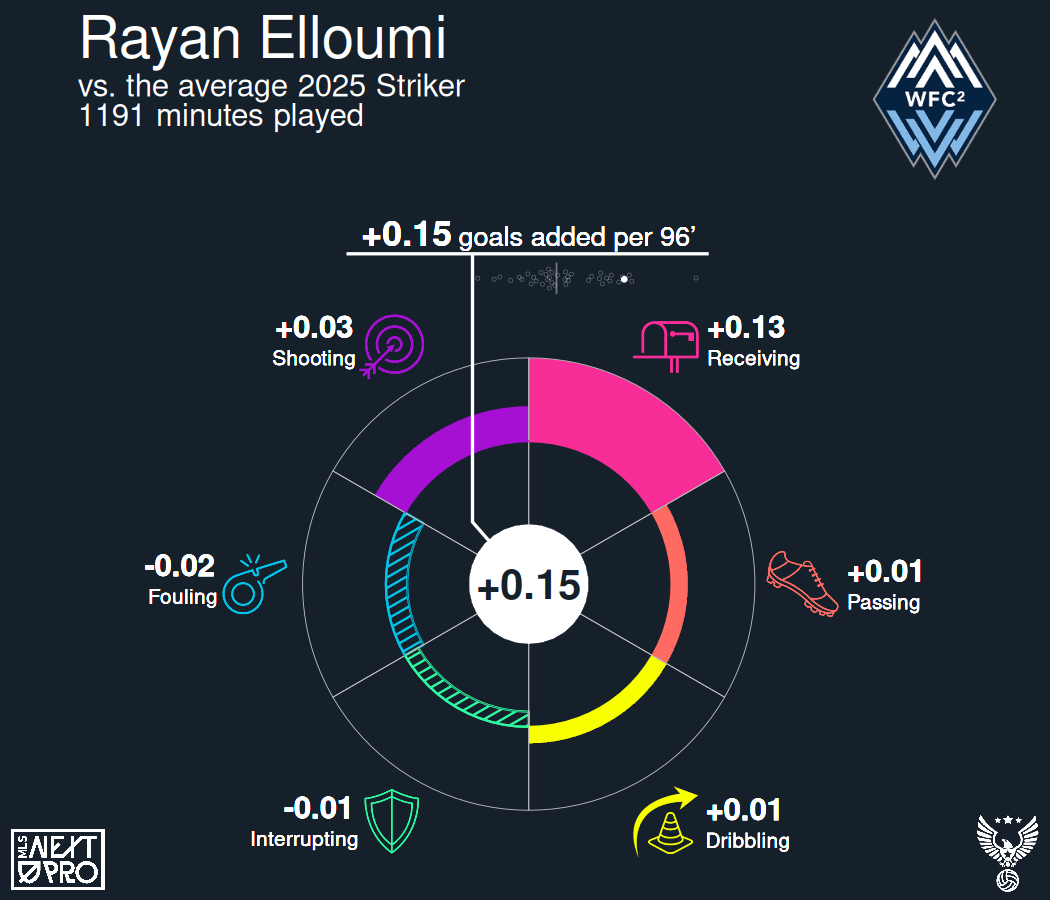
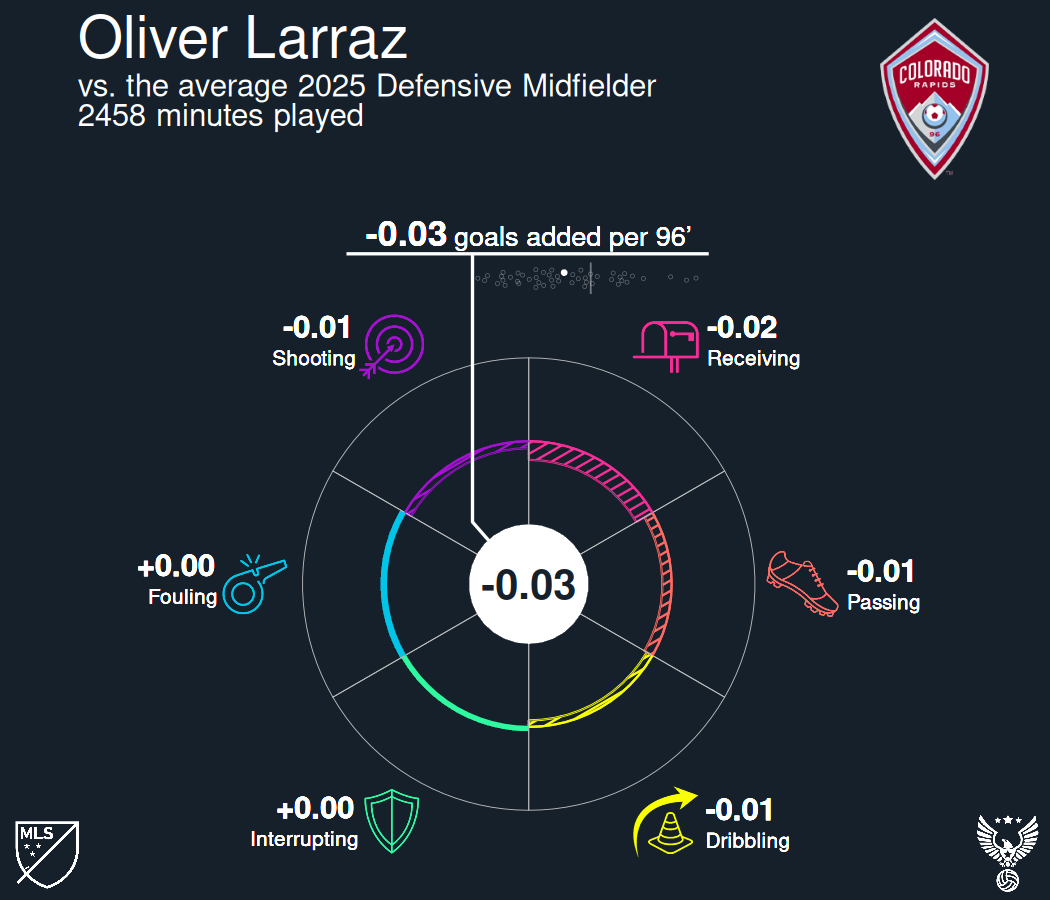
The Whitecaps have seen two major outgoings, both in the same position. Jayden Nelson was traded to Austin F.C and Ali Ahmed was sold to Norwich. Both players were amongst the Whitecaps’s best G+ performers, providing a lot of ball carrying and playmaking from wide areas (they combined to assist almost a quarter of Vancouver’s MLS goals). Kenji Cabrera, who joined as a U-22 signing in the summer window, is likely to take over this role in the squad in the starting 11. Cabrera turned in some very strong performances in limited minutes down the stretch in 2025. He’s unlikely to be as good as Ahmed was right away but he might make that loss a bit less devastating than it looks at first blush.
Vancouver’s most significant attacking addition is Senegal international Cheikh Sabaly who joins from Metz. Sabaly Has a lot of experience in the top two French divisions. He has played most of his career on the wing but his most productive season by far was as the little man in big man/little man strike partnership with Metz in Ligue 2. Vancouver plays with a 4-2-3-1 so it will be interesting to see if the ‘Caps can find a tactical solution that gets the best out of him. We’ve seen excellent league translation from strong Ligue 2 performers before (namely Denis Bouanga), they will be hoping for the same again here.
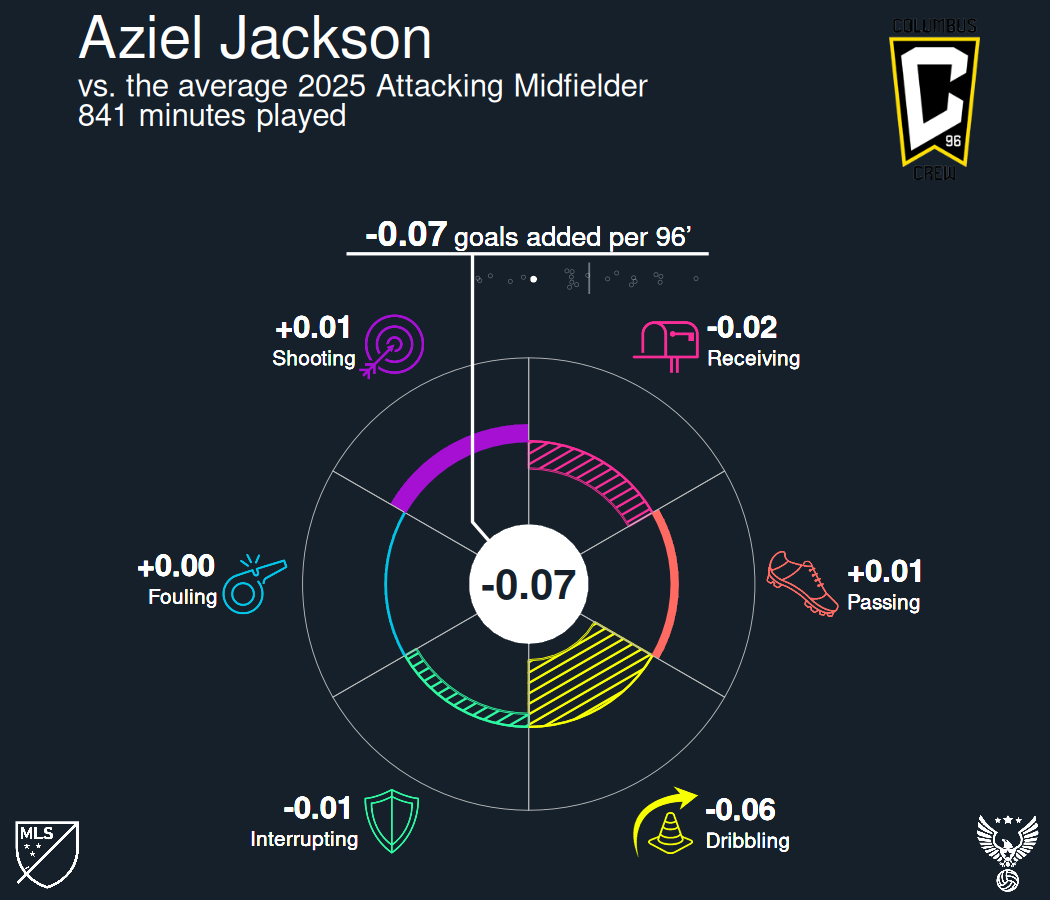
By way of further cover in the attacking positions the Whitecaps have added U-22 winger Bruno Caicedo (21) as well as Aziel Jackson (24) on a short-term loan with an option to buy. Caicedo has demonstrated some strong ball-carrying in Ecuador but his outputs are worryingly low. Of course, Jesper Sorensen is basically batting 1.000 on turning this sort of guy into an MLS monster so a certain amount of benefit of the doubt is due. Jackson, on the other hand, is more of a play finisher. He is reliant on the team to get him good stuff. Luckily for him, Vancouver was near best in the league in both field tilt and xG last year so this seems like a place where Jackson would thrive. Previously, he played with mixed results Wilfried Nancy’s Columbus Crew, so I think it’s with good reason the ‘Caps are taking ‘try before you buy’ approach.
Daniel Rios departs after an adequate if unspectacular season as Vancouver’s back-up striker. The emergence of Rayan Elloumi, who had one of the best seasons by a U-18 player in MLSNP’s short history, made Rios surplus to requirements.
Lastly, Oliver Larraz (24) joins as a free agent after a couple of successful seasons in Colorado. Larraz provides much needed cover in the double pivot of the 4-2-3-1 Vancouver employed after the arrival of Thomas Müller.
Like a New Signing
Injuries were a significant storyline in 2025 for Vancouver, making their rise all the more impressive. Sam Adekugbe and Ranko Veselinovic both suffered season ending injuries, Ryan Gauld was out for most of the season, and summer signing Sebastian Schonlau didn’t play at all.
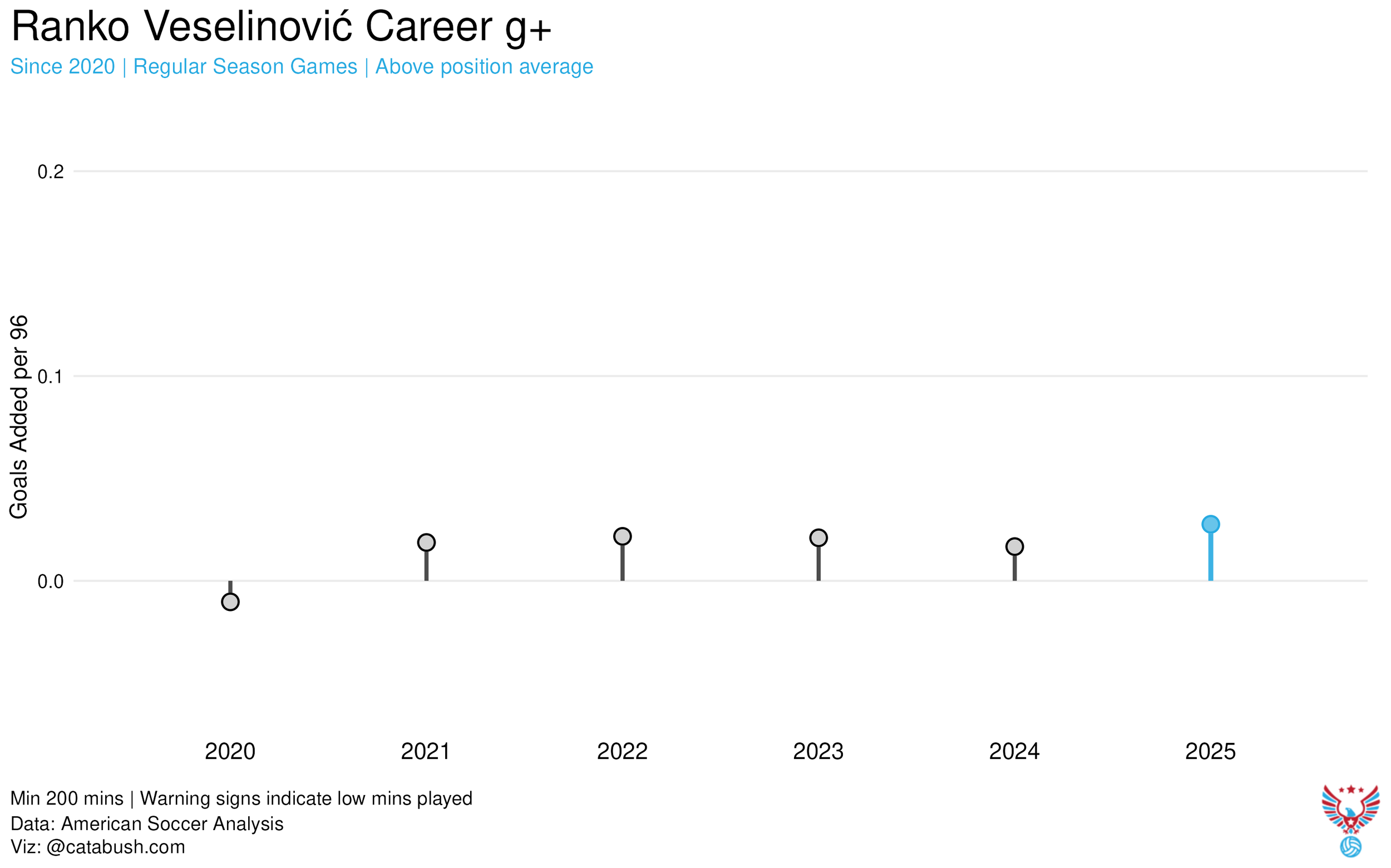
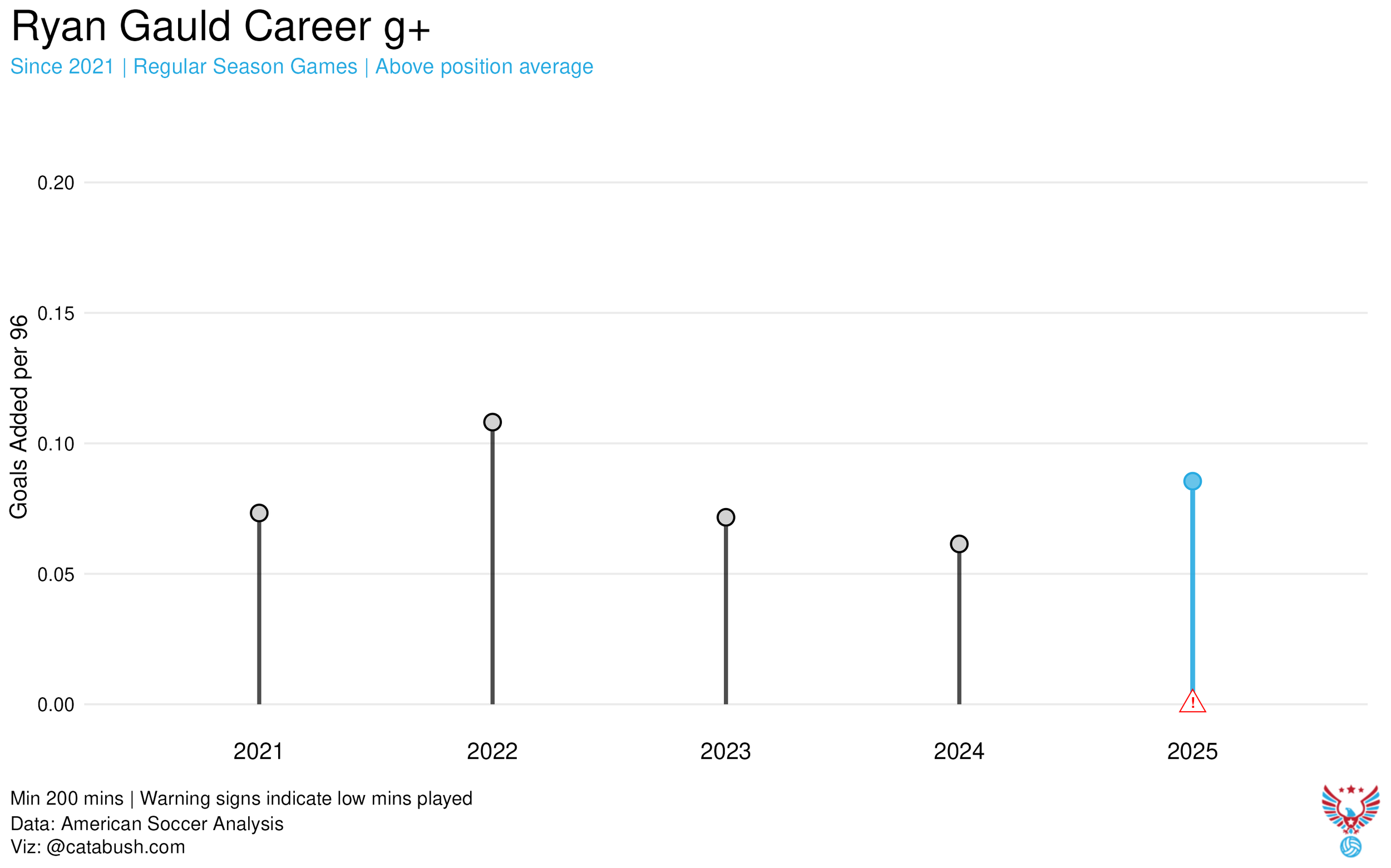
Adekugbe hasn’t cleared 1000 minutes since the 2022/23 season so he might just be cooked. But in the sporadic minutes he has played in Vancouver he has averaged 0.33 xG+xA/96, mostly playing as a left-back. So, if he is fit for any substantial period of time, he could well make a positive difference. If not, he might be a buyout candidate for a team looking to contend, given his hearty salary.
Veselinovic was having a DOTY level season before doing his ACL. He is said to be ahead of schedule in his recovery. As this is the first major injury of his career, I would expect him to slot back in with a minimum amount of fuss.
Gauld is already out again after undergoing an arthroscopic debridement. I am led to believe that this is a fairly basic procedure with a quick turnaround time. Still, having missed so much time and having entered his 30s, I don’t think it’s realistic to expect Gauld to be back to his peak. That’s not to say he won’t still be quite good, but he might be a top 40 attacker in the league rather than a top 10.
Schonlau hasn’t played at all but he has a lot of experience playing in the top two divisions in Germany so he could at least be a cromulent back-up.
Break-out Candidates
A big reason the Whitecaps were so good last year was that almost all of their young players hit incredibly hard. That level of success probably won’t happen again in a single season but there are quite a few candidates to take the next step. The ‘Caps have four returning players aged 23 or younger who cleared 1000 minutes in all competitions last year; Ralph Priso, Edier Ocampo, Tate Johnson, and Jeevan Badwal. We can reasonably add Cabrera, Caicedo, and MLSNP stand-out Rayan Elloumi to this list as well. Even if only one or two of those guys takes a developmental leap, that would go a long way to replacing some of the value lost with the departure of Ahmed and Nelson. But youth development is often not linear, some might not hit again, some might take a step back, some might hit huge.
The Sword of Damocles:
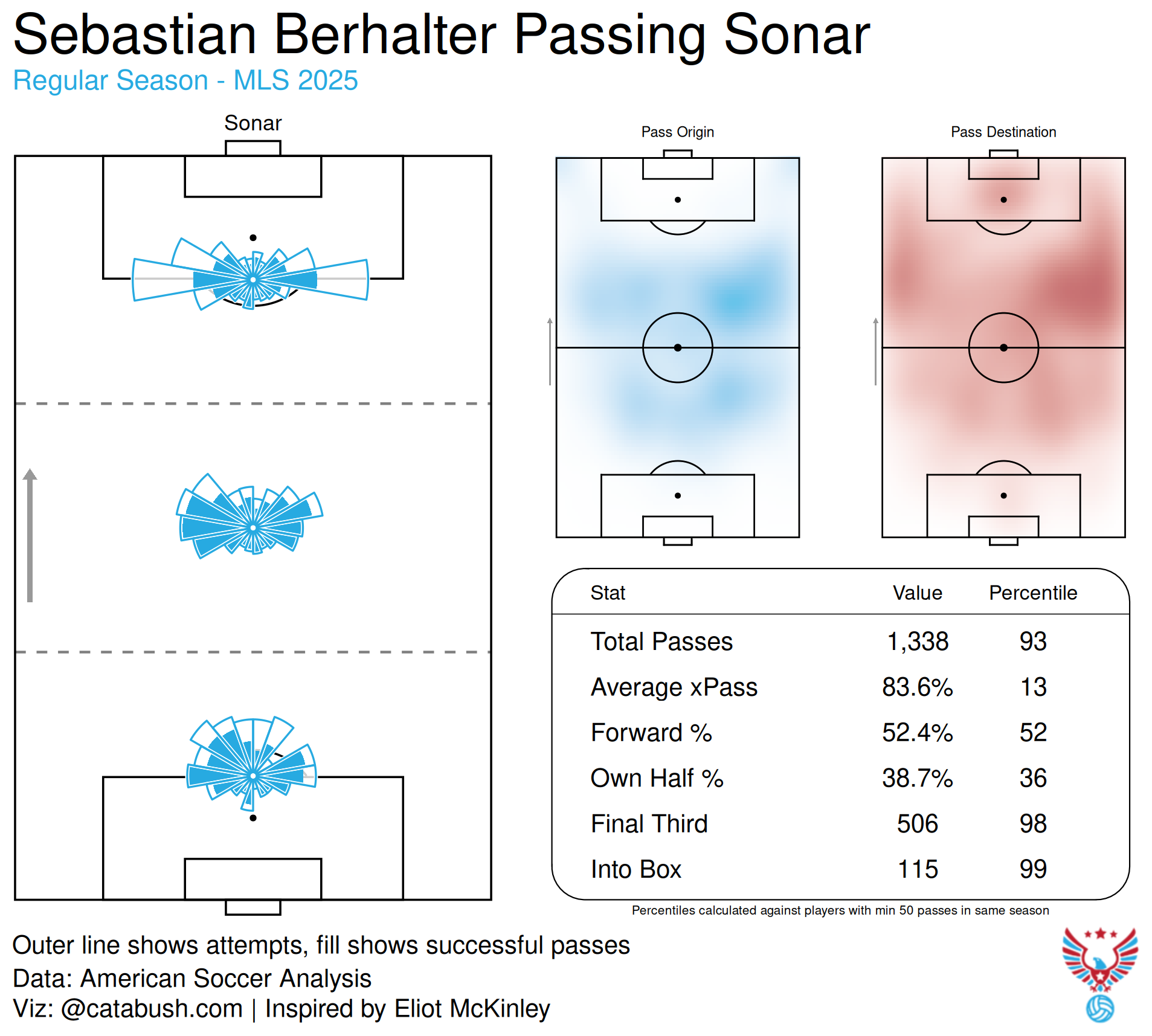
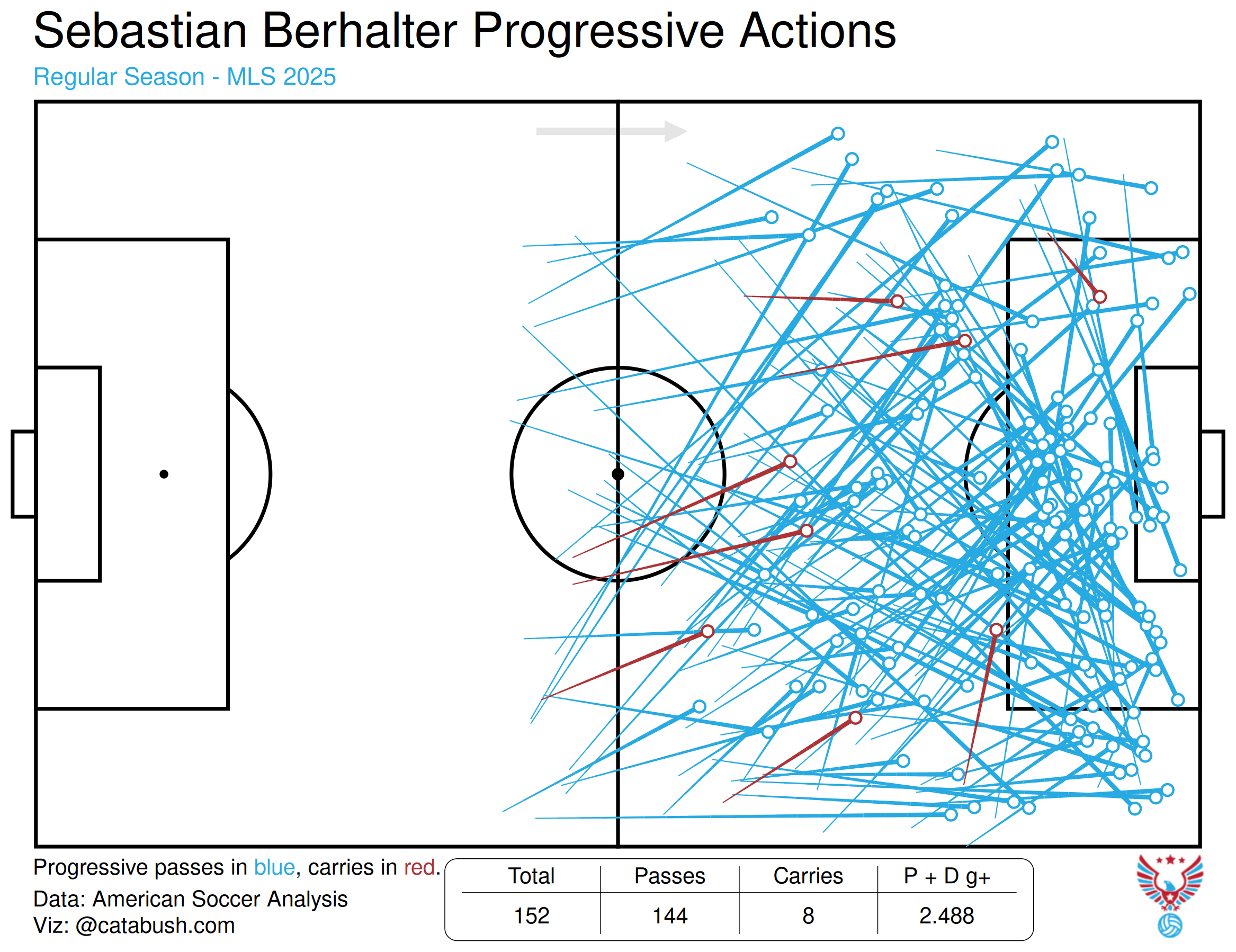
This preview would not be complete without a brief mention of the big issue that hangs over the Whitecaps’ 2026 season. That’s right, Sebastian Berhalter and Mathias Laborda are both in the last year of their contracts! Both were key in the 2025 game and the ‘Caps are in a tricky situation if they aren’t able to extend them. Berhalter in particular would be hard to replace in my opinion, as none of the other double pivot options are as strong at progressing the ball. If the Whitecaps hit the summer transfer window in a lower than expected league position, keep an eye on one or both of these players getting moved.
Conclusions:
I expect the Whitecaps to be really good again in 2026. Ahmed’s departure probably means they start the season a little bit weaker than they finished 2025 but otherwise the roster is mostly intact and they are much deeper than they were at this time last year. I also expect them to come out of the gate fast as World Cup considerations mean they play 8 of their first 10 at home. At a minimum they should be strong contenders to top the Western Conference, not that anyone at MLSHQ thinks so.
Sophomore Slump or Sophomore Shine?
San Diego FC won the West in their expansion year, notching a freshman points record along the way. Fans worry about a sophomore slump: St. Louis also won the West in their first year but missed the playoffs in their second.
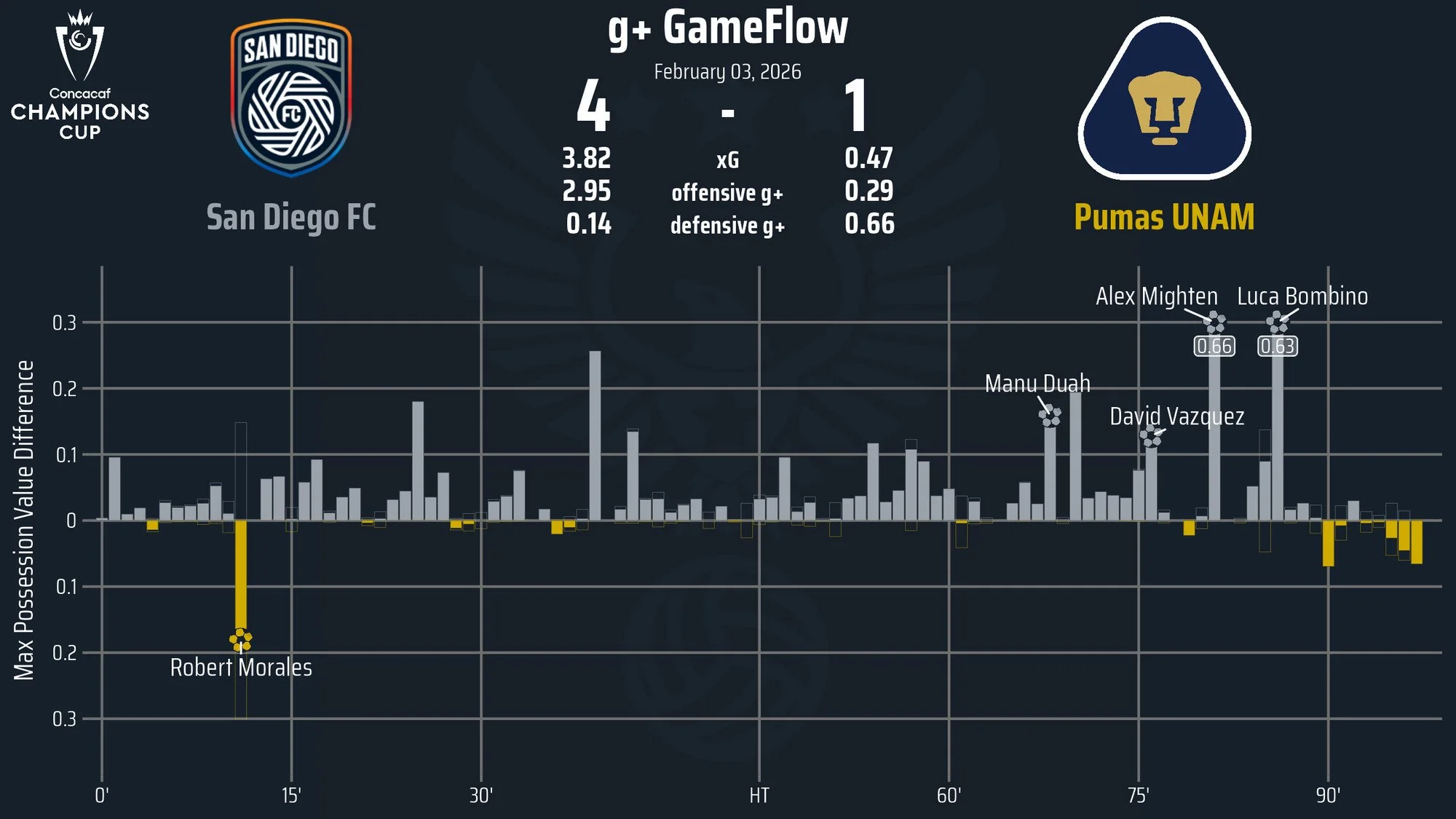
But hold your horses! A preseason SDFC dominated in-season Liga MX giants UNAM Pumas in their CONCACAF Champions’ Cup opener.
This might be the beginning of America’s Finest Sophomore Season.
Coach Mikey Varas already worked magic in his first season by winning the West with a group of relative unknowns. He might be the worst magician ever: SDFC announced their purist tiki-taka-and-press style long before signing anyone. They told teams how they’d beat them, and they still beat them. Anders Dreyer was the breakout headliner en route to 35 regular season goal contributions. That would be an MVP effort first try were it not for the existence of one Lionel Messi.
For his next act, Varas will attempt to force out his highest-profile player, sign virtually no new players, and really put his vaunted system to the test.
Whether it was the likes of Anders Dreyer, Jeppe Tverskov or Onni Valakari comfortably setting in to the league, MLS veterans such as Anibal Godoy and Amahl Pellegrino guiding the team, or breakout years from prospects Manu Duah and Luca Bombino, San Diego gelled in ways that not even the most seasoned San Diego soccer fan could have expected. Notable surprises came in the disappointment of Luca De La Torre and a rookie Manu Duah taking over the role of seasoned veteran and Northern Ireland captain Paddy McNair.
They went into hostile environments, big games--and delivered, most notably beating former champions LA Galaxy (little did we know…) in their away season opener, and LAFC on Son Heung-min’s debut. Led in output by the excellent Dreyer, the Danish winger led the league in key passes (81), assists (16) and assists above expected (10.5 xA), SDFC became a force to reckon with as they reached the Western Conference Semifinals only to go out to a Vancouver team that also defied expectations.
Chucky Conundrum, Scandinavian Solution
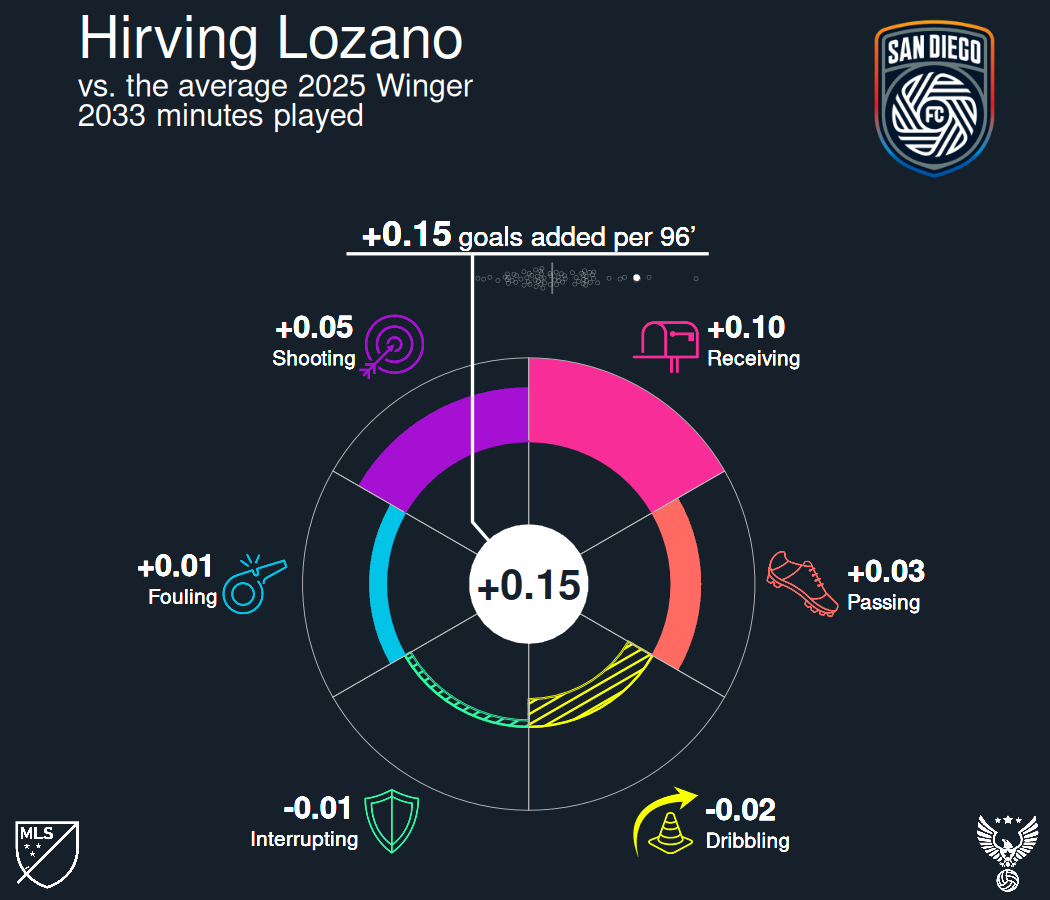
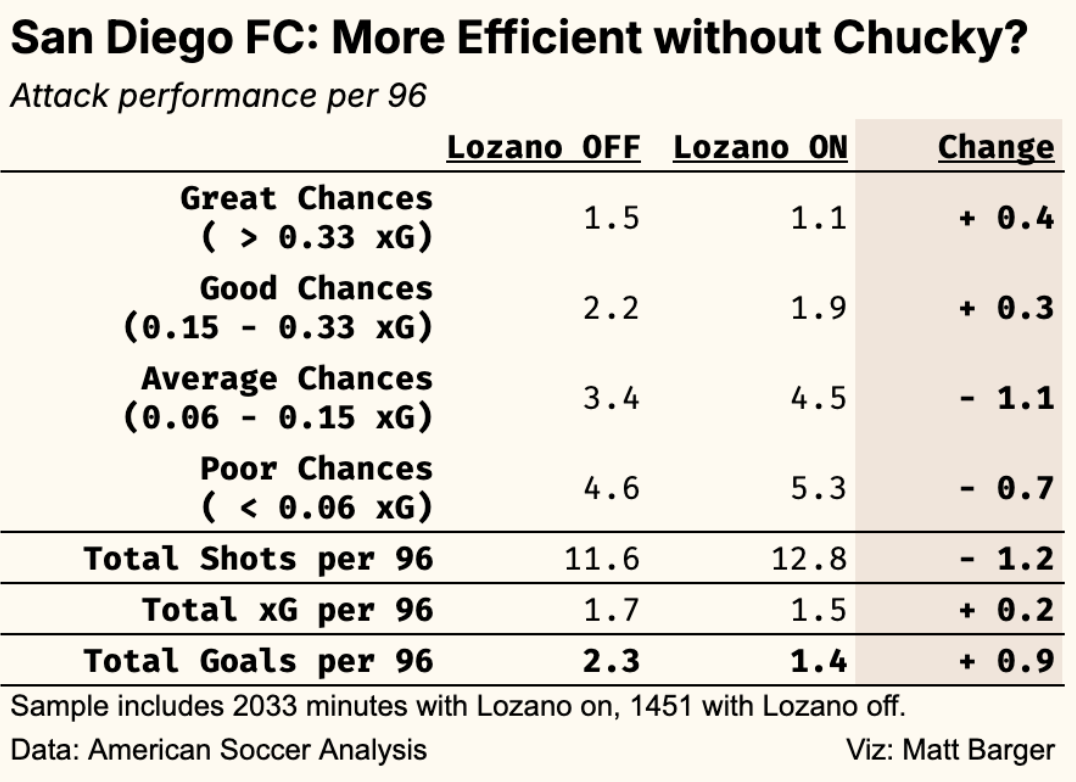
While SDFC has done little in terms of transfer arrivals in the offseason, the biggest news concerns Anders Dreyer staying for another season, and Hirving “Chucky” Lozano on his way out.
Chucky carried $24 million in expectations as San Diego’s shining star. He appears to be on the way out. The Mexican fan favorite wasn’t in the lineup against Pumas; the front office means business here. Assuming he’s gone, what does San Diego lose without him?
First, they lose 20 goal contributions in just over 2000 minutes. His underlying numbers were fantastic, placing among the top five wingers in goals added per 96. His advantage over the average winger (+0.15 goals added per 96) was nearly double that of Dreyer’s (+0.08). So what if I told you that SDFC performed better in the 1500 minutes Chucky was off the pitch?
San Diego scored 2.3 goals per 96 in the 1451 regular season minutes Chucky was off the pitch. This is nearly a full goal better than the 1.4 goals scored per 96 when Lozano was playing. SDFC did this by being less wasteful with their chances; two fewer average and poor chances were created when Chucky was off, to which one good-to-great chance was created. Doing on-off analysis in soccer is really hard and there are a lot of caveats to consider (who did they play? How many minutes are as a sub or as a starter?), but it at least lends credence to the idea that they’ll be okay without him.
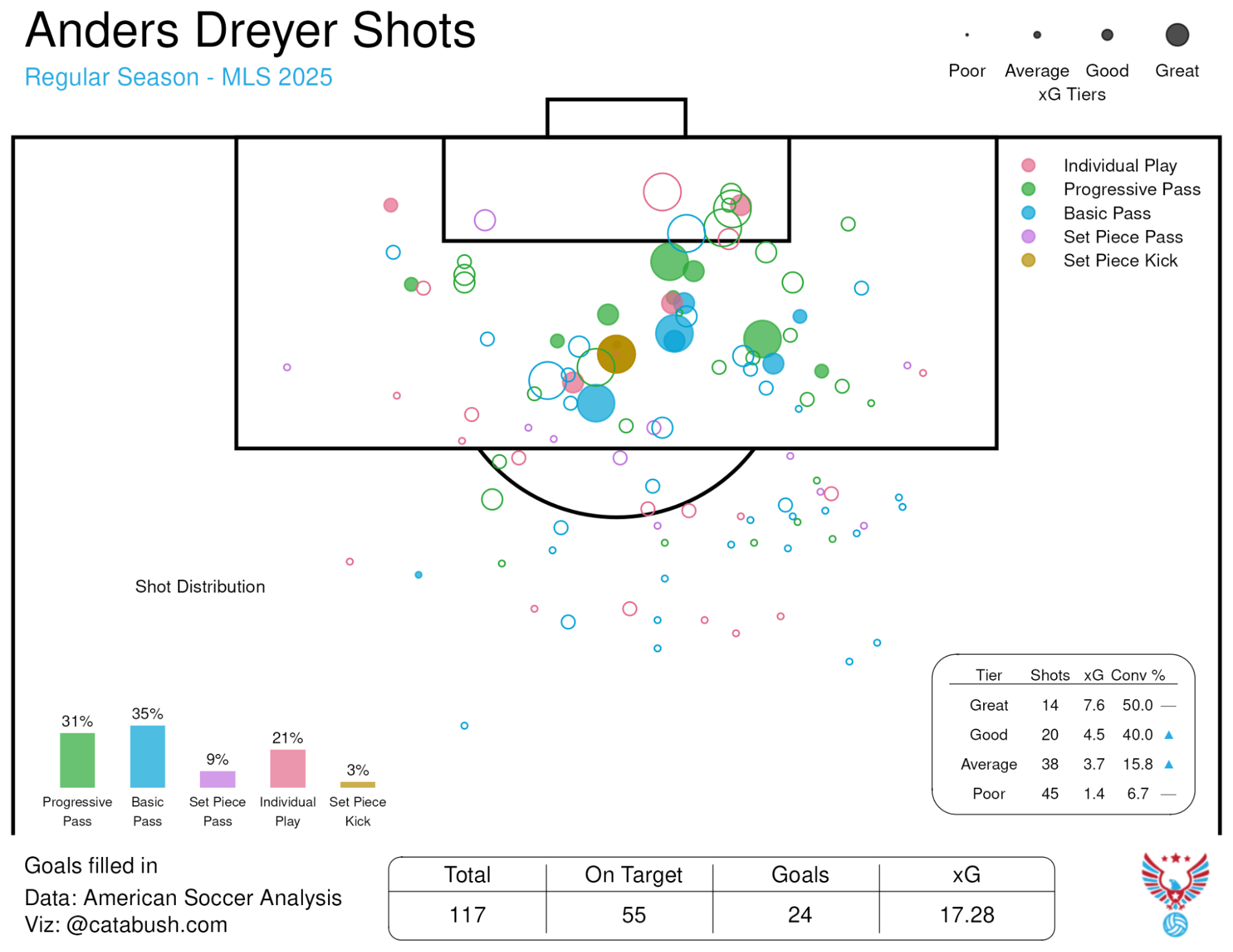
With Chucky gone, the bullseye on MVP contender Anders Dreyer’s back just gets larger. The 35 goal contribution man may very well continue his stellar form in 2026. His 19 goals fell relatively in-line with his 16.5 xG of service. Dreyer’s playmaking, however, was much more impressive. However, 33 of his 81 league-leading key passes and 10 of his 16 assists went to departing players (23 to Lozano, 10 to Milan Iloski). His main targets gone, Dreyer will need to adapt his attacking instincts to fit the preferences of his new-look Nordic front three.
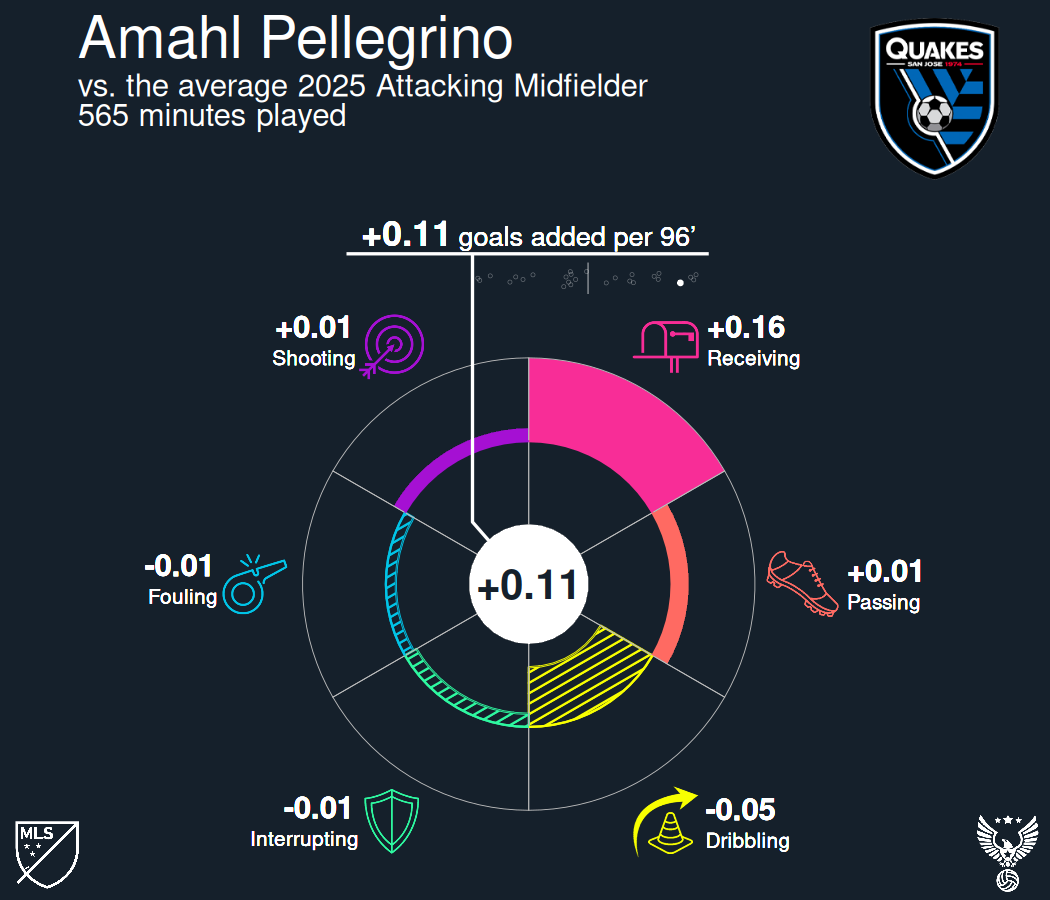
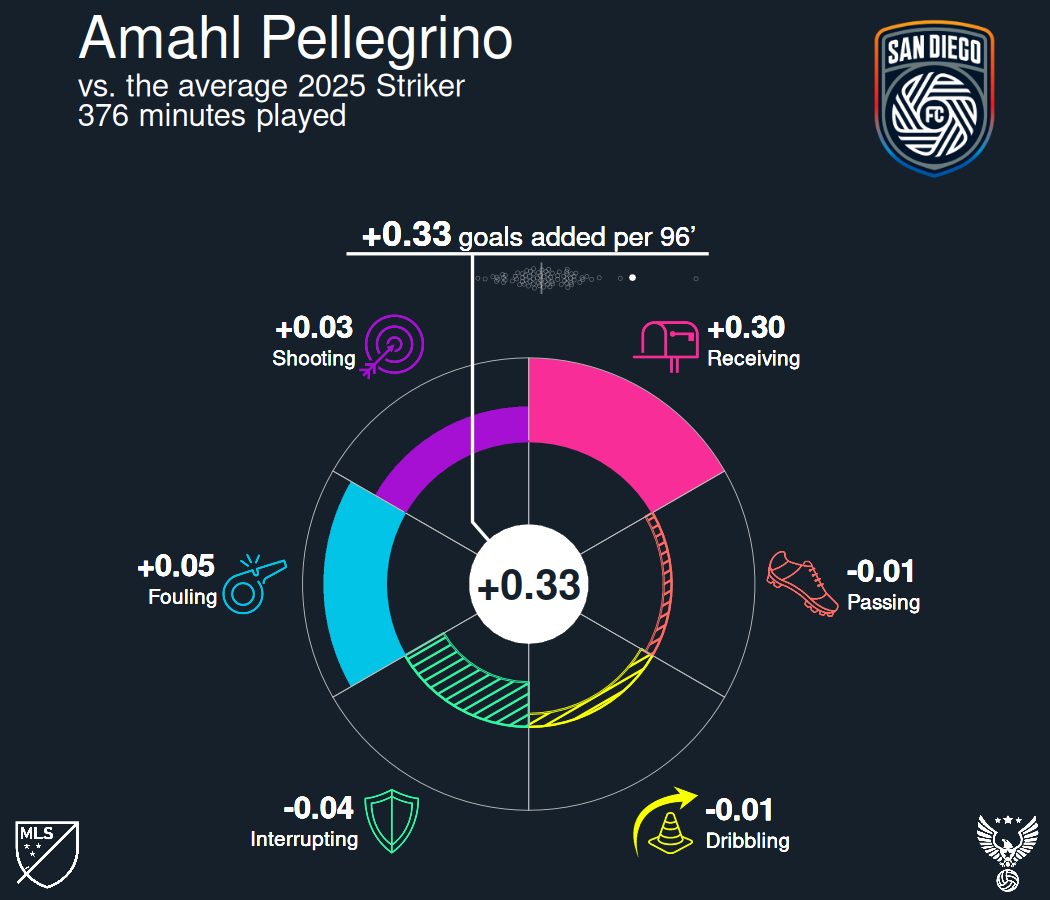
On that point, Amahl Pellegrino will need to take a big step forward. The Norwegian journeyman started the 2025 season as a benchwarmer in San Jose and ended it as SDFC’s most important player. In six regular season games with San Diego, Pellegrino’s average g+ contribution per 96 jumped past both Lozano’s and Anders Dreyer’s. Pellegrino’s ascent should be approached with caution: he barely breached 500 minutes in 14 appearances with the Earthquakes and did not play a full match in any of his six regular season appearances with SDFC. Still, the 35-year-old will need to maintain his stellar form and find better connections with Dreyer (only 2 in 2025).
Marcus Ingvartsen will also need to cover any gaps left by his Scandinavian compatriots. Sidelined by injury through most of 2025, Ingvartsen is essentially a new signing and might be the evolution point for the 2026 offense. Ingvartsen’s combination with Dreyer is vital; the Danish striker’s $1.7 million comes with the expectation that he can become the new outlet for Dreyer’s prolific key passes. New boy Lewis Morgan is an adept off ball mover who can contribute similarly, if healthy.
How does the Varas game model evolve?
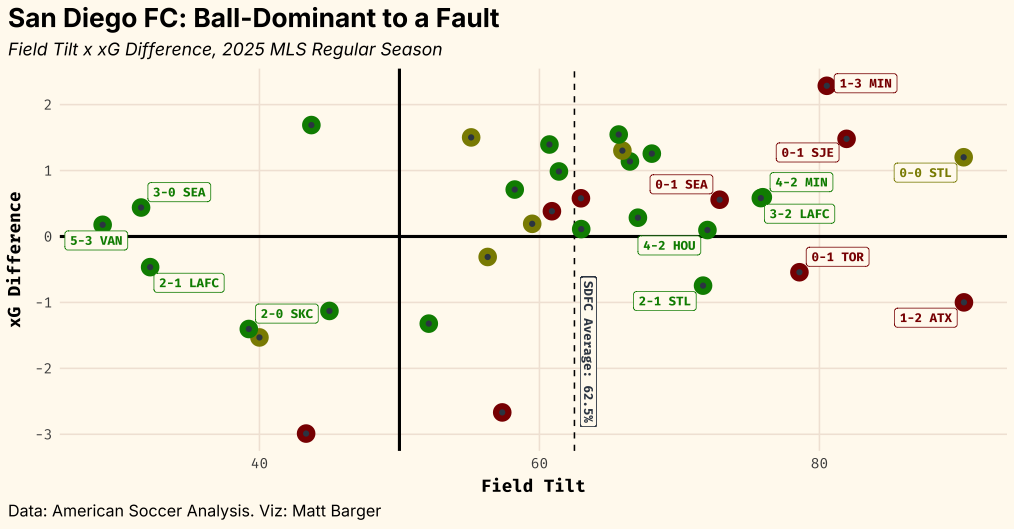
The San Diego system was one of the most distinctive in MLS. It relied on high-volume passing and positive field tilt to dominate the field of play.Futi’s Team Styles notes SDFC alternated exclusively between the Guardiola press-and-possess and patient control-and-regroup blocks. SDFC averaged the most completed passes per game (557) and the second-highest field tilt per game (62.5% of total attacking third touches per game). Therefore, San Diego’s stout defense comes from strong possession and winning the ball high up the field.
Dominating the ball comes with its own problems, though.
San Diego’s field tilt aesthetic is generally credited with winning them the Western Shield, but the Guardiola-esque passing emphasis ran into Dyche-y issues when opponents sat back and allowed it. SDFC garnered one point (and a middling xG advantage) from their five most dominant field tilt games.
The Western Playoff Final against Vancouver was instructive as well. The Whitecaps pressed intensely as soon as SDFC entered the final third and sat with a quickly-progressed ball in the other end, equalizing the field tilt and dominating the productive metrics. If San Diego embraces the Guardiola style, choking the passing lanes a la Simeone seems to be a worthy antidote.
Like most press-and-possess models, Varas’ game model relied on stellar individual performances to lift the team above their decent efficiency metrics, San Diego’s underlying metrics put them below the top-third of the league (11th-most xG, 11th-fewest xGA). But the attack scored 64 goals, nearly 7 more than expected. More impressively, the defense allowed 39 goals, 12 fewer than expected.
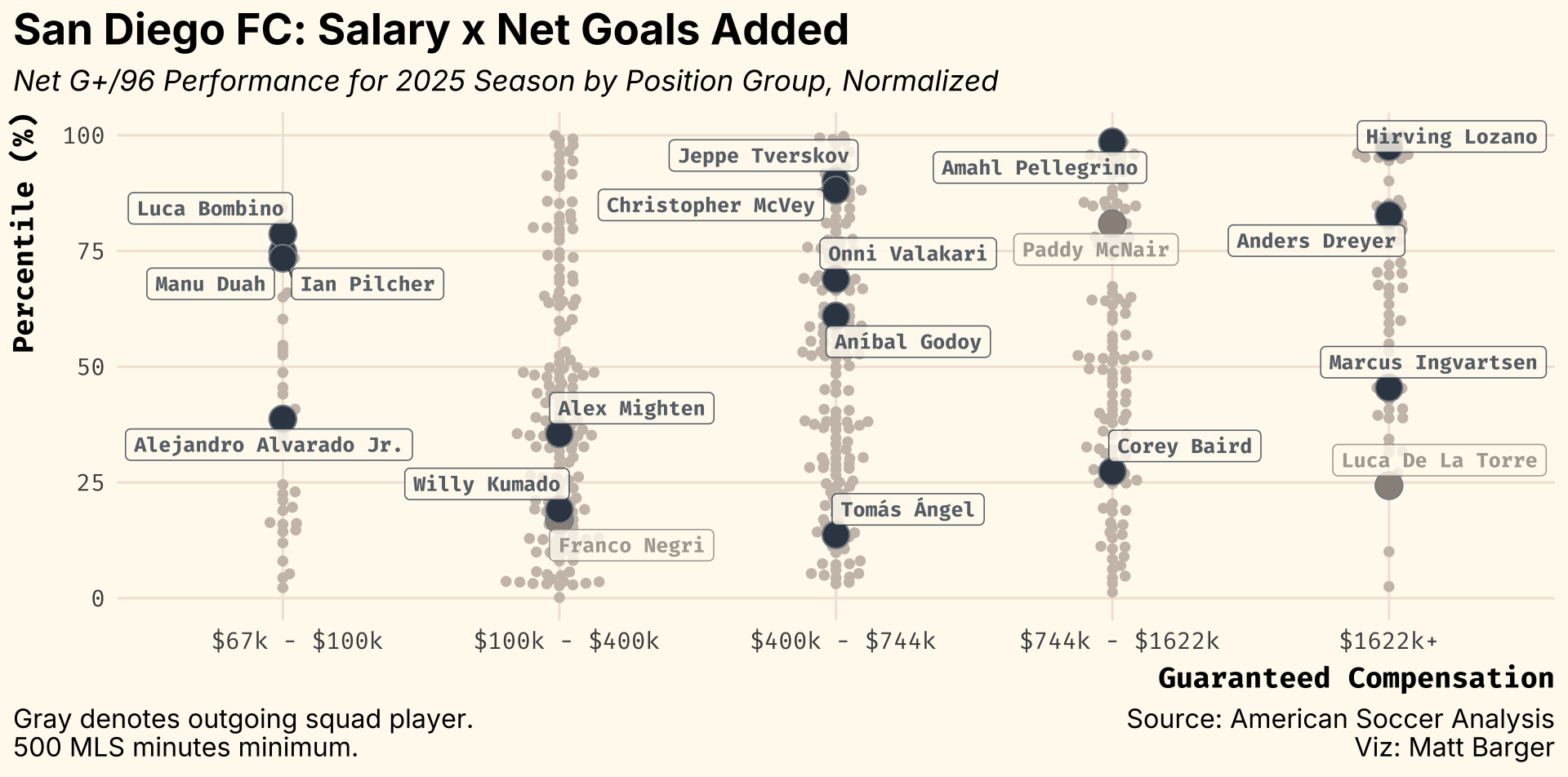
Unlike most press-and-possess models, SDFC didn’t pay a lot to acquire this talent advantage. To this end, Mikey Varas is putting a ton of faith into a backline and midfield whose on-field contribution vastly over-performed their salary requirements.
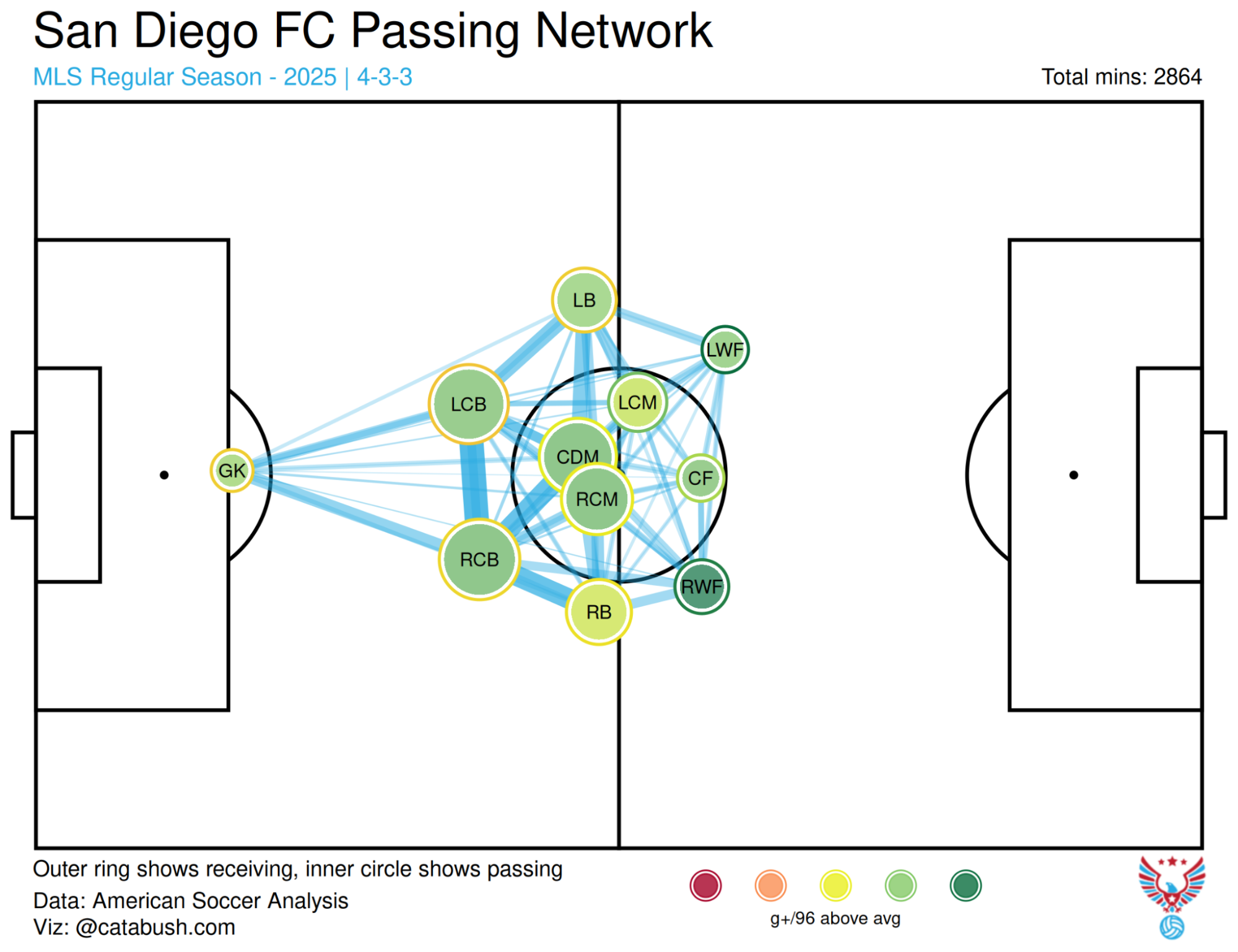
Manu Duah in particular steps into the biggest season of his career with Paddy McNair off to Hull City. The rookie impressed on all accounts in his 1100 minutes of play, most notably as a willing passer of the ball and aerial backstop. His combination with Christopher McVey and Luca Bombino (the best-performing fullback at his price point) will be vital, especially given the latter’s competence in both passing and defending space. Jeppe Tverskov and Onni Valakari are trusted with maintaining dominant possession advantages alongside Duah, McVey, and Bombino.
What’s Next for the Most Interesting Team in MLS
Have the Western Shield holders hit their ceiling?
With all of the success of last season, one can only wonder how a team with offseason drama and minimal spending will fare in their second go at the cherry. However, with the ability to maintain their productive core, savvy sporting decisions, and with a coach in Mikey Varas’ that has implemented a system instead of catering to specific players, expect SDFC to continue to be a force to be reckoned with.
If it comes off, they’re the best team in the West. If it doesn't, the sophomore gets shoved in a midtable locker.