

Hot... Foot? Fallacy
/Finishing is a fairly contentious topic when it comes to the world of soccer analytics. The somewhat mainstream analytics practitioner opinion can be summed up as follows: finishing is objectively a skill that exists, but the majority of players possess a skill level that impacts the underlying finishing rate to a much smaller degree than the random noise of sometimes ball go in. This is the thing with soccer as a sport as a whole. Feet are just so much worse than hands. One topic that this has made me think about is the whole hot hand fallacy. Do feet, which are much less good at manipulating balls than hands, get hot? I’m going to try and avoid being too academic and stiff here, but bear with me.
To lay out the stall, the hot hand fallacy (originally described by a bunch of economists who researched cognitive biases, go figure) is the idea that if a player makes a shot, they are more likely to make their next shot in a game of basketball. You can go through the wikipedia and find a number of the academic literature that all showed some variation of “No, this is not real”. Over time, studies have used larger datasets and accounted for things like defender positioning and shot difficulty and shown it maybe does exist, but is small.
But soccer is not basketball, and analytics in soccer is much more nascent than other fields. There is some academic literature, Parsons and Rohde looked at team level goal scoring and saw no evidence of momentum in the Premier League, while Ayana et al. did show that there is some clustering of goals together in games. Joseph Buchdahl at Pinnacle, one of the sharpest oddsmakers on the soccer side, did some analysis showing that betting markets were actually over-favoring “hot” teams.
But soccer is not basketball, and analytics in soccer is much more nascent than other fields. There is some academic literature, Parsons and Rohde looked at team level goal scoring and saw no evidence of momentum in the Premier League, while Ayana et al. did show that there is some clustering of goals together in games. Joseph Buchdahl at Pinnacle, one of the sharpest oddsmakers on the soccer side, did some analysis showing that betting markets were actually over-favoring “hot” teams.
On the player side, there is less. Gauriot and Page showed that managers, journalists, and fans over-index on shots that resulted in goals compared to identical shots that hit the post. Our own Eliot McKinley and John Muller (now of Futi) saw similar, that players who scored played more the next game than if they missed a similar chance. As far as I can tell, nobody has directly ported the research over. If a player scores, do they score the next shot more frequently? We’ve got 171k shots in the ASA dataset for MLS and NWSL, and a little over 17,000 goals, so we should be able to look at exactly this.
Raw Conversion
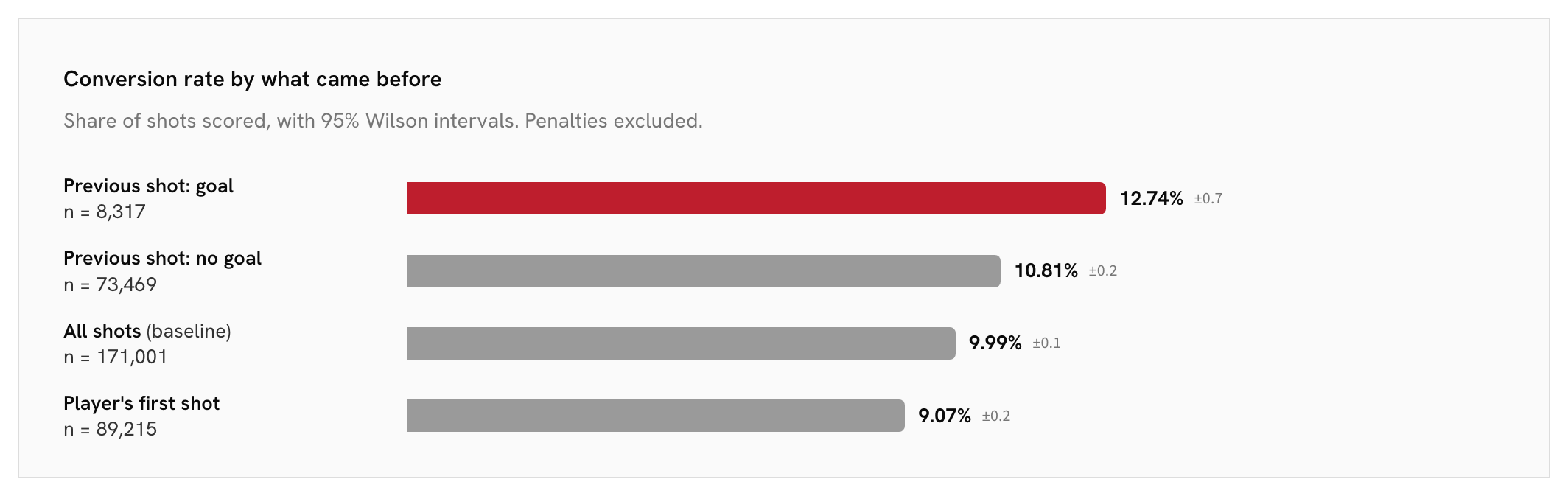
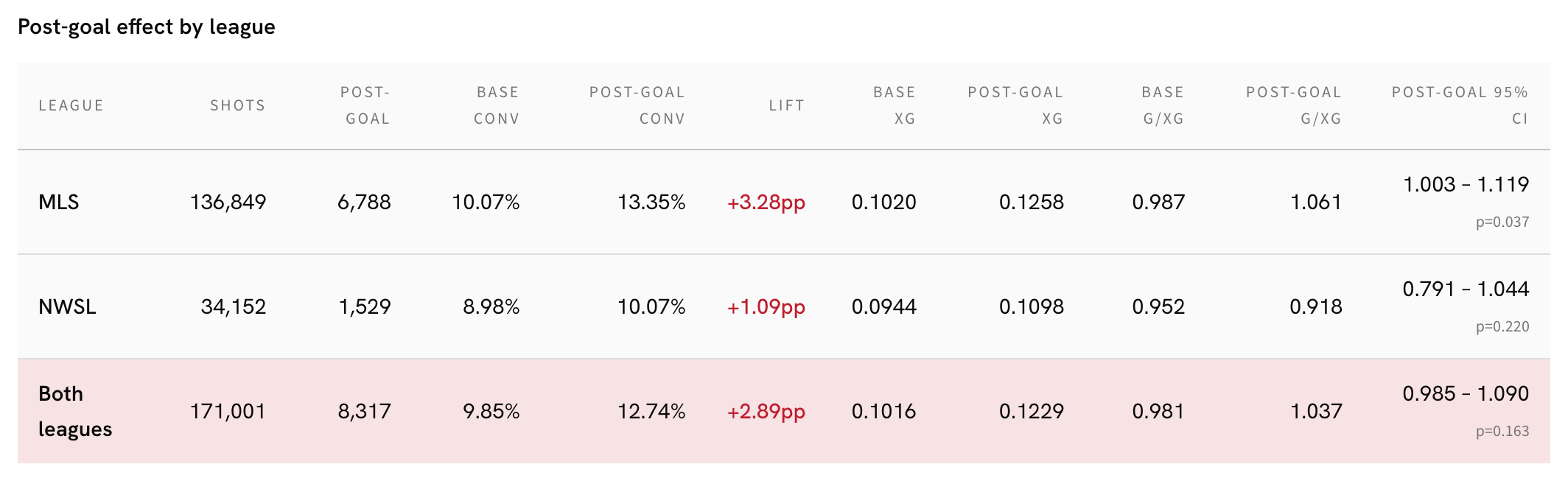
Conversion rate is a stupid stat for soccer, but is the explicit metric to start with. If we look at the conversion rate of a player for the next shot they take after scoring a goal, we see some signal! Players, on average, score those shots 12.7% of the time, compared to 10.8% of the time when they miss the previous shot. Interestingly, players generally score more on any second shot they take compared to the first shot they take. That’s almost certainly a function of who takes two shots in a game against who only takes one, but neat.
Shot Quality (xG) Adjusted
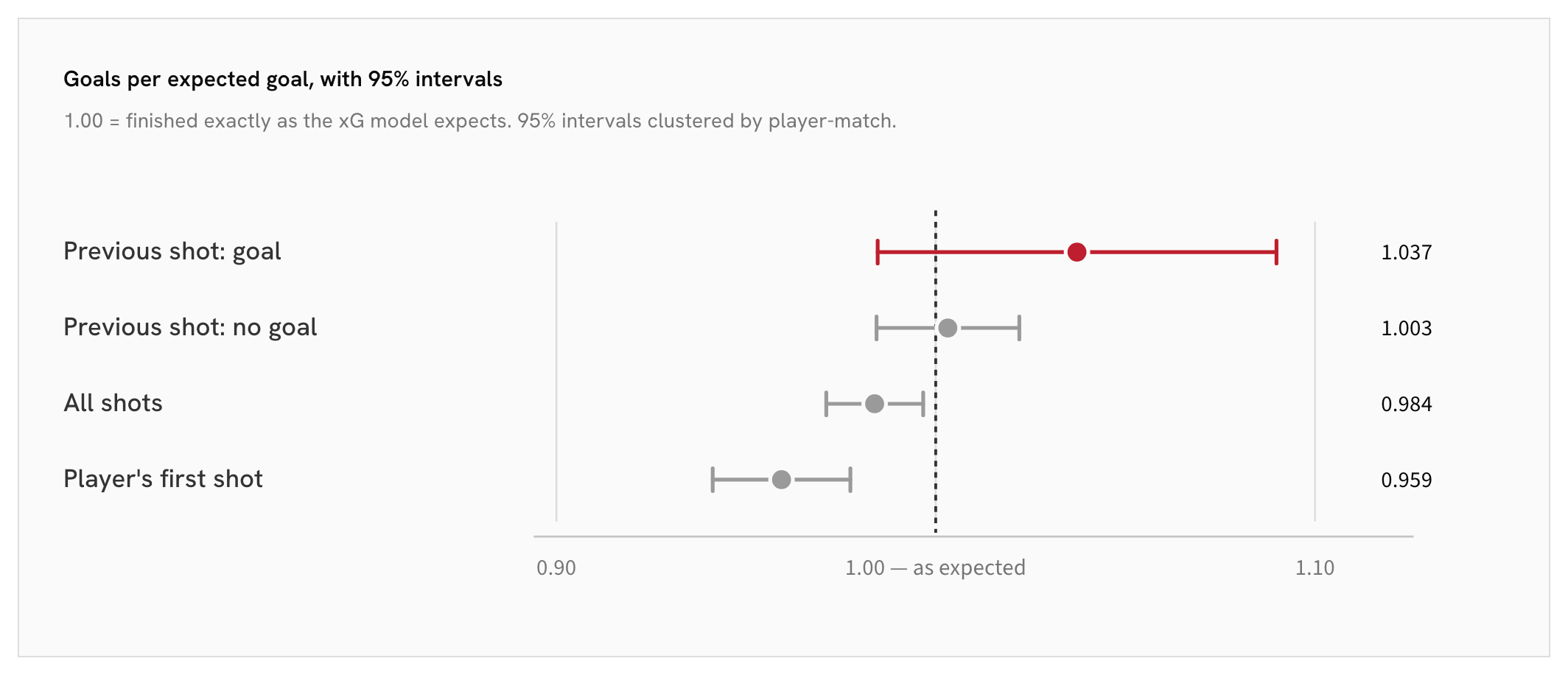
In the basketball theory, one of the key adjustments as the research progressed was that as players got “hot” they would attempt more difficult shots and as such their shooting percentage wouldn’t show their heat, but given the increased difficulty they actually were somewhat hot. Here, we see the raw shooting percentage go up, but we can still adjust for shot difficulty. It’s not perfect, but given xG is largely the blend of location and shot context, it makes sense here. When we look at the ratio of goals and expected goals (G/xG), we see that while the error bars do include G/xG=1.00, again, players do seem to be finishing ahead of their xG on the next shot after they score.
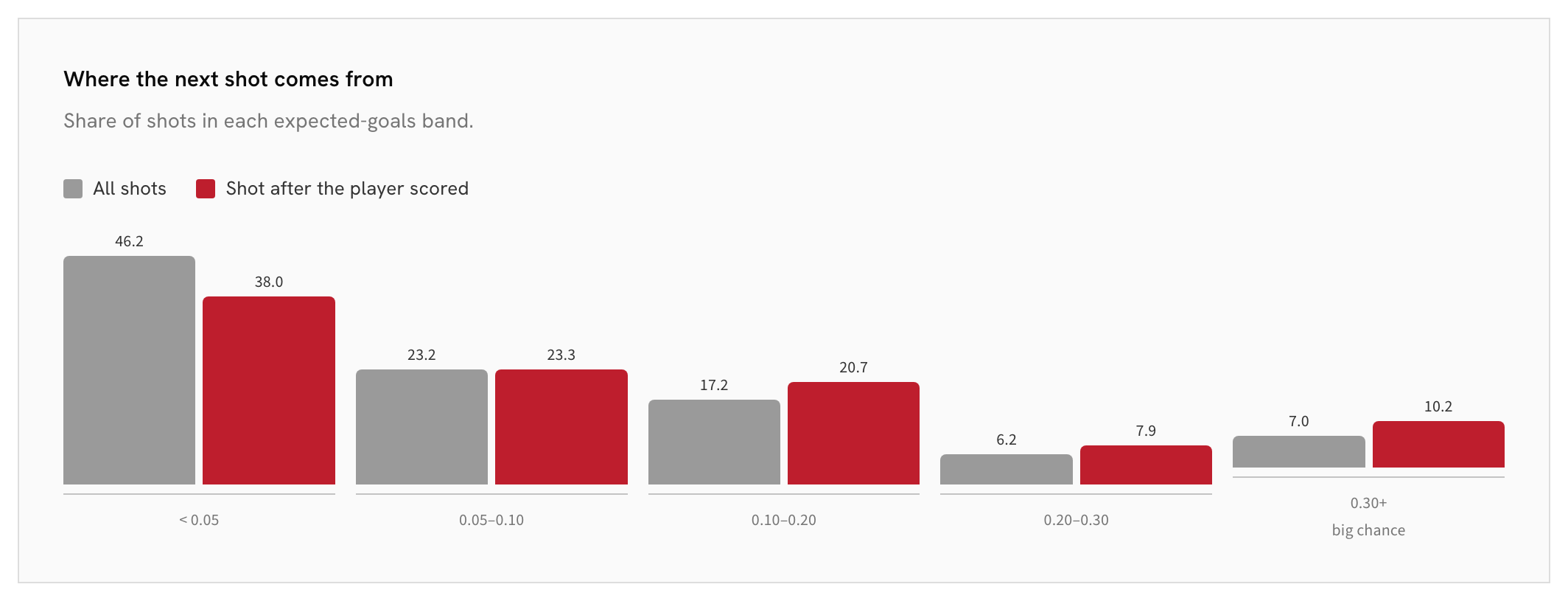
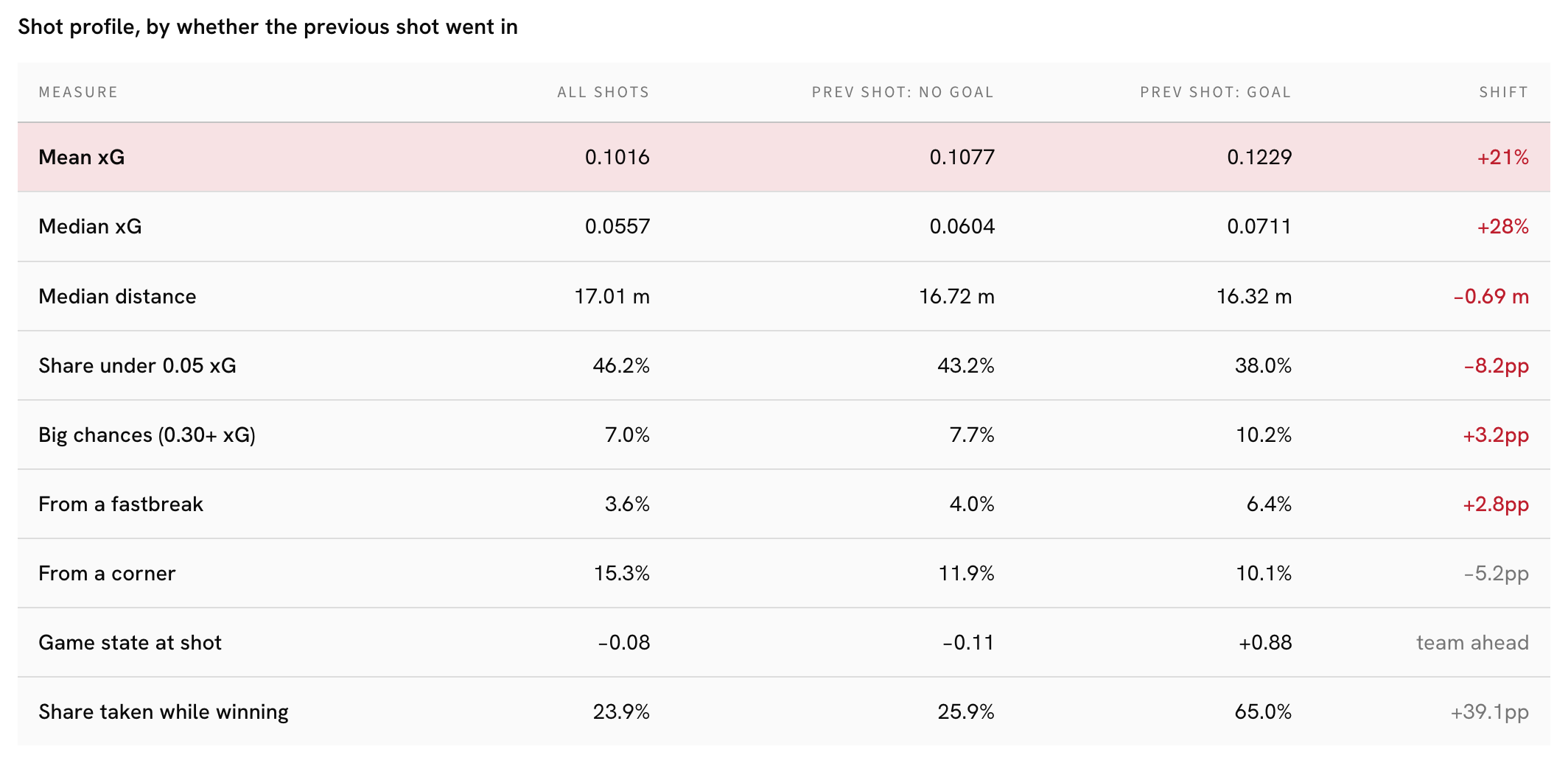
I was somewhat surprised by this, so I decided to look at how the shots players are taking change after goals and misses. Again, in the basketball research, players take worse shots. In soccer, the opposite appears to be true. After scoring, players take fewer low xG shots and get a nice boost to shots in the 0.1-0.2, 0.2-0.3, and 0.3+ xG buckets. Similarly, both mean and median xG are up between 20 and 30%, and the median shot distance drops from 17 meters to 16 meters. Obviously, the gamestate shifts towards shots taken while winning (duh), but the situations the shots come from change. Fast break shots jump from about 4% up to 6.4%, and set piece shots drop from 15% to 10%.
This makes sense, I think. You can’t exactly bunker and counter in basketball, but you definitely can exploit the game state to generate transitions in soccer. I don’t control for team strength at all here, and I can imagine that just being able to get into a winning gamestate positively impacts your ability to generate better future chances.
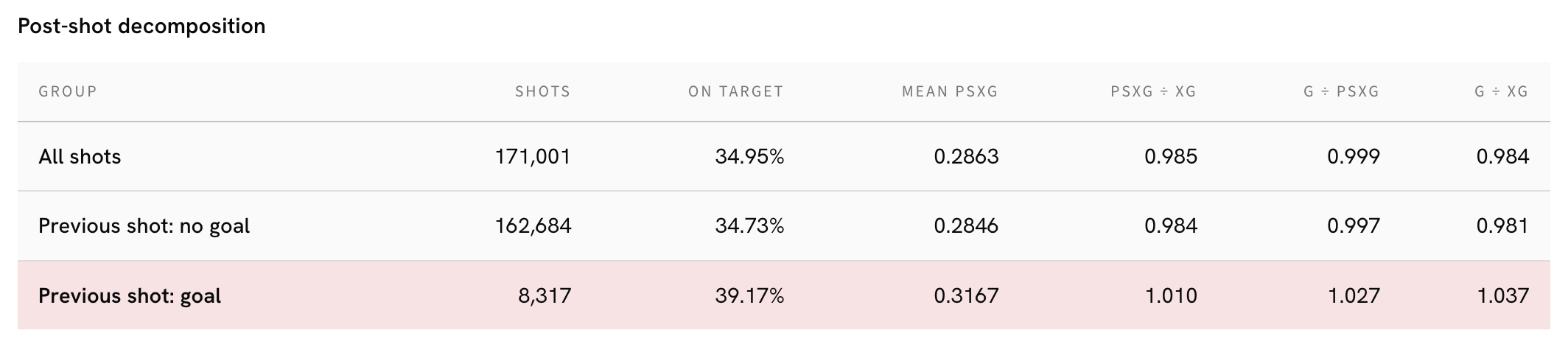
We can also dive a bit deeper on what the players are doing with the shots by looking at the post shot expected goals (PSxG). Here we see two things: 1) players are putting the shots in better spots (that is, a higher post shot expected goals) and 2) they’re still scoring even more than that. About one third of the xG overperformance is coming from players placing their spot better, 1%, but the other two thirds remains mysterious.
Goals Change Games
Next, I wanted to explore the idea that only good shooters shoot multiple times in a game and decided to see how the effect holds up for all goals, as well as across positions. What we see is that across positions, the effect largely holds up. It changes in magnitude (apparently defensive midfielders are imbued with the power of El Brujo when they score) and the error bars get wider for the positions with fewer shots, but directionally it’s the same. Everybody scores more on their next shot.
I also wanted to see, does the same effect happen if somebody else scores the goal, ie. is this mostly a gamestate thing. The answer is yes, and even more than the scorer on an expected goal adjusted basis.
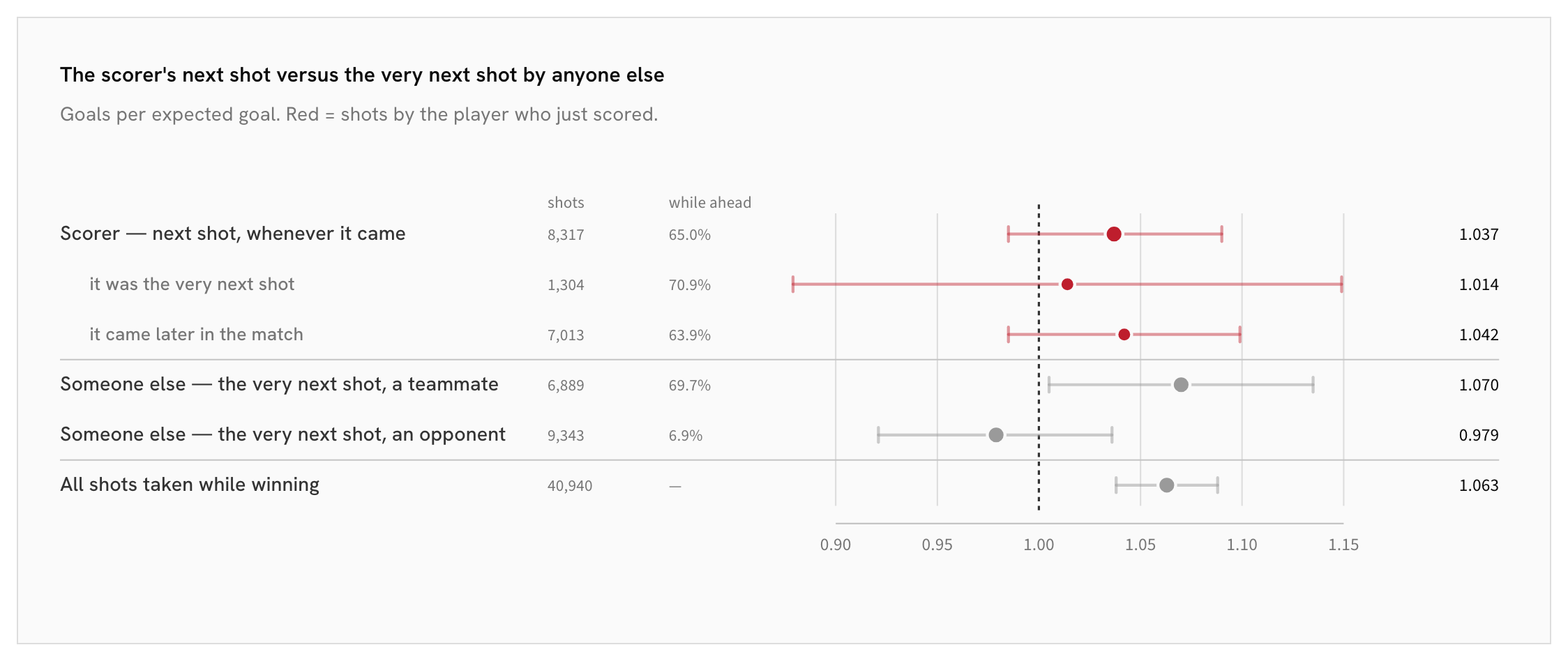
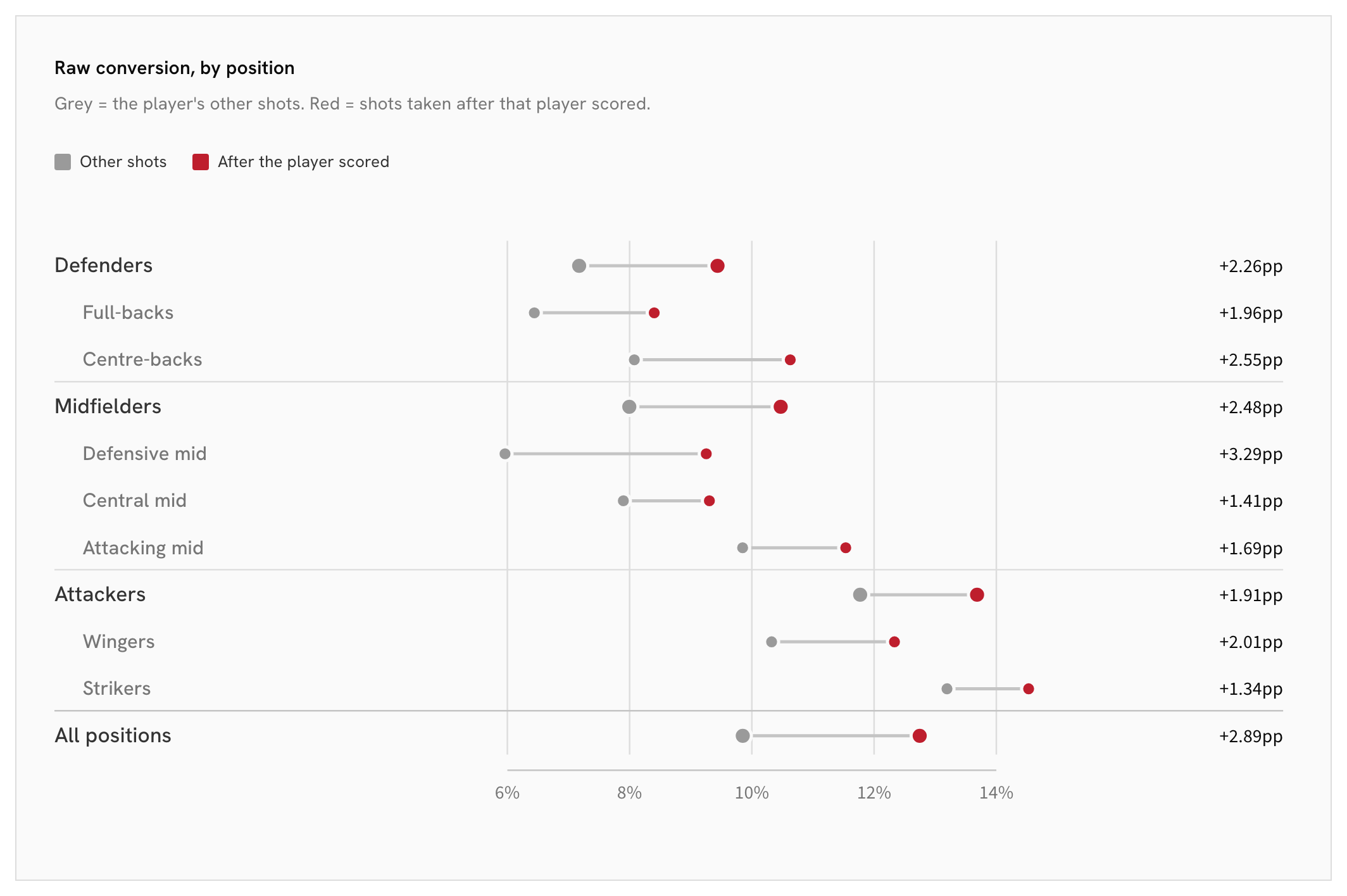
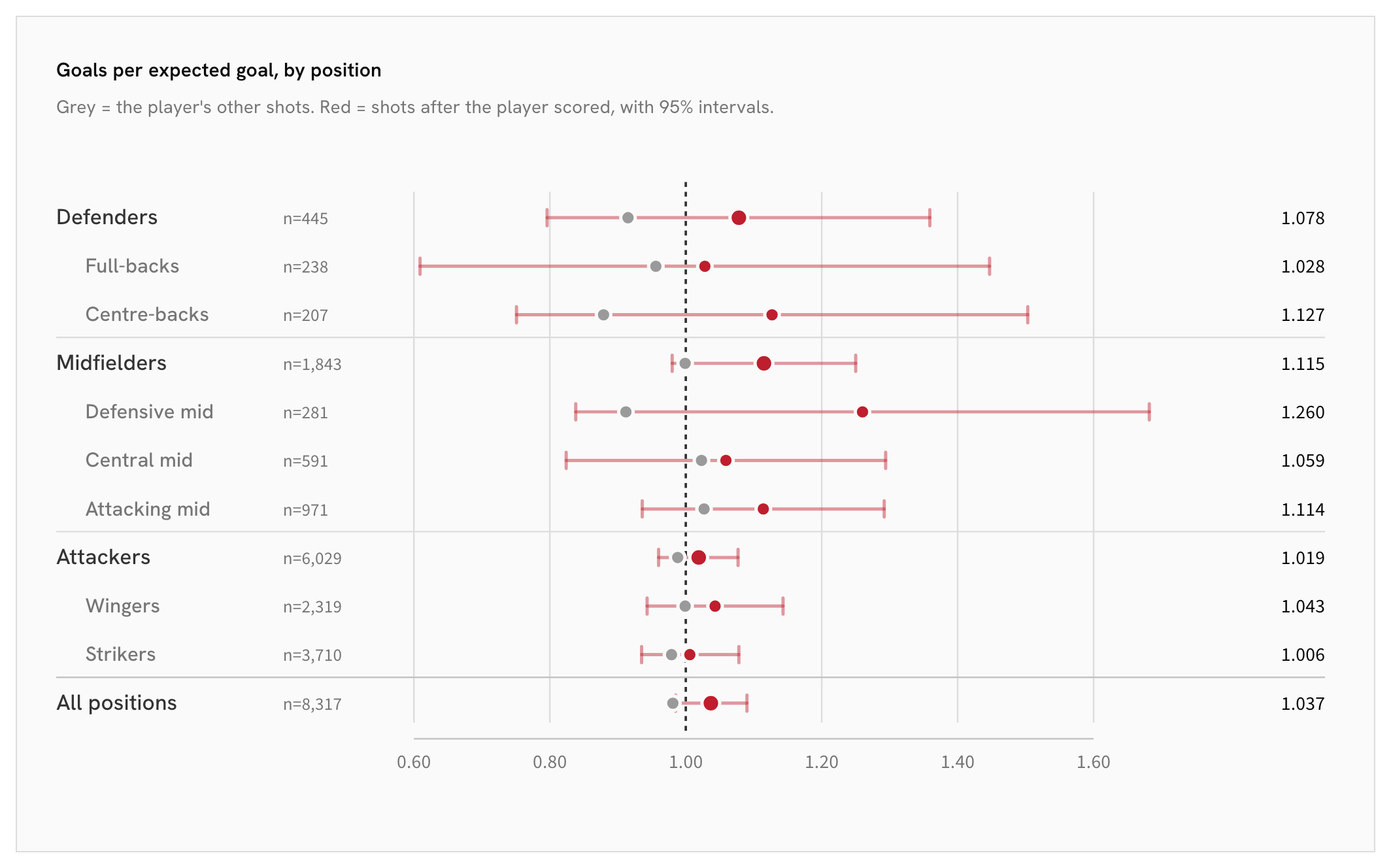
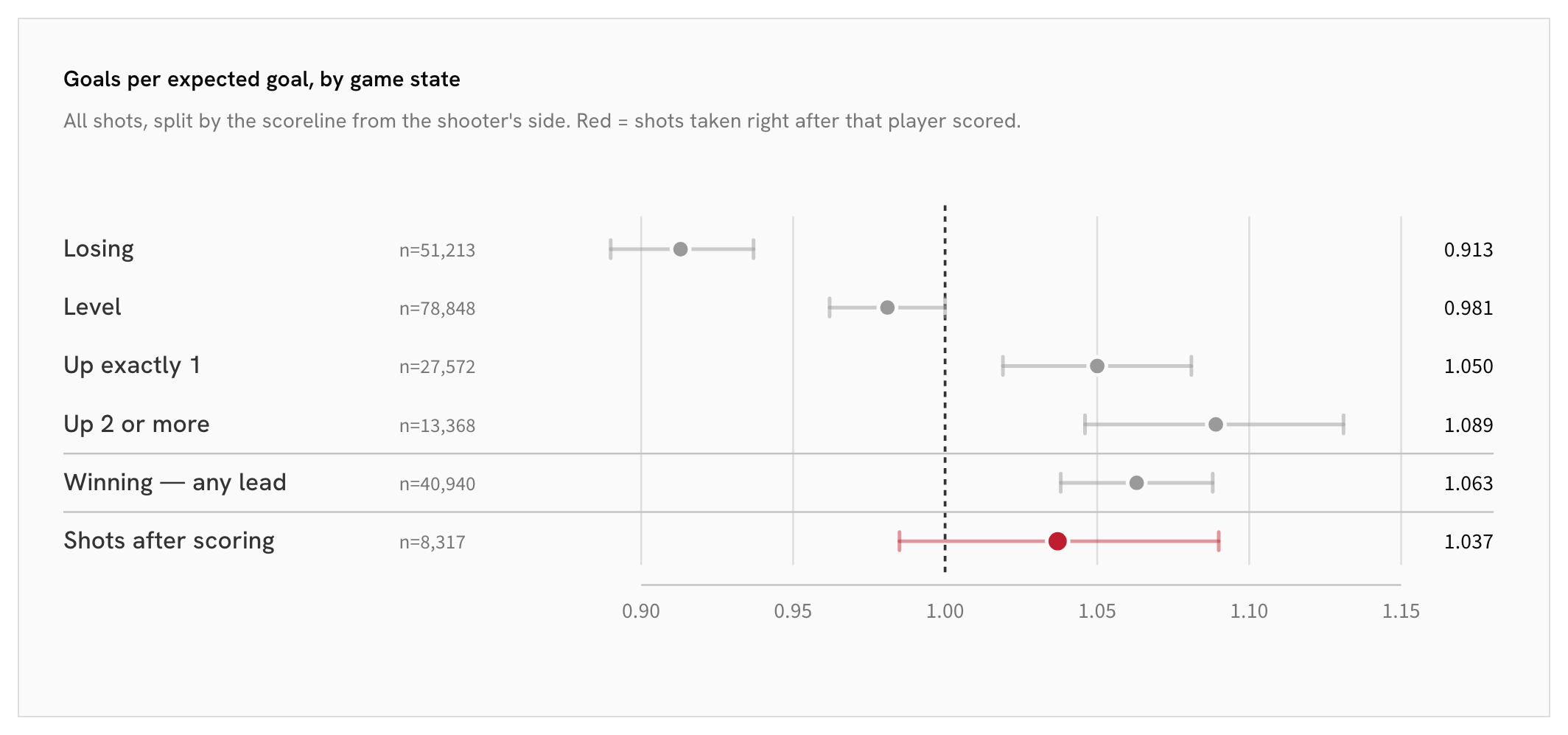
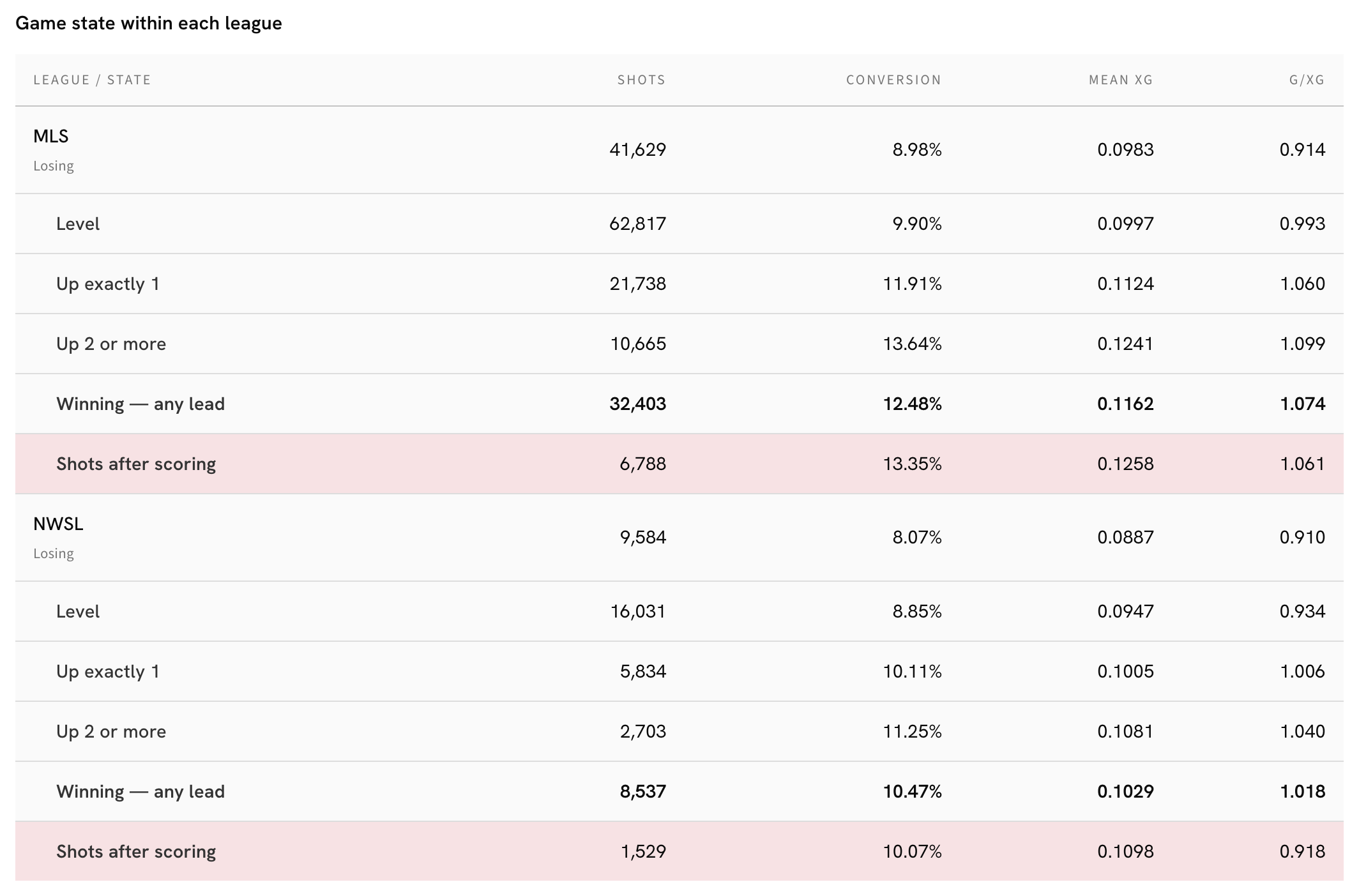
At this point, I wanted to check some gamestate tomfoolery. ASA’s xG model explicitly includes gamestate as a variable, and we know that generally winning gamestates finish ahead of a naive expected goals model (the opposite also holds true), but perhaps not enough. Here are some plots of how finishing rates at different gamestates compare to our post-goal ones.
Losing, bad, don’t do it. Your finishing rates go down precipitously. Winning, good, do it. Finishing goes up a lot. Ok, clearly our xG model isn’t capturing all of this. You can see the G/xG of the next shot after a goal is actually lower than the regular G/xG of just winning. So if we break shots immediately following goals down by gamestate, we should see that it’s entirely driven by the fact that scoring means you’re taking more shots up goals, right? Wrong!
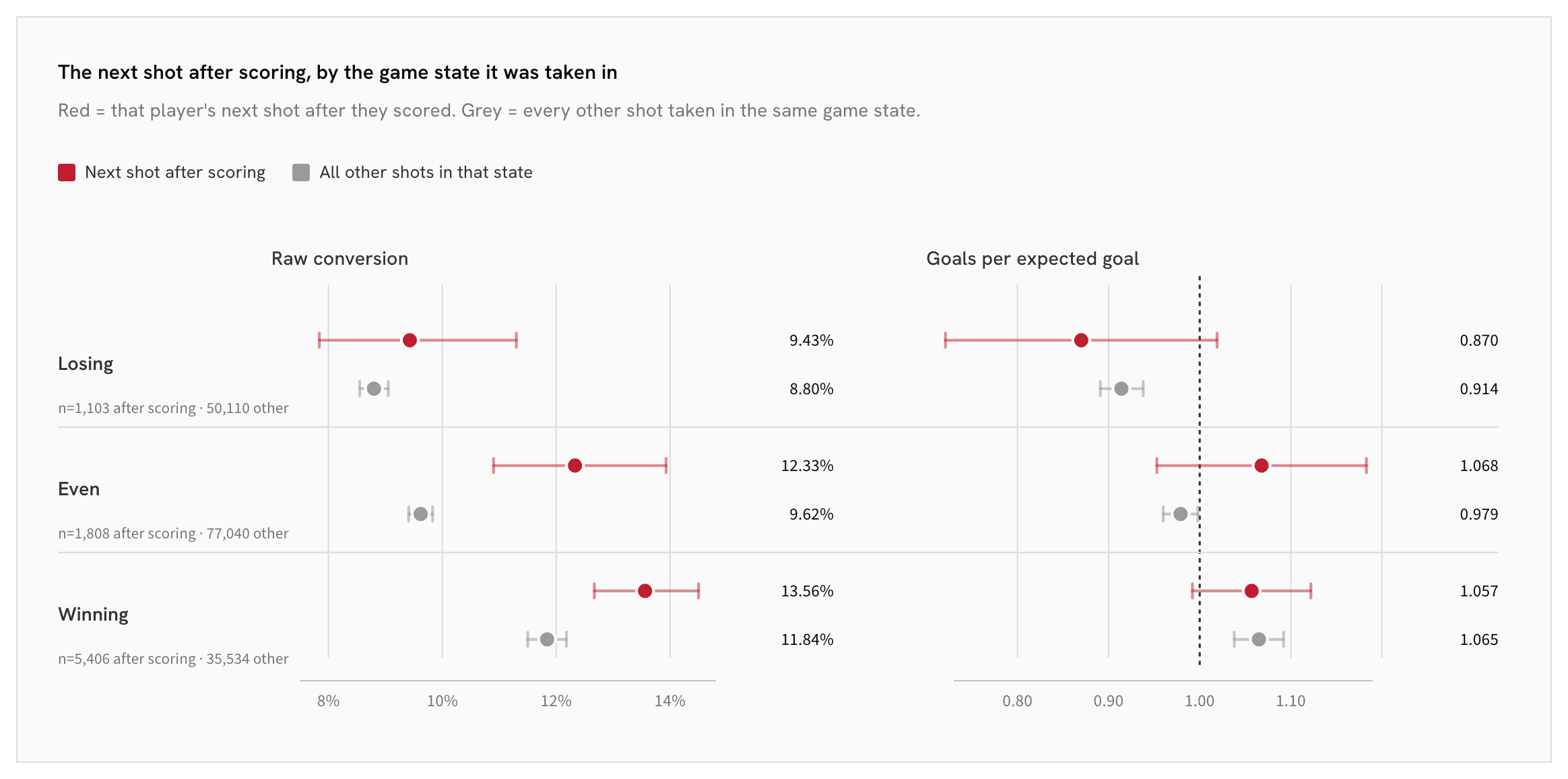
When we look at shots immediately following goals for a given gamestate, we see 1) when losing, your raw conversion rate goes up but G/xG is largely flat. Shot quality is getting better but finishing isn’t. 2) When you’re winning, again, your raw conversion rate goes up, but per expected goal you’re even. 3) When you’re even, that is, your goal was an equalizer, you are considerably ahead on both raw and per expected goal finishing rates. Now, that’s only 1100 shots, but there is almost certainly some signal there.
Shooters Shoot
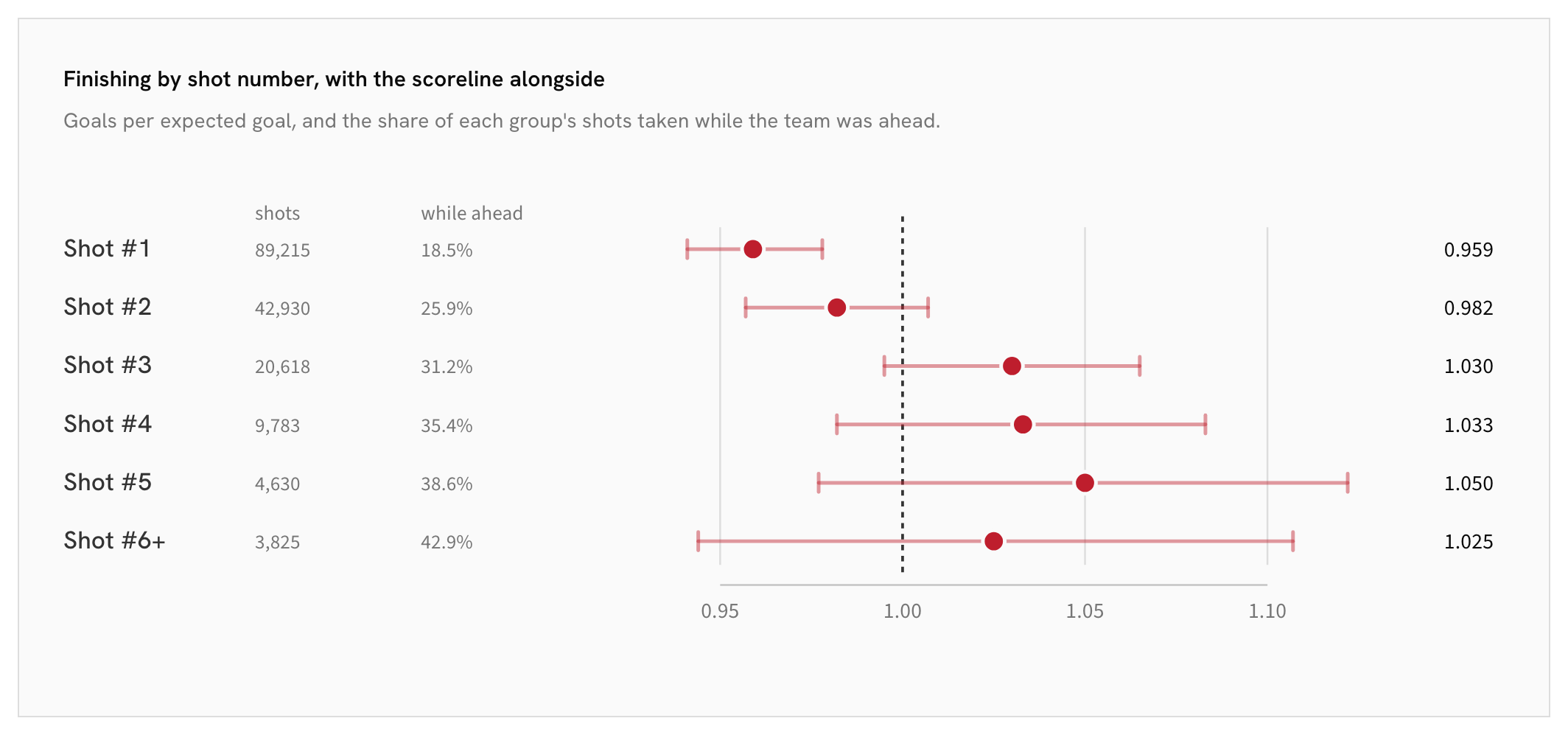
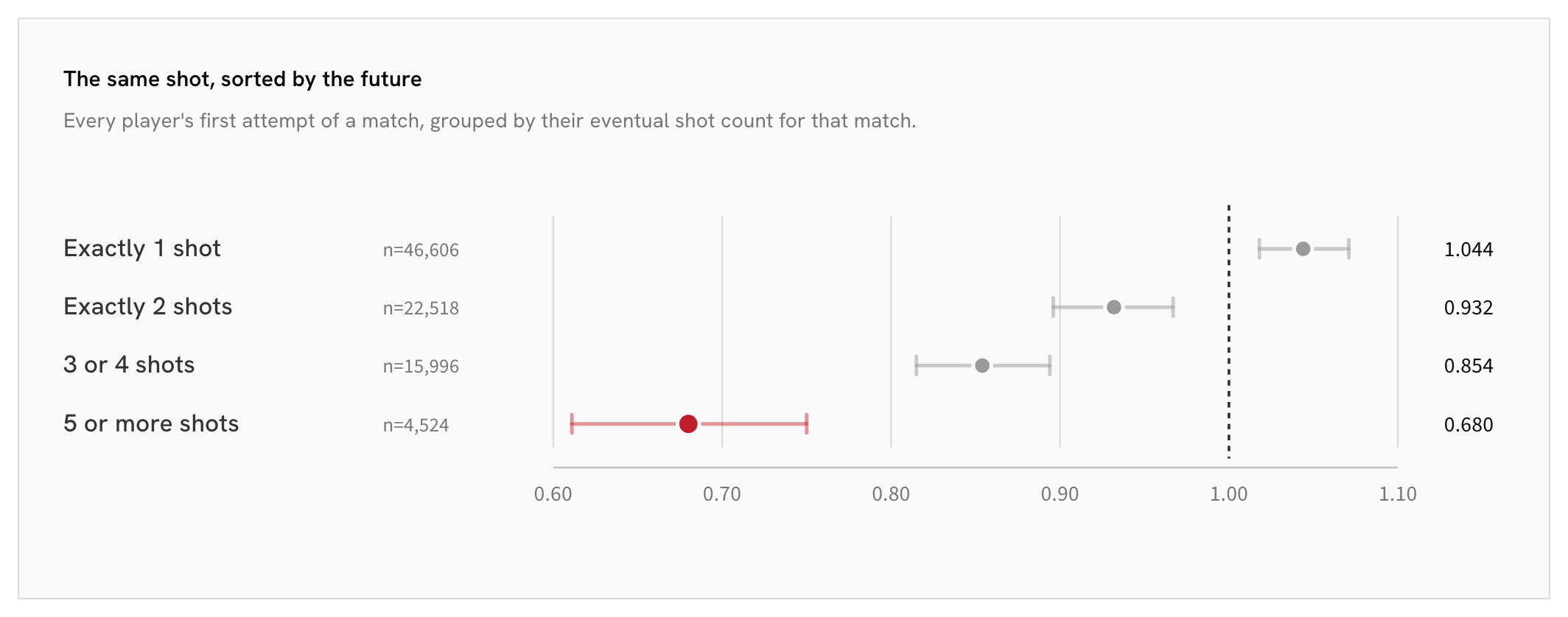
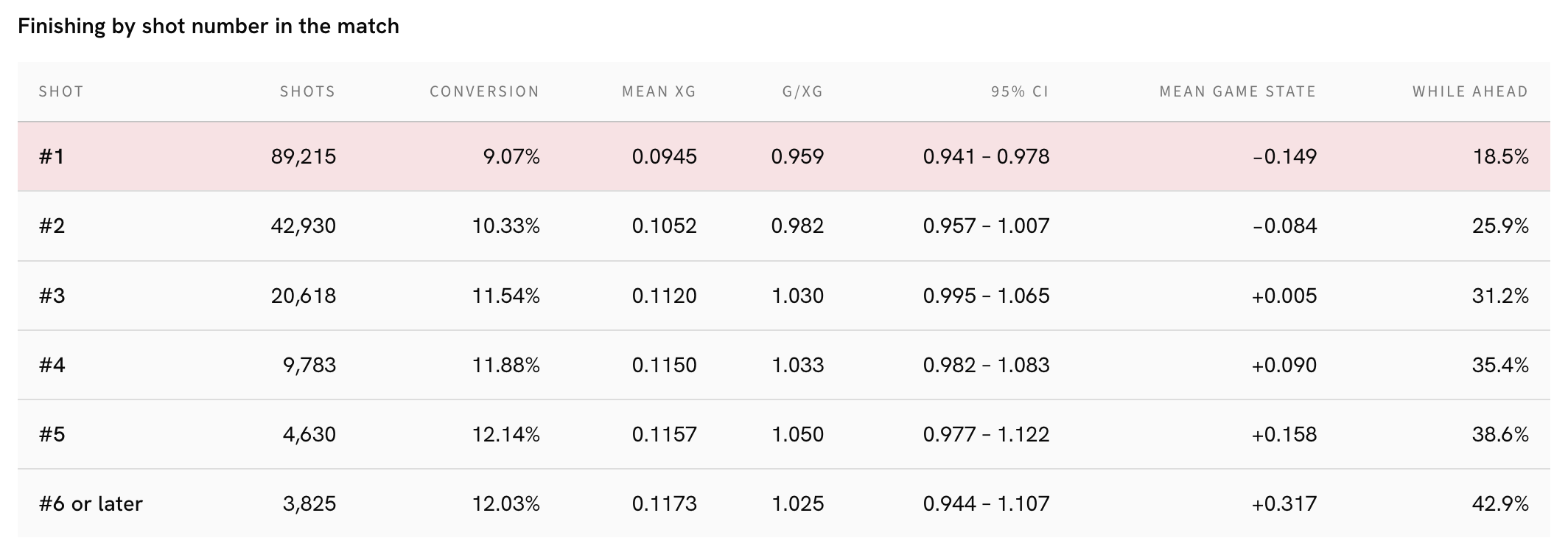
I wanted to check if this happens after a goal, do players generally get more dialed in with the more shots they take? The answer appears to be broadly yes, G/xG goes up as players shoot more. There is a weird wrinkle that if you group players by how many shots they will take in a game and look at only their first shot, the more you shoot the worse your first shot is. My thinking here is that these are gunner types just getting truly horrible shots off to get their beak wet to start the game.
Can you get cold?
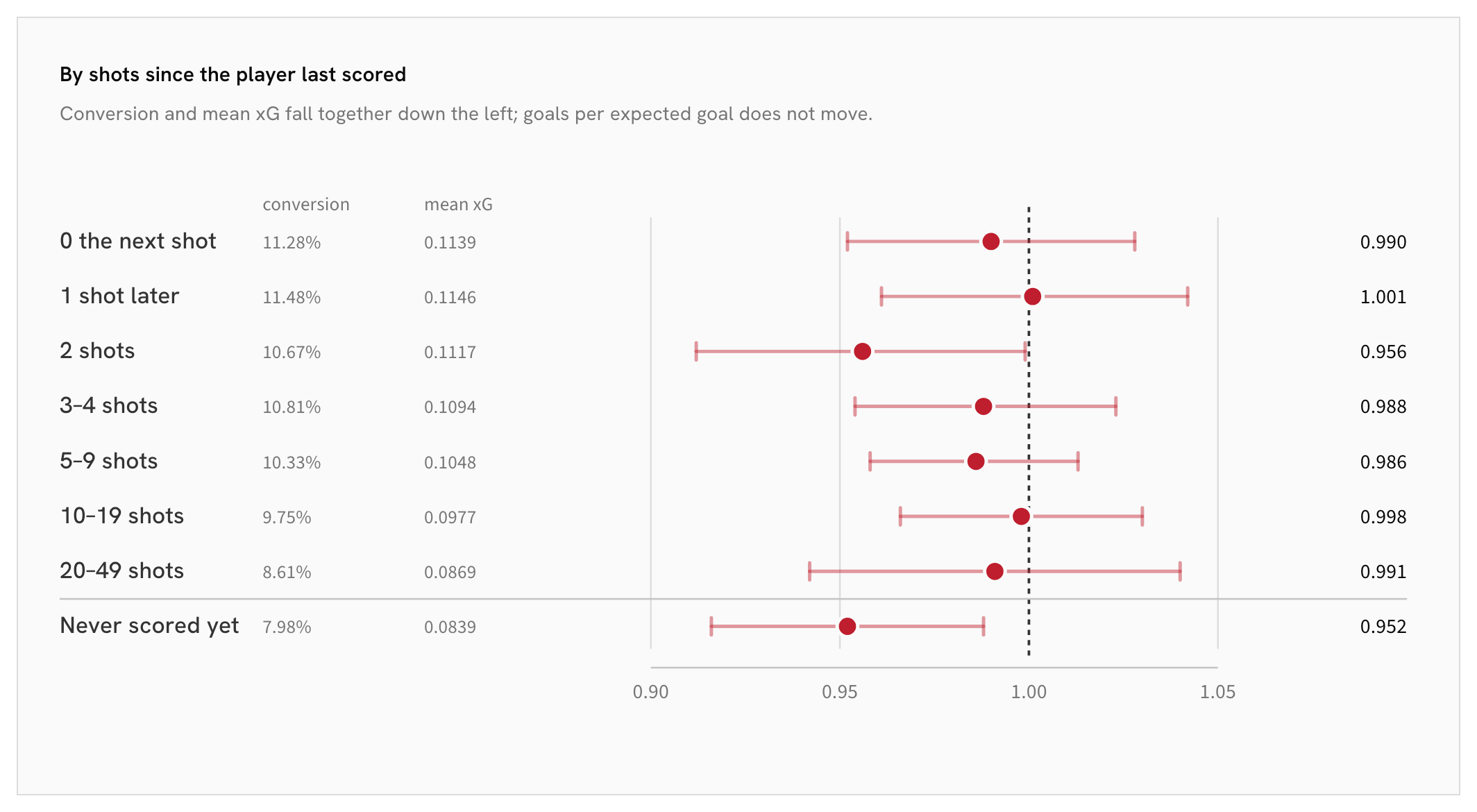
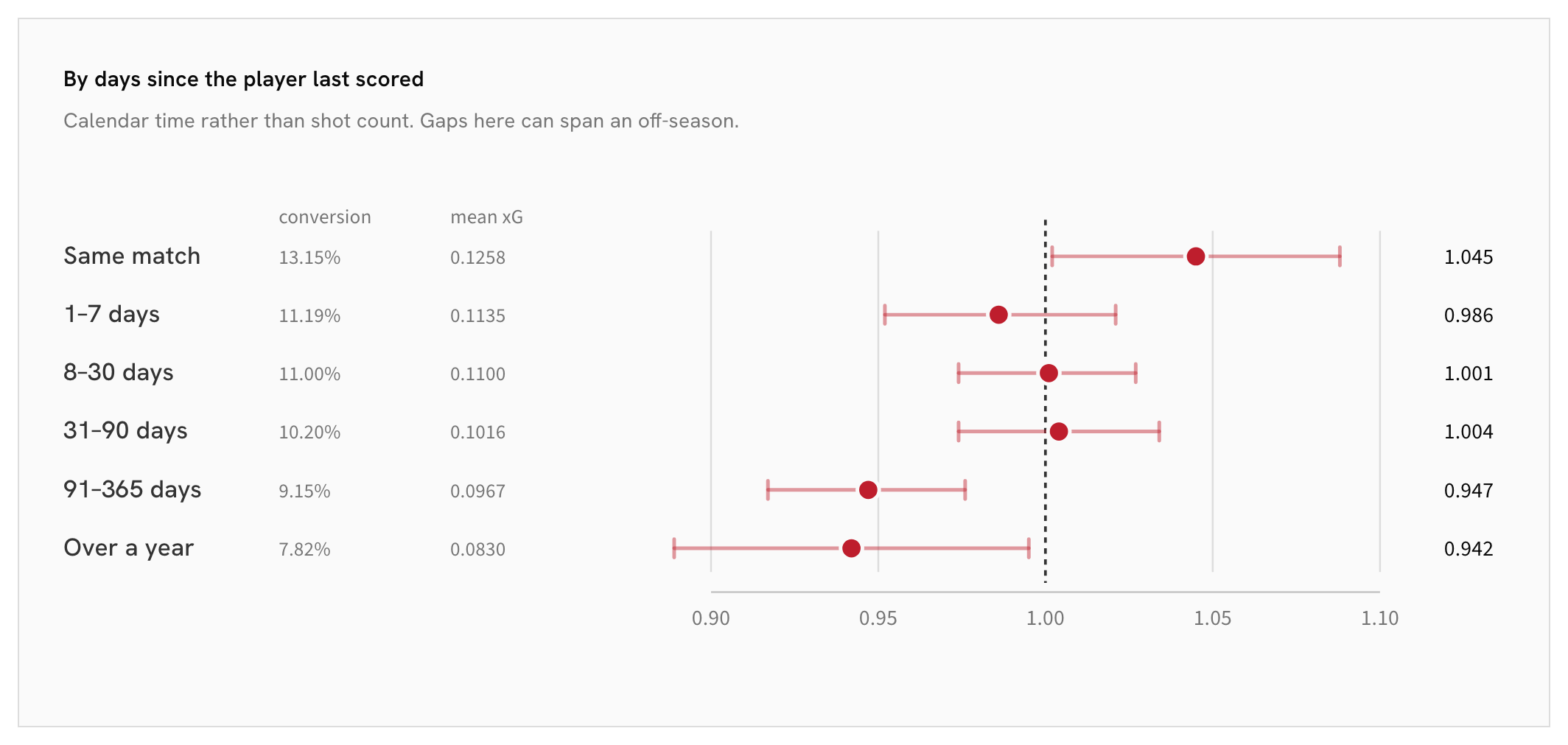
We love some haterade at ASA, so testing the opposite corollaries felt worthwhile. Do players get cold? With the exception of players who have never scored in their career, it doesn’t seem to be the case in terms of shot count, but might with real life time (at least for players who haven’t scored in over a year).
Momentum?
Another consideration is time based effects. Does how soon the next shot happens impact things? Does finishing carry into the next game? Next week?
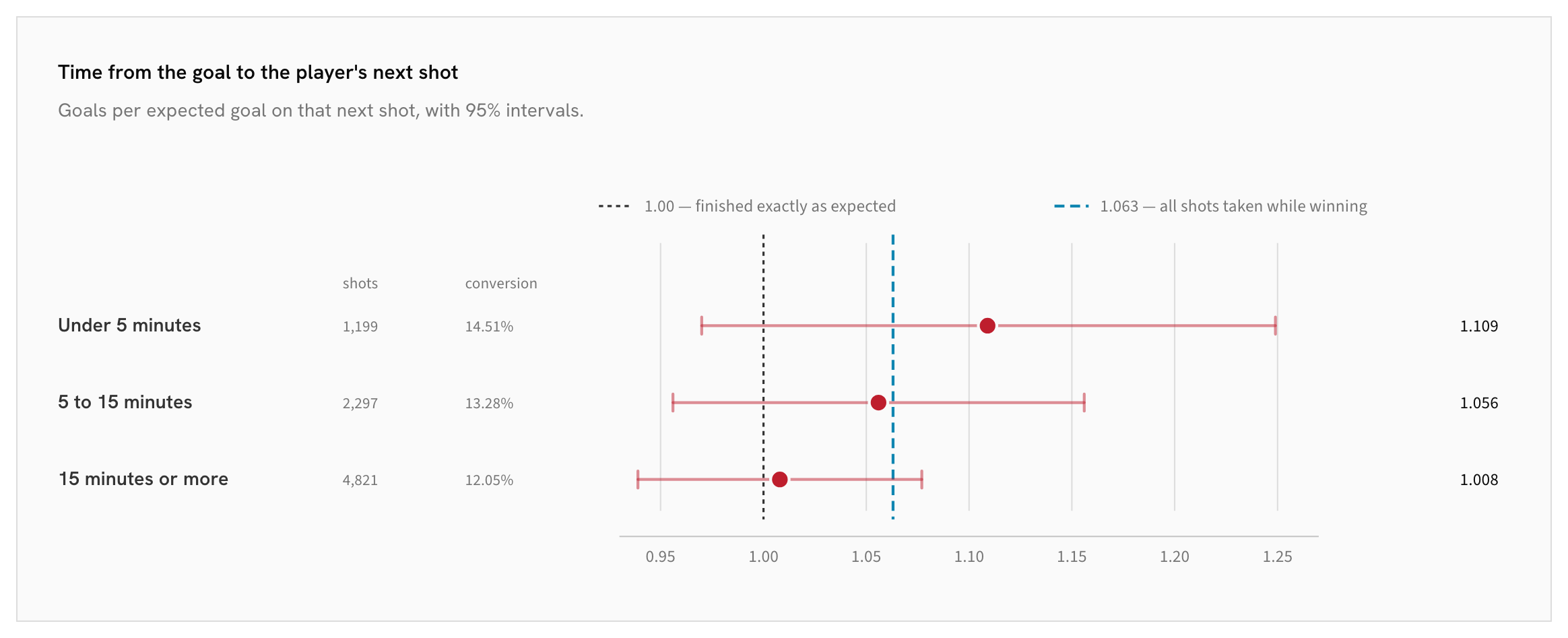
There is certainly something there with the immediacy of shots after a goal. In the next five minutes, the effect is almost double that of general winning gamestate xG boosting. I suspect this has a very strong team strength component to it, ex. The 2026 Chicago Stars conceding and immediately giving up more good shots. But after 15 minutes, the effect has almost entirely dissipated back to a G/xG of 1.008.
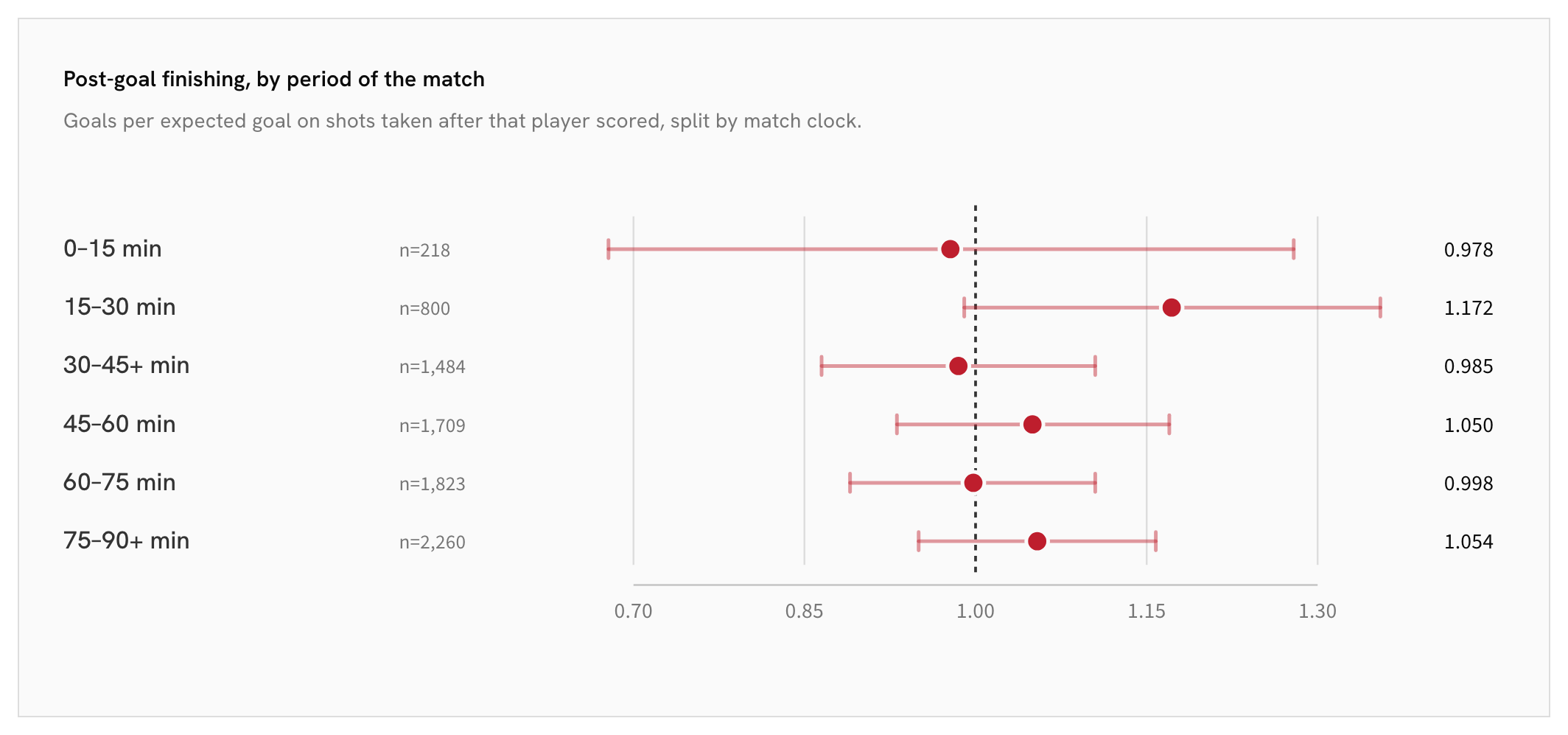
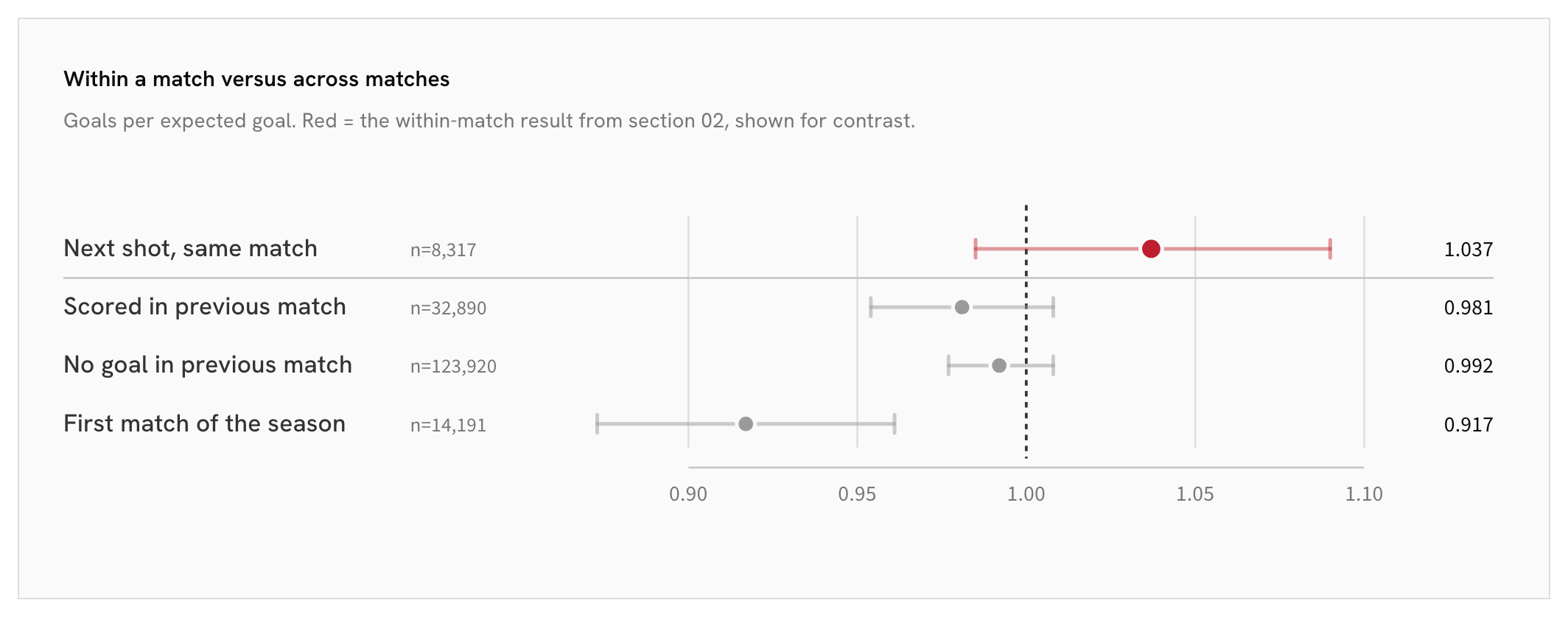
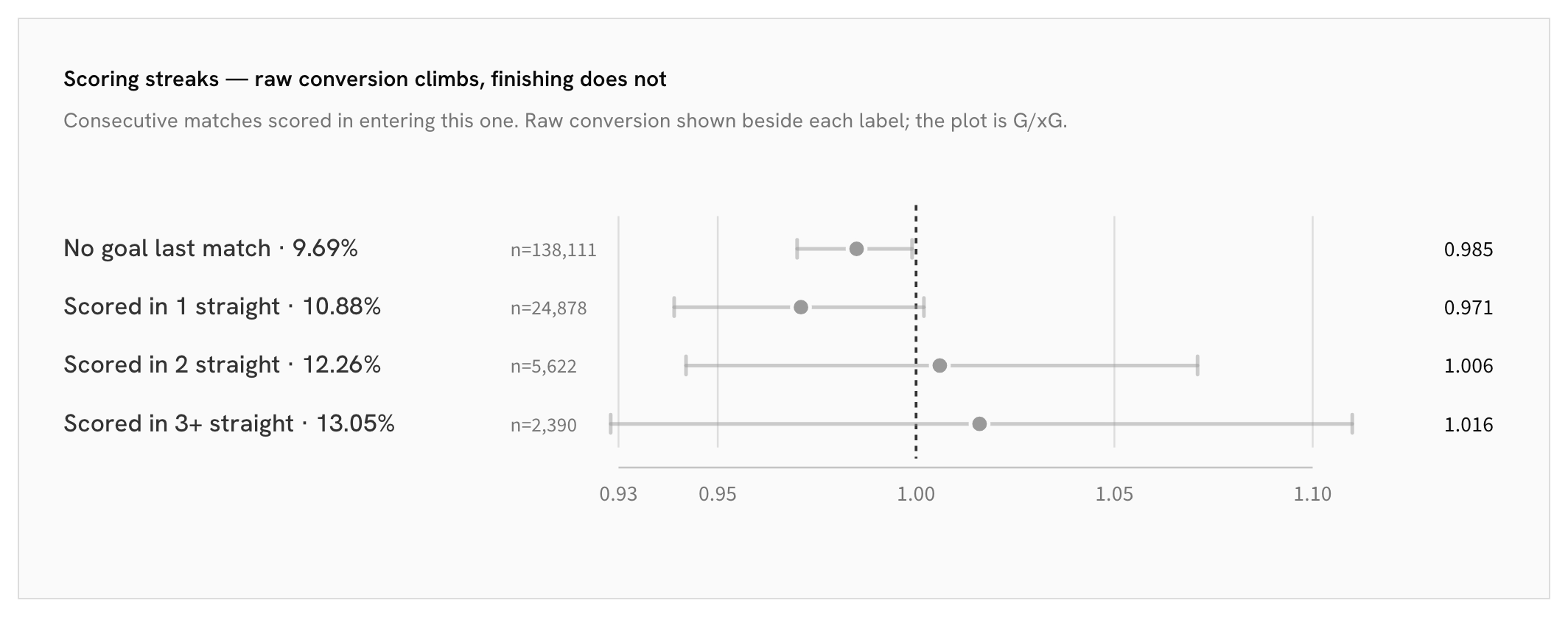
There doesn’t seem to be any signal when in the match the goal/shot happens, and any effect that does exist certainly doesn’t carry over match to match. This is well aligned with John and Eliot’s previous work. This also doesn’t hold true if you keep scoring multiple games in a row, you know the old saying “Form doesn’t exist, class is permanent”.
NWSL vs MLS
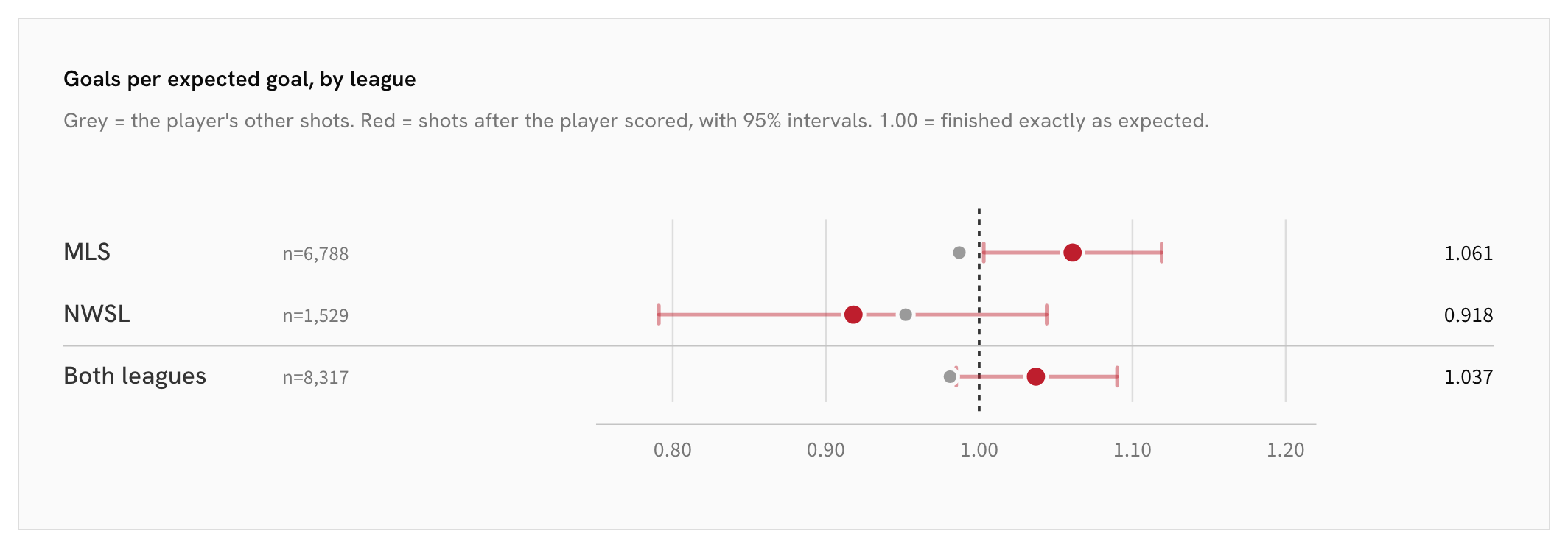
All of this includes both MLS and NWSL data, but I was curious to see if splitting it shows any signal. NWSL actually shows the opposite effect to MLS. Weird. The gamestate effects still hold true for all NWSL shots, but apparently after a player scores they turn into a pumpkin, or goalkeepers take goals conceded personally. I’d be curious to hear some ideas on why this is a thing, otherwise a big old shrug emoji from me. We see NWSL generally finishes under it’s xG on our model, it’s clearly just not capturing everything and we have significantly fewer NWSL shots in the set than MLS, but still weird.
Re: Thoughts?
When you look at a next shot basis, even when accounting for shot volumes and gamestates, it appears that there is some signal on the hot foot fallacy being not a fallacy. Most of the raw increase in goal rates can be attributed to an improvement in shot quality after goals (winning gamestates, closer to goal, more fast breaks etc.) and a small portion to better shot placement (higher PSxG), but players appear to score even above those levels, particularly when the goal brings the game back to an even game state or the next shot follows the goal very closely (less than 5 minutes).
Let me know what you think.